Meta Attribution Changes: What Ecommerce Brands Need to Know About Clicks, Engage-Through Conversions, and First-Party Data
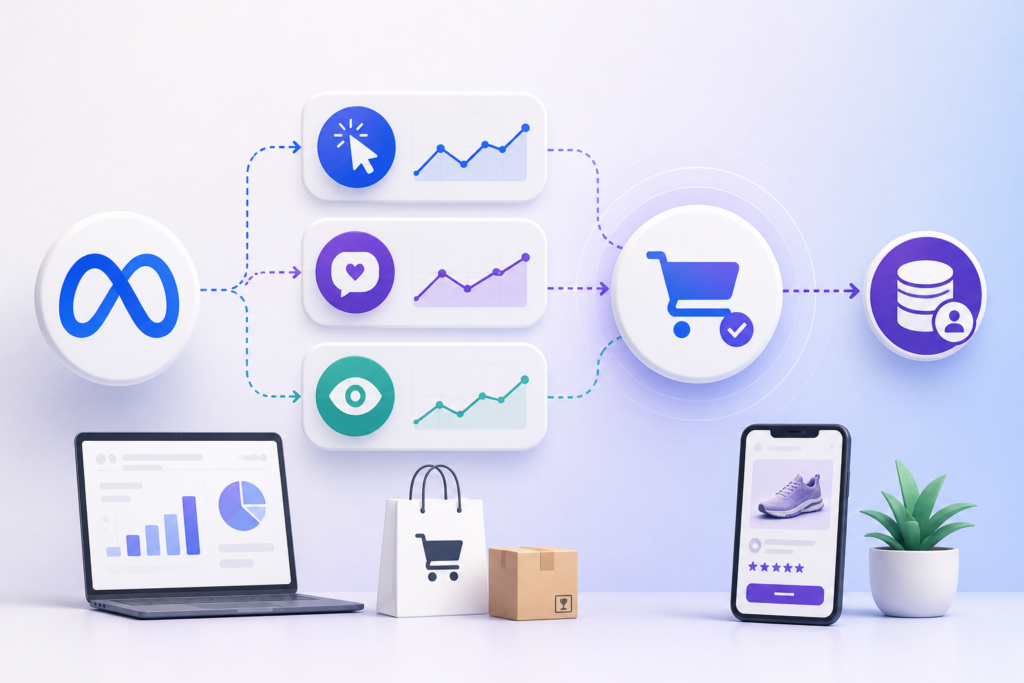
Meta attribution is changing how ecommerce advertisers interpret campaign performance.
Meta’s updated click-through attribution now focuses more narrowly on actual link-based actions, while social interactions such as likes, comments, shares, saves, and other non-link engagements are being classified under engage-through attribution instead of traditional click-through attribution.
For ecommerce brands, this means reported Meta performance may shift even when actual sales have not changed.
The key takeaway is simple: ecommerce brands should not treat every Meta-reported conversion the same way.
Link clicks, engage-through conversions, view-through conversions, and store-side purchases each tell a different part of the performance story.
To scale profitably, brands need a first-party attribution foundation that connects Meta activity to real customer behavior, revenue, product performance, and repeat purchase value.
What Changed With Meta Attribution?
Meta’s attribution update changes how click-through conversions are classified for advertisers running website and in-store conversion campaigns.
Under the updated framework, click-through attribution is more focused on actual link clicks, such as clicks to websites, app destinations, lead forms, Meta Shops, click-to-call actions, and similar destination-based interactions.
Previously, a broader set of ad interactions could be counted inside click-through attribution. That meant actions like likes, comments, saves, shares, and other non-link clicks could influence what advertisers saw as click-based performance.
With the update, many of those interactions are now separated into engage-through attribution.
This matters because Meta Ads Manager may show lower click-through conversions after the update. That does not automatically mean campaign performance declined.
In many cases, it means conversions were reclassified from one attribution bucket to another.

What Is Engage-Through Attribution?
Engage-through attribution is Meta’s attribution category for conversions that happen after a person engages with an ad without clicking a link.
That can include likes, reactions, comments, shares, saves, other non-link clicks, and engaged video views.
In practical terms, engage-through attribution helps advertisers see when social interactions may have influenced a conversion.
For example, a shopper might save a product ad, comment on it, send it to a friend, or watch part of a video before purchasing later. Those actions can matter, but they are different from clicking through to a website and buying.
That difference is important for e-commerce teams. A link click often shows clearer intent to visit, browse, or purchase. An engagement action may show interest, awareness, or social proof. Both can be valuable, but they should not be interpreted the same way.

Why Meta Attribution Changes Matter for Ecommerce Brands
Meta is one of the most important paid media channels for ecommerce brands, but platform-reported performance is only one view of reality. Every ad platform has its own attribution logic, conversion windows, reporting definitions, and optimization incentives.
When Meta changes how it classifies clicks and engagement, ecommerce teams need to revisit how they evaluate performance. Otherwise, they may make budget decisions based on misunderstood metrics.
For ecommerce brands, the biggest risks are:
- Mistaking reclassification for performance decline
If click-through conversions drop, the campaign may not be failing. Some conversions may have moved into engage-through attribution.
- Overvaluing engagement-heavy campaigns
Engagement can support awareness and consideration, but it does not always mean profitable customer acquisition.
- Undervaluing campaigns that drive real store-side revenue
Some campaigns may look weaker in Meta but perform better when measured against actual Shopify revenue, repeat purchases, or customer lifetime value.
- Comparing Meta to other platforms incorrectly
Meta, Google Analytics, Shopify, TikTok, Amazon, and other systems use different attribution models. A cleaner Meta click definition helps, but it does not eliminate cross-platform reporting differences.
- Optimizing toward platform metrics instead of profit
A campaign can look strong inside an ad platform while still underperforming on margin, new customer quality, or repeat purchase behavior.
The Difference Between Click-Through, Engage-Through, and View-Through Attribution
Meta attribution now requires ecommerce marketers to understand the role of each attribution type – Click-through, Engage-through, Video-through, and First-party

Meta attribution helps advertisers understand performance inside Meta. First-party attribution helps ecommerce brands understand what actually happened across the customer journey.
Why Platform-Only Reporting Is Not Enough
Meta Ads Manager is useful, but it should not be the only source of truth for ecommerce performance.
Platform reporting tells you how Meta sees performance.
It does not always tell you which campaigns produced profitable customers, which creatives drove higher-value orders, or which audiences created long-term revenue.
That distinction matters because ecommerce growth is not just about generating conversions. It is about generating the right conversions.
A strong ecommerce attribution strategy should answer questions like:
- Which Meta campaigns are driving actual purchases?
- Which ads are producing new customers versus returning customers?
- Which creative concepts are connected to profitable revenue?
- Which products are being purchased after Meta engagement?
- Which campaigns look good in-platform but underperform in store-side data?
- Which customers return after their first purchase?
- Which campaigns deserve more budget based on real contribution to revenue?
Without first-party data, media buyers can end up optimizing toward the numbers that are easiest to see instead of the numbers that matter most.
How First-Party Data Helps E-commerce Brands Interpret Meta Performance
First-party data is data collected directly from customer interactions with your own ecommerce store, checkout, campaigns, and customer journey.
For e-commerce brands, this can include purchases, add-to-cart events, checkout activity, customer records, product-level performance, order value, repeat purchases, and customer lifetime value.
First-party attribution gives brands a more reliable way to evaluate Meta performance because it connects ad activity to actual business outcomes.
Instead of asking only, “What does Meta say happened?” ecommerce teams can ask:
- What happened in our store?
- Which campaign was connected to the purchase?
- Was the customer new or returning?
- Which product did they buy?
- Did the customer come back?
- Was the order profitable?
- Which creative or audience should we scale next?
AdBeacon is built around this type of visibility. AdBeacon describes its platform as e-commerce intelligence for optimization, reporting, analytics, AI, creative, and attribution, with first-party data, server-side tracking, e-commerce store data, and click-based attribution as key parts of its platform.
How AdBeacon Helps With Meta Attribution
AdBeacon helps ecommerce brands, agencies, and media buyers move beyond platform-only reporting by using first-party ecommerce data to understand which campaigns, creatives, channels, and audiences are producing real revenue.
For Meta advertisers, AdBeacon is especially useful because it helps connect Facebook and Instagram ad performance to store-side behavior.
AdBeacon’s Facebook attribution tool is positioned as multi-touch attribution software for marketers operating in the post-iOS 14.5 environment, where platform tracking and privacy changes have made accurate measurement more difficult.
AdBeacon helps ecommerce teams:
Report more accurately
Use first-party data to compare platform-reported performance against actual ecommerce outcomes.
Understand true campaign performance
See which campaigns are driving purchases, revenue, and customer value instead of relying only on Meta’s attribution view.
Separate clicks from engagement
Evaluate link-click performance and engagement-driven influence without treating them as the same signal.
Optimize creative with better context
Identify which ads are producing revenue, not just likes, comments, saves, or video views.
Improve signal quality
Use server-side tracking and ecommerce data to improve the quality of conversion signals.
Scale new and returning customer audiences
Understand how Meta campaigns contribute to acquisition, retention, and repeat purchase behavior.
Reduce wasted ad spend
Reallocate budget away from campaigns that look strong in-platform but do not create profitable store-side outcomes.
What Ecommerce Brands Should Do After Meta’s Attribution Update
Meta’s attribution changes are not a reason to panic. They are a reason to clean up your reporting process.
1. Audit your Meta attribution columns
Review how your reporting is currently set up inside Meta Ads Manager. Make sure your team understands which results are coming from click-through, engage-through, and view-through attribution.
The goal is not to ignore engage-through conversions. The goal is to interpret them correctly.
2. Compare Meta results against store-side revenue
Look at Shopify, ecommerce backend data, and first-party attribution data alongside Meta reporting. If Meta conversions shift after the update, compare those changes against actual revenue, order volume, and customer behavior.
3. Update client and executive reporting
If you report to clients, founders, executives, or finance teams, explain the change clearly. A drop in click-through attributed conversions may reflect attribution reclassification rather than a real decline in sales.
4. Separate engagement metrics from conversion metrics
Likes, comments, saves, shares, and video views are useful creative and awareness indicators. They should not be treated the same as destination clicks, checkouts, purchases, or repeat orders.
5. Reevaluate creative performance
Creative that drives engagement may still play an important role, especially in social commerce and consideration. But ecommerce teams should evaluate whether that engagement leads to profitable buying behavior.
6. Use first-party data as your source of truth
Use Meta reporting for platform optimization, but use first-party attribution to understand real revenue impact. This gives media buyers a stronger foundation for scaling campaigns and defending budget decisions.

Common Mistakes to Avoid!
Mistake 1: Assuming lower click-through conversions mean worse performance
A reporting change can make performance look different without changing what customers actually did. Always compare attribution changes against store-side revenue.
Mistake 2: Treating engage-through conversions as worthless
Engagement can influence purchases, especially on social platforms. The issue is not whether engagement matters. The issue is whether engagement should be valued the same as a click, checkout, or purchase.
Mistake 3: Optimizing only inside Meta Ads Manager
Meta is valuable, but it is still one platform. Ecommerce teams need a broader view across channels, customers, and products.
Mistake 4: Reporting ROAS without context
ROAS can be useful, but it does not always show profitability, customer quality, repeat purchase behavior, or product-level impact.
Mistake 5: Ignoring first-party attribution
As attribution definitions change across platforms, first-party data becomes more important. Ecommerce brands that rely only on ad platform dashboards may struggle to understand what is actually driving growth.

The Bigger Picture: Meta Attribution Is Moving Toward Cleaner Signal Separation
Meta’s update reflects a broader shift in ecommerce measurement. Paid media platforms are getting more specific about the difference between clicks, engagement, impressions, and conversions. That is a good thing for advertisers, but it also makes reporting more complex.
The brands that benefit most will be the ones that build a measurement system around clean data and clear definitions.
A modern ecommerce attribution framework should separate:
- Traffic-driving clicks
- Social engagement
- Video engagement
- Impressions
- Purchases
- New customer acquisition
- Returning customer revenue
- Product-level performance
- Customer lifetime value
- Profitability
AdBeacon gives ecommerce teams a way to bring those signals together so they can make better decisions from the data they already have.
What This Means for Media Buyers and Agencies
For media buyers and agencies, Meta’s attribution update creates both a reporting challenge and a client communication opportunity.
Clients may see changes in reported Meta performance and assume something is wrong. Agencies that can explain the difference between click-through and engage-through attribution will be better positioned to protect trust, defend strategy, and guide budget decisions.
This is where first-party attribution becomes a competitive advantage. Instead of debating platform numbers, agencies can show what happened in the store and connect campaign activity to real revenue outcomes.
For agencies managing multiple ecommerce accounts, AdBeacon can help create clearer reporting, stronger optimization workflows, and more transparent client communication.
The Final Takeaway
Meta’s attribution changes do not make Meta less valuable for ecommerce brands. They make accurate measurement more important.
Click-through attribution, engage-through attribution, and view-through attribution each show a different type of customer interaction. Ecommerce teams need to understand those differences before making budget decisions.
The brands that win will be the ones that use Meta’s platform data and first-party ecommerce data together. Meta can show how ads perform inside the platform. AdBeacon helps show what those ads mean for actual revenue, customer behavior, and profitable growth.
Ready to see which Meta campaigns are actually driving ecommerce revenue?
Book a demo with AdBeacon to see how first-party attribution, real-time analytics, AI insights, and performance tracking can help your team optimize campaigns with more confidence.
FAQs About Meta Attribution Changes
What changed with Meta click-through attribution?
Meta’s click-through attribution is now more focused on actual link-based actions instead of counting broader non-link interactions as click-through activity. Social interactions such as likes, comments, shares, saves, and other non-link clicks are now handled through engage-through attribution.
What is engage-through attribution?
Engage-through attribution measures conversions that happen after someone engages with an ad without clicking a destination link. This can include reactions, comments, shares, saves, other non-link clicks, and engaged video views.
Will Meta conversions look lower after this update?
They may. Some conversions that were previously counted under click-through attribution may now appear under engage-through attribution. That means a drop in click-through conversions does not always mean actual sales declined.
Should ecommerce brands ignore engage-through conversions?
No. Engage-through conversions can help show how social interactions influence purchase behavior. However, they should be analyzed separately from link clicks and store-side purchases.
Why does first-party data matter for Meta attribution?
First-party data helps ecommerce brands understand what actually happened in their store. It connects ad activity to purchases, revenue, products, customer behavior, and repeat orders, which gives marketers a clearer view than platform reporting alone.
How does AdBeacon help with Meta attribution?
AdBeacon helps ecommerce brands and agencies use first-party data, server-side tracking, ecommerce store data, and attribution insights to understand which campaigns, creatives, audiences, and channels are actually driving revenue.
What should ecommerce brands track besides Meta ROAS?
Brands should track new customer acquisition, returning customer behavior, product-level revenue, average order value, customer lifetime value, contribution margin, creative performance, and post-purchase behavior.
Is Meta still a good channel for ecommerce advertising?
Yes. Meta remains an important paid media channel for ecommerce brands. The key is to measure Meta performance with the right attribution framework so budget decisions are based on real business impact.