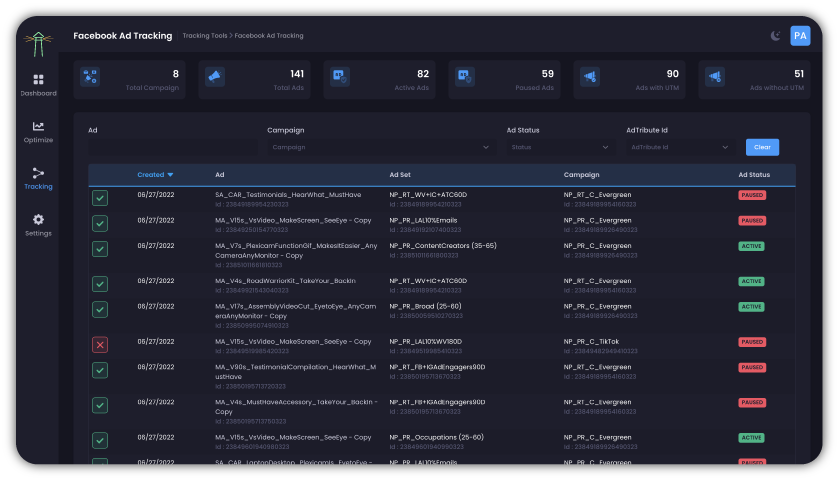
AdBeacon shows which Search, Shopping, Performance Max and YouTube campaigns really drive orders, using click-only, first-party data from your store, side by side with what Google Ads reports. Built for media buyers at brands and agencies.
Curved velvet sofa in four colors. Handmade to order, with a 100-night home trial.
Google Ads optimization means moving budget, bids, keywords and creative toward the Search, Shopping, Performance Max and YouTube campaigns that drive profitable sales, and away from the ones that don’t.
It only works if you can trust the numbers. AdBeacon ties every attributed order to a real Google ad click and your store’s own order record, so you optimize on sales you can verify.
Modeled conversions. When consent settings, browsers or devices block tracking, Google Ads fills the gaps with modeled conversions instead of real orders.
Data-driven attribution. Since 2023, Google Ads splits credit across ad interactions with its own model, including YouTube engaged views, so one order can show up as fractions across several campaigns.
Cross-device and view-through credit. Google can count conversions from people who saw or watched an ad on one device and bought on another, without ever clicking.
Different clocks. Google Ads reports conversions against the date of the ad interaction, and conversions can keep arriving for days. Your store records the order when it happens.
Google’s AI now runs bidding, matching and placement across Performance Max, AI Max and Smart Bidding. That automation is only as good as the conversion data it learns from, which is why accurate, first-party measurement matters more every year.
Seven updates that moved control from media buyers to Google’s AI. Pick a search to see what changed and how AdBeacon helps.
Performance Max put Search, Shopping, YouTube, Display, Discover, Gmail and Maps into one goal-based campaign, with Google’s AI choosing where every dollar goes.
Less control and less visibility. PMax can look like your best campaign while quietly taking credit for branded searches and retargeting.
AdBeacon shows what every PMax campaign really earned in first-party orders, so you can compare it fairly with Search and Shopping.
Google Ads made data-driven attribution the default and retired first click, linear, time decay and position-based models.
Credit is now split by Google’s own model, so one order can appear as fractions of a conversion across several campaigns and channels.
Choose your own attribution model and lookback window in AdBeacon, applied to click-only data from your store.
Discovery campaigns were upgraded to Demand Gen, with image and video ads across YouTube, Shorts, Discover and Gmail.
More upper-funnel, visual inventory that is often judged on view-influenced conversions rather than clicks that buy.
See whether Demand Gen clicks turn into real orders and new customers, side by side with Google’s numbers.
AI Max for Search added opt-in, AI-powered query matching beyond your keyword list, plus automatically generated ad text and landing page choices.
Your keyword list no longer fully decides which searches you pay for, and new matches need to prove they are profitable.
Track revenue down to the keyword so you can keep the matches that sell and turn off the ones that don’t, right inside AdBeacon.
Performance Max channel reports now break results out by Search, Search Partners, YouTube, Display, Discover, Gmail and Maps in Google Ads and the API, along with up to 10,000 campaign-level negative keywords.
You can finally see where PMax spends. But every number in the report is still counted by Google’s rules.
Pair Google’s channel view with first-party revenue for the same campaign, so you know how much of the reported value is real.
From August 17, 2026, budget-limited Target CPA and Target ROAS campaigns bid toward the exact target you set, instead of treating it as a loose ceiling.
If your target is based on inflated conversion values, Smart Bidding now chases that wrong number more precisely.
Set Target ROAS and CPA from first-party results in AdBeacon, so Smart Bidding aims at a number your store can confirm.
New AI Max reporting adds a Sources column, search terms and ad combination reports, AI Max expanded match totals and a landing page “Selected by” column.
You can see what AI Max added to your campaigns. Whether those additions actually sold is still a separate question.
Match AI Max campaigns, keywords and landing pages to orders in your store to see which expansions pay for themselves.
Channel reports tell you where the money went, counted by Google. Check the same campaign against your store before you move budget.
Google Ads is where you run campaigns. AdBeacon is where you check what they really earned.
Where we agree: Smart Bidding and Performance Max are powerful. They just perform best when your targets come from accurate data, and you can plan budgets across every channel with Google’s Meridian MMM, free in AdBeacon. See Meridian MMM in AdBeacon
Set Target ROAS, budgets and keywords from first-party sales, not modeled conversion value.
From Search to Performance Max, AdBeacon tracks each campaign type on the same first-party data.
PMax spends across seven channels on Google’s AI. AdBeacon checks every PMax campaign against first-party orders, so you know if it is finding new buyers or claiming sales you would have made anyway.
Track revenue by campaign, ad group and keyword, including AI Max matches, and turn unprofitable keywords off in AdBeacon.
Tie every Shopping click to the exact order, product and customer type, then compare Google and first-party ROAS side by side.
Google counts engaged views. AdBeacon shows which video campaigns lead to clicks that turn into orders.
Separate real click-through sales from view-through credit, and cut placements that never drive orders.
Image and video ads across YouTube, Shorts, Discover and Gmail, measured on real orders and new customers.
Even with Google running the controls, AdBeacon shows the real return on every dollar.
Seven tools to manage, measure and scale Google campaigns on real sales. Pick one to see it in action.
Activate or pause Google Ads campaigns right inside AdBeacon, with Google-reported and first-party ROAS side by side, so every decision is made on real sales.
See the platformBreak every campaign down by ad group and ad to see where first-party revenue comes from, and where spend leaks away.
See accurate reportingSee revenue and ROAS for every keyword, including AI Max matches, and turn keywords on or off in AdBeacon to cut wasted spend.
See the platformRank Google Ads creatives on first-party revenue. AI Creative Insights pinpoint winning creatives with custom AI agents and Luma.
Activate creativesWatch spend velocity through the day and adjust Google Ads budgets inside AdBeacon, so winning campaigns never run dry and losers never run hot.
See the platformCompare AdBeacon revenue with Google revenue, AdBeacon ROAS with Google ROAS, plus conversions, conversion rate, CPC and AOV, in customizable views for every brand or client.
See case studiesSwitch between Full Impact, Linear, First Click and Last Click models with lookback windows up to 180 days. Compare date ranges, filter new vs returning customers and audiences, track historical ad performance and export reports.
See how accurate reporting worksResults from ecommerce brands optimizing Google campaigns on first-party data.
Guides from the AdBeacon blog on Performance Max, Smart Bidding and Google’s creative updates.

What excluding Search Partners and Display means for your PMax campaigns.
Read the article
Why accurate Target ROAS and CPA matter more than ever.
Read the article
Ad Strength, auto-generated assets and what Google now rewards.
Read the articleGoogle Ads optimization is the process of improving the return on Google Search, Shopping, Performance Max, YouTube, Display and Demand Gen campaigns by shifting budget, bids, keywords and creative toward what drives profitable sales. AdBeacon helps by showing which Google campaigns drive real orders, using click-only, first-party data from your store, side by side with what Google Ads reports.
Google Ads counts conversions with its own rules: data-driven attribution splits credit across ad interactions, modeled conversions fill gaps where tracking is blocked, engaged views and view-through conversions can count without a click, and conversions are reported against the date of the ad interaction. Your store counts real orders when they happen. AdBeacon shows both numbers side by side.
Data-driven attribution is Google’s model for distributing conversion credit across the ad interactions before a conversion. It became the default in 2023, when Google retired the first click, linear, time decay and position-based models. Because Google builds and runs the model, it is useful to check its results against an independent, first-party source.
Google Ads now offers Performance Max channel reporting, which breaks results out by Search, Search Partners, YouTube, Display, Discover, Gmail and Maps. Those results are still counted by Google’s rules, so AdBeacon adds first-party revenue for the same campaign to show how much of the reported value is tied to real orders.
AI Max for Search is an opt-in set of Google Ads features that uses AI to match ads to searches beyond your keyword list and to generate ad text and landing page choices. In September 2026, Google added reporting such as a Sources column and search term and ad combination reports. AdBeacon shows which keywords and matches turn into real orders.
From August 17, 2026, budget-limited Target CPA and Target ROAS campaigns bid toward the exact target you set. That makes accurate targets more important, which is why many media buyers set them from first-party ROAS rather than platform-reported conversion value.
Google upgraded Discovery campaigns to Demand Gen campaigns in 2024. Demand Gen runs image and video ads across YouTube, YouTube Shorts, Discover and Gmail. AdBeacon tracks Demand Gen alongside every other Google campaign type.
AdBeacon tracks Search, Shopping, Performance Max, YouTube and video, Display, Demand Gen and Smart campaigns, with first-party revenue down to the campaign, ad group, ad and keyword level.
Yes. You can activate or pause campaigns, turn keywords on or off and adjust campaign budgets inside AdBeacon, with Google-reported and first-party results side by side.
AdBeacon offers Full Impact, Linear, First Click and Last Click attribution models with lookback windows up to 180 days, plus date range comparisons, new vs returning customer filters and exportable reports.
Agencies use AdBeacon to manage and report on every client’s Google Ads with first-party data, with customizable views, side-by-side Google and AdBeacon ROAS and exportable reports, alongside Meta, TikTok and other channels.
Yes. AdBeacon connects with GA4, and Google’s Meridian marketing mix model is free inside AdBeacon, so you can plan budgets across Google and every other channel.
Yes. Brands and agencies can try AdBeacon free for 30 days with every feature included, with simple setup and hands-on help from our team.
See your Google Ads on click-only, first-party data in a live demo, or start a 30-day free trial with every feature included.
3D sofa model © 2021 Wayfair, LLC, used under CC BY 4.0.