AI Search Visibility for Ecommerce: How Brands Can Show Up in ChatGPT, Google AI Overviews, Gemini, and AI Shopping Results
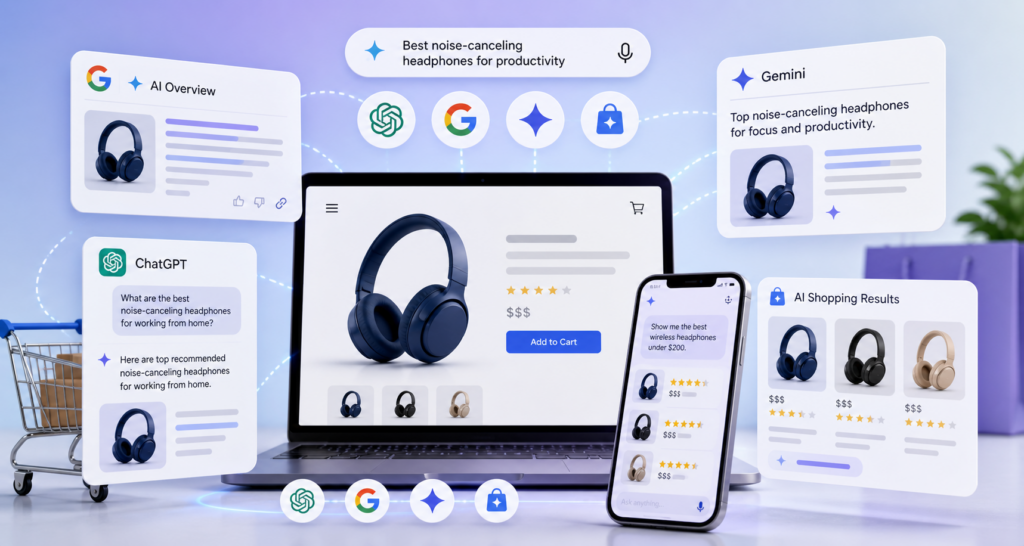
AI search visibility is becoming one of the most important growth priorities for ecommerce brands. As shoppers move from traditional search results to AI-generated answers, product recommendations, shopping assistants, and conversational discovery, brands need a new strategy for being found, understood, recommended, and measured.
Traditional SEO helped ecommerce brands rank in search results. AI search visibility is different. It focuses on whether AI systems like ChatGPT, Google AI Overviews, Gemini, Perplexity, Copilot, Amazon Rufus, Meta AI, and TikTok’s AI-powered discovery tools can understand your brand, surface your products, cite your content, and recommend you for relevant shopping queries.
For ecommerce teams, the goal is not only to appear in AI-generated answers. The real goal is to understand whether AI visibility leads to traffic, purchases, new customers, repeat buyers, and revenue. That is where first-party attribution becomes essential.
AdBeacon helps ecommerce brands, agencies, and media buyers connect AI-assisted discovery, paid media performance, first-party ecommerce data, customer behavior, product performance, and revenue outcomes into a clearer optimization framework.
Key Takeaways
AI search is changing how shoppers discover ecommerce brands. Instead of clicking through a list of links, shoppers can ask AI tools for recommendations, comparisons, summaries, and product shortlists.
Ecommerce AI visibility depends on three layers: technical infrastructure, useful on-site content, and off-site authority signals.
Brands need to optimize for both humans and AI systems. Product pages, category pages, FAQs, buying guides, reviews, and comparison content should be clear, structured, and easy to summarize.
AI visibility is difficult to measure with standard analytics alone. Many AI interactions happen before a click, which means ecommerce brands need better attribution to understand revenue impact.
AdBeacon helps ecommerce teams connect fragmented discovery journeys to first-party revenue data so they can see what is actually driving growth.
What Is AI Search Visibility for Ecommerce?
AI search visibility is the ability of an ecommerce brand or product to appear in AI-generated answers, shopping recommendations, product comparisons, citations, and conversational search results.
A shopper might ask:
- “What are the best noise-canceling headphones for working from home?”
- “Which skincare products are best for sensitive skin under $50?”
- “Compare these two Shopify attribution platforms.”
- “What is the best gift for someone who travels often?”
- “Which running shoes are best for flat feet?”
In a traditional search experience, the shopper receives a list of links. In an AI search experience, the shopper may receive a summarized answer, a shortlist of products, a comparison table, or a direct recommendation.
That means ecommerce brands need to compete for inclusion inside the answer, not just ranking below it.
What Is Ecommerce AI SEO?
Ecommerce AI SEO is the practice of improving how a brand, product, or website appears in AI-generated search experiences. It includes optimizing technical structure, product data, content, reviews, category authority, and off-site mentions so AI systems can better understand and recommend the brand.
You may also see this work described as:
- AEO: Answer Engine Optimization – Optimizing content to answer questions clearly inside AI-generated answers, snippets, and search summaries.
- GEO: Generative Engine Optimization – Structuring content so generative AI engines can retrieve, understand, summarize, and cite it.
- LLMO: Large Language Model Optimization – Improving how large language models interpret and mention your brand or products.
- AI SEO – A broader term for optimizing visibility across AI-powered search and shopping experiences.

The terminology is still evolving, but the practical goal is the same: make your brand easier for AI systems to find, understand, trust, and recommend. The provided draft correctly identifies that AEO, GEO, LLMO, and AI SEO are often used interchangeably, although each term can emphasize a slightly different part of AI search optimization.
How AI Search Is Different From Traditional SEO
Traditional SEO is built around search results. AI search is built around synthesized answers.
In traditional search, a shopper enters a query, scans links, clicks a result, and evaluates pages manually. In AI search, the system may interpret the shopper’s intent, compare options, and provide a recommendation directly.

Classic SEO still matters. Search engines, product feeds, technical performance, links, reviews, and content quality remain important. But AI search adds a new layer: your content must be easy for AI systems to parse, summarize, compare, and trust.
Why Ecommerce Brands Need to Care About AI Search Now
AI search affects ecommerce because shoppers are changing how they research products. Instead of typing short keyword fragments, they are asking detailed questions in natural language.
A shopper may not search:
“best carry-on luggage”
They may ask:
“What is the best carry-on suitcase for a frequent traveler who needs something lightweight, durable, and under $250?”
That kind of query gives AI systems more context. It also raises the bar for ecommerce brands. Product pages and category pages need to explain more than features. They need to clearly communicate use cases, audience fit, benefits, comparisons, limitations, reviews, policies, and buying criteria.
If AI systems cannot understand why your product fits the query, they may recommend another brand.
The Three Ways Ecommerce Brands Appear in AI Results
Ecommerce brands can show up in AI search in several ways.
1. Brand Mentions
A brand mention happens when an AI tool names your brand in a response. For example, if a shopper asks for the best attribution platforms for Shopify brands and the AI includes AdBeacon in the answer, that is a brand mention.
Mentions matter because they build awareness inside AI-driven discovery paths. Even when the shopper does not click immediately, the brand becomes part of the consideration set.
2. Citations
A citation happens when an AI system references or links to a source connected to your brand. This could be a product page, blog post, comparison guide, customer story, review, or third-party article.
Citations matter because they help AI systems support their answers with source material. They also create opportunities for shoppers to click through for deeper research.
3. Product Recommendations
A product recommendation happens when an AI tool recommends a specific product, category, or solution. This is especially important for ecommerce brands because the shopper may be closer to purchase.
For example, an AI assistant may recommend a specific skincare product, shoe, appliance, software platform, or subscription product based on the shopper’s criteria.
For ecommerce brands, the strongest AI visibility strategy should support all three: mentions, citations, and product recommendations.
Which AI Platforms Matter Most for Ecommerce Brands?
Not every AI platform matters equally for every brand. Ecommerce teams should prioritize the AI surfaces where their customers are most likely to discover, compare, and buy.
Google AI Overviews and AI Mode
Google remains one of the most important discovery channels for ecommerce. Google AI Overviews and AI Mode can influence how shoppers receive product information, buying advice, and comparisons.
Ecommerce brands should prioritize Google if they rely on organic search, Google Shopping, Merchant Center, Performance Max, or high-intent product discovery.
ChatGPT
ChatGPT is becoming a major research and recommendation surface. Shoppers use it to compare products, ask category questions, evaluate alternatives, and make buying decisions.
Brands cannot simply buy placement in organic ChatGPT recommendations. Visibility depends heavily on product data, content clarity, third-party mentions, reviews, and how well AI systems understand the brand.
Perplexity
Perplexity is important for research-driven shoppers because it emphasizes sourced answers. Ecommerce brands with strong educational content, comparison content, and third-party mentions may benefit from visibility here.
Amazon Rufus
Amazon Rufus matters for brands selling on Amazon. Product titles, bullet points, reviews, A+ content, availability, and product attributes can influence how shoppers receive AI-assisted answers inside Amazon.
Microsoft Copilot
Microsoft Copilot matters for brands that rely on Bing, Microsoft Shopping, and broader AI-assisted search behavior. It may become increasingly important for research-heavy product categories.
Meta AI
Meta AI matters because Facebook, Instagram, and WhatsApp are major discovery environments. For ecommerce brands using Meta Catalog, Advantage+ campaigns, Shops, and paid social, AI-assisted product discovery inside Meta’s ecosystem may become more important.
TikTok Search and AI-Powered Shopping
TikTok matters for social-first ecommerce brands. TikTok is increasingly used as a product discovery engine, especially for beauty, apparel, wellness, home goods, gadgets, food, and lifestyle products.
Brands should prioritize TikTok if creator commerce, TikTok Shop, short-form video, and social search are already part of their growth strategy.

How AI Search Changes the Ecommerce Buyer Journey
AI search compresses the buyer journey.
In the traditional ecommerce funnel, a shopper might:
- Search on Google
- Click a blog post
- Visit a product page
- Read reviews
- Compare alternatives
- Return through a paid ad
- Purchase later
In an AI-assisted journey, the shopper may:
- Ask ChatGPT or Gemini for recommendations
- Compare products inside the AI answer
- Click one shortlisted option
- Purchase directly or through a shortened path
This creates fewer visible touchpoints for marketers. It also makes attribution harder.
A shopper may be influenced by your content, reviews, product data, ads, creator mentions, and AI recommendations before ever creating a trackable website session. This is why zero-click discovery matters. The influence can be real even when the click is invisible.
The Three Pillars of Ecommerce AI Search Visibility
AI search visibility depends on three connected pillars: infrastructure, on-site content, and off-site authority.
Pillar 1: Technical Infrastructure
AI systems need to be able to access, crawl, read, and understand your ecommerce site. If your site is difficult for bots to access or parse, your products and content may be less visible in AI-generated answers.
Make Sure AI Systems Can Read Your Site
Review technical barriers that could prevent AI systems and search crawlers from accessing important content.
Check:
- robots.txt rules
- CDN bot-blocking settings
- Web application firewall rules
- JavaScript-heavy product content
- Broken links
- Redirect chains
- Duplicate pages
- Missing metadata
- Slow page speed
- Indexing issues
AI visibility starts with accessibility. If crawlers cannot read your product and category content, they cannot reliably surface it.
Use Structured Data
Schema markup helps search engines and AI systems understand your content more clearly.
For ecommerce brands, important schema types include:
- Product schema
- FAQ schema
- Review schema
- Organization schema
- Breadcrumb schema
- Article schema
- Collection or category schema where appropriate
Product schema is especially important because it helps define price, availability, reviews, variants, images, and product details.
Keep Product Feeds Complete
Product feeds are becoming more important as AI shopping experiences connect to Merchant Center, Shopify Catalog, Meta Catalog, TikTok Catalog, Amazon listings, and other commerce data sources.
A strong product feed should include:
- Product title
- Product description
- Category
- Price
- Availability
- Images
- Variants
- Size, color, material, or ingredient attributes
- Brand
- Product identifiers
- Shipping information
- Return information where supported
Incomplete product data creates gaps that AI systems may fill incorrectly or ignore.
Pillar 2: On-Site Content Optimization
On-site content gives AI systems the context they need to understand your brand, products, and expertise.
This includes:
- Product pages
- Category pages
- Blog posts
- Buying guides
- Comparison pages
- FAQs
- Reviews
- Use-case pages
- Glossaries
- Customer stories
Write for Conversational Search
AI shoppers ask questions differently than traditional search users. They often describe the situation, the problem, the audience, and the constraints.
Instead of optimizing only for:
“best attribution platform”
A better AI-search-ready section might answer:
“What is the best attribution platform for Shopify brands that need first-party data, Meta Ads tracking, and clearer ROAS reporting?”
That type of content gives AI systems more context to understand when your brand is relevant.
Write in Answer Blocks
AI systems are more likely to extract and summarize content that answers a question clearly.
A strong answer block should follow this structure:
“[Topic] is [clear definition]. It helps [audience] solve [problem] by [mechanism]. This matters because [business outcome].”
Example:
“First-party attribution helps ecommerce brands measure campaign performance using data collected directly from their own store, customers, and purchase journeys. It gives media buyers a clearer view of which campaigns drive actual revenue, not just platform-reported conversions.”
This format is useful for both readers and AI engines.
Build Product Pages That Answer Real Buyer Questions
A strong product page should answer:
- What is this product?
- Who is it for?
- What problem does it solve?
- What makes it different?
- How does it compare to alternatives?
- What size, variant, or option should a shopper choose?
- What are the materials, ingredients, or specifications?
- What are the shipping and return details?
- What do customers commonly ask?
- What should the shopper do next?
Product pages that only list features may not give AI systems enough context to recommend the product confidently.
Use Chunk-Friendly Formatting
AI systems often retrieve specific sections of content, not entire pages. Each section should make sense on its own.
Use:
- Clear H2 and H3 headings
- Question-based subheads
- Short answer paragraphs
- Tables for comparisons
- Bullets for steps and criteria
- FAQs for long-tail questions
- Definitions for important terms
This makes the page easier for humans to scan and easier for AI systems to parse.
Pillar 3: Off-Site Authority and Citation Signals
AI systems do not evaluate your website in isolation. They may also draw from reviews, social platforms, Reddit discussions, YouTube videos, publisher articles, affiliate content, marketplaces, forums, and third-party comparisons.
Off-site authority helps AI systems understand whether your brand is trustworthy and relevant.
Earn Third-Party Mentions
Third-party mentions can include:
- Publisher listicles
- Product reviews
- Affiliate comparison articles
- Expert roundups
- Founder interviews
- Podcast features
- Industry reports
- YouTube reviews
- Reddit discussions
- Partner content
For ecommerce brands, third-party validation can be especially important because AI systems often compare multiple sources before generating recommendations.
Monitor Social and Community Conversations
AI systems may reflect how the broader web talks about your brand and product category.
Brands should monitor:
- YouTube
- TikTok
- X / Twitter
- Facebook Groups
- Product review sites
- Amazon reviews
- Industry forums
- Publisher content
The goal is not to manipulate conversations. The goal is to understand buyer questions, objections, competitor mentions, and category language.
Build Content Worth Citing
AI systems are more likely to cite content that is specific, helpful, structured, and trustworthy.
Good citation-worthy content includes:
- Original data
- Clear definitions
- Practical frameworks
- Product comparisons
- Category education
- Expert commentary
- Customer examples
- Transparent methodology
- Detailed FAQs
- Clear recommendations
Vague marketing copy is less useful for AI search. Specific, defensible content is stronger.
How to Measure AI Search Visibility
Measuring AI visibility is harder than measuring traditional SEO because many AI interactions do not create a visible click.
A shopper may see your brand mentioned in an AI answer and later search for you directly. Another shopper may compare your brand in ChatGPT and purchase after clicking a Meta retargeting ad. Another may receive a recommendation in Gemini and buy through a Shopify storefront.
Standard analytics may miss these influence points.
Brands should track AI visibility in four layers.
Layer 1: Prompt Tracking
Build a prompt library of real shopping questions your customers might ask.
Examples:
- “What are the best [category] products for [use case]?”
- “Compare [your brand] vs [competitor].”
- “What is the best [product type] under [price]?”
- “Which [category] product is best for [audience]?”
- “What should I look for when buying [product]?”
- “Which Shopify attribution platform is best for ecommerce media buyers?”
Run these prompts across relevant AI platforms and record:
- Whether your brand appears
- Where competitors appear
- How your brand is described
- Whether the answer is accurate
- Whether your content is cited
- Whether products are recommended
- What sources the AI uses
- What gaps or inaccuracies appear
Layer 2: AI Referral Tracking
Track traffic from AI sources when available.
Monitor:
- ChatGPT referrals
- Perplexity referrals
- Gemini or Google AI referrals where visible
- Copilot or Bing AI referrals
- AI-related source and medium patterns
- Direct traffic changes after AI visibility increases
- Branded search lift
AI referral reporting is still imperfect, but brands should start building baselines now.
Layer 3: First-Party Attribution
Prompt tracking can show visibility. First-party attribution helps show revenue impact.
AdBeacon helps ecommerce brands connect customer behavior, campaign activity, and revenue outcomes so teams can understand whether AI-assisted discovery contributes to purchases, repeat orders, and customer value.
Track:
- AI-referred traffic
- Assisted conversions
- New customer rate
- Product-level revenue
- Average order value
- Repeat purchase rate
- Customer lifetime value
- Paid media overlap
- Conversion paths
- Channel attribution gaps
Layer 4: Competitive Visibility
AI search visibility is relative. It matters not only whether your brand appears, but also who appears instead.
Track:
- Which competitors are mentioned
- Which competitors are cited
- Which products are recommended
- Which sources support competitor visibility
- Which comparison queries you lose
- Which questions your content does not answer
- Which third-party sites influence AI responses
This helps ecommerce teams prioritize content, PR, product page updates, reviews, and comparison assets.
Why AI Visibility Needs First-Party Attribution
AI visibility without attribution can create a reporting problem. A brand may know that it appears in AI answers, but not whether that visibility creates revenue.
The real question is not only:
“Are we showing up in AI search?”
The better question is:
“Is AI search visibility helping us acquire better customers and grow revenue?”
AdBeacon helps answer that by connecting AI-assisted discovery to first-party ecommerce outcomes. That means teams can evaluate AI visibility alongside Meta, Google, TikTok, Amazon, email, Shopify, affiliates, creators, and direct traffic.
This matters because AI search is rarely isolated. A customer may interact with multiple channels before purchasing.
For example:
- They see a TikTok creator video.
- They search Google for reviews.
- They ask ChatGPT for product comparisons.
- They click a Meta retargeting ad.
- They buy through Shopify.
- They return later through email.
Without first-party attribution, the brand may overvalue the last click and undervalue the AI-assisted discovery path.
How AdBeacon Helps Ecommerce Brands With AI Search Visibility
AdBeacon helps ecommerce brands, agencies, and media buyers understand what is actually driving revenue across fragmented customer journeys.
For AI search visibility, AdBeacon helps teams answer:
- Which channels are driving revenue after AI-assisted discovery?
- Which campaigns are creating demand before AI search interactions?
- Which products are gaining traction across nontraditional journeys?
- Which customers are new versus returning?
- Which product pages and content assets support conversion?
- Which paid campaigns overlap with AI-referred traffic?
- Which channels are overclaiming credit?
- Which products are worth scaling?
- Which customers return after the first purchase?
- Which AI visibility efforts are connected to real business outcomes?
AI visibility helps e-commerce brands get discovered. AdBeacon helps them understand whether that discovery leads to profitable growth.
Your E-commerce AI SEO Checklist
Use this checklist to improve AI search visibility.
Technical Infrastructure
- Make sure important pages are crawlable.
- Review robots.txt, CDN, and firewall rules.
- Fix broken links, redirect chains, and duplicate pages.
- Improve page speed and Core Web Vitals.
- Add product, FAQ, review, article, organization, and breadcrumb schema where appropriate.
- Keep product feeds accurate and complete.
- Make product variants clear and crawlable.
- Ensure canonical product pages are structured correctly.
Product and Category Content
- Explain what each product is.
- State who the product is for.
- Describe the problem it solves.
- Include product attributes, materials, sizing, variants, and use cases.
- Add clear FAQs.
- Include comparison content.
- Use tables for product differences.
- Add reviews and proof points.
- Keep pricing, inventory, and shipping details accurate.
- Avoid vague product descriptions.
Blog and Educational Content
- Answer real buyer questions.
- Use question-based headings.
- Lead sections with direct answers.
- Create buying guides.
- Publish comparison pages.
- Define category terms.
- Include practical examples.
- Use structured formatting.
- Refresh outdated content.
- Build internal links between related pages.
Off-Site Authority
- Monitor Reddit, YouTube, TikTok, X, and publisher mentions.
- Earn reviews and third-party product coverage.
- Build affiliate and publisher relationships.
- Encourage accurate customer reviews.
- Participate in relevant communities without overpromoting.
- Track competitor mentions in AI answers.
- Identify sources AI systems cite in your category.
- Build expert commentary and thought leadership.
Measurement
- Build a prompt library.
- Track AI mentions and citations manually or through tools.
- Monitor AI referral traffic.
- Track branded search lift.
- Measure assisted conversions.
- Use first-party attribution.
- Compare AI-influenced journeys to paid channels.
- Track new customer rate, AOV, LTV, and repeat purchase behavior.
- Monitor product-level revenue.
- Connect AI visibility to business outcomes.
Common Mistakes Ecommerce Brands Make With AI SEO
Mistake 1: Treating AI SEO as keyword stuffing
AI search optimization is not about repeating keywords. It is about clarity, structure, context, and trust.
Mistake 2: Ignoring product data
Product feeds, schema, attributes, availability, and variants all help AI systems understand ecommerce products.
Mistake 3: Writing vague product pages
AI systems need specific product information. Generic product descriptions make recommendations harder.
Mistake 4: Ignoring comparison content
AI shoppers often ask comparison questions. Brands should create content that explains differences clearly and honestly.
Mistake 5: Measuring only clicks
AI search may influence purchases without producing a visible click. Brands need first-party attribution to understand impact.
Mistake 6: Separating AI visibility from paid media
AI visibility, paid ads, organic search, social commerce, and email can all influence the same customer journey.
Mistake 7: Not tracking competitors
If competitors appear in AI answers and you do not, you need to understand why.
Best Practices for E-commerce AI Visibility
1. Make your brand easy to define
Clearly state what your brand does, who it serves, what category it belongs to, and what problems it solves.
2. Make every product easy to understand
Product pages should explain features, benefits, use cases, variants, pricing, availability, shipping, and returns.
3. Create comparison content
AI systems often answer “best,” “vs,” and “which should I choose” questions. Comparison content helps your brand participate in those answers.
4. Add FAQs to key pages
FAQs help answer long-tail conversational questions in a format AI systems can parse.
5. Strengthen product feeds
AI shopping surfaces rely on accurate product data. Keep feeds complete and current.
6. Earn off-site validation
Reviews, publisher mentions, expert commentary, and community discussions can influence how AI systems understand your brand.
7. Track AI visibility regularly
Run prompt checks across ChatGPT, Google, Gemini, Perplexity, Copilot, Amazon, Meta, and TikTok where relevant.
8. Connect AI visibility to revenue
Use first-party attribution to understand whether visibility leads to purchases, new customers, repeat orders, and LTV.
What This Means for Agencies and Media Buyers
AI search visibility creates a new advisory opportunity for agencies and media buyers.
Clients will increasingly ask:
- Are we showing up in ChatGPT?
- Are we appearing in Google AI Overviews?
- Which competitors are being recommended?
- Which sources are AI systems citing?
- Which product pages need improvement?
- Which content helps us appear in AI answers?
- Is AI search driving revenue?
- How does AI visibility overlap with Meta, Google, TikTok, Amazon, and Shopify?
- Which customers are coming from AI-assisted journeys?
- What should we do next?
AdBeacon helps agencies answer the revenue side of that conversation. Instead of stopping at visibility, agencies can connect AI-assisted discovery to first-party ecommerce outcomes.
Final Takeaway
AI search visibility is the next major evolution of ecommerce discovery. Shoppers are using AI tools to ask detailed questions, compare products, evaluate options, and make buying decisions faster.
To compete, ecommerce brands need strong technical infrastructure, structured product data, helpful content, off-site authority, and a measurement strategy that connects AI visibility to revenue.
Showing up in AI-generated answers is valuable, but it is not the final goal. The final goal is profitable growth.
AdBeacon helps ecommerce brands, agencies, and media buyers connect AI-assisted discovery to first-party attribution, customer behavior, product performance, and real revenue outcomes. As AI search becomes a larger part of the buying journey, the brands that win will be the ones that are easy to find, easy to understand, and easy to measure.
Ready to understand whether AI search visibility is turning into real ecommerce revenue?
Create your free AdBeacon account to see how first-party attribution, real-time analytics, actionable insights, and performance tracking can help your team measure what is actually driving growth across AI-assisted customer journeys.
FAQs About AI Search Visibility for Ecommerce
What is AI search visibility?
AI search visibility is the ability of a brand or product to appear in AI-generated answers, product recommendations, comparison results, citations, and shopping experiences across tools like ChatGPT, Google AI Overviews, Gemini, Perplexity, Copilot, Amazon Rufus, Meta AI, and TikTok search.
What is ecommerce AI SEO?
Ecommerce AI SEO is the process of optimizing product data, website content, technical structure, authority signals, and measurement systems so AI engines can better understand, cite, and recommend an ecommerce brand.
How is AI SEO different from traditional SEO?
Traditional SEO focuses on ranking in search results. AI SEO focuses on being included, cited, recommended, or accurately summarized inside AI-generated answers and conversational shopping experiences.
What is the difference between AEO, GEO, and LLMO?
AEO usually refers to optimizing for answer engines. GEO refers to optimizing for generative AI engines. LLMO refers to optimizing for large language models. In practice, all three focus on making brand and product information easier for AI systems to understand and use.
Which AI platforms should ecommerce brands prioritize?
Most ecommerce brands should start with Google AI Overviews, ChatGPT, Gemini, Perplexity, Amazon Rufus, Meta AI, and TikTok search depending on where their shoppers discover and compare products.
What content helps ecommerce brands appear in AI search?
Helpful content includes product pages, category pages, FAQs, comparison pages, buying guides, reviews, customer stories, educational blogs, and structured product data.
Why does first-party attribution matter for AI search?
First-party attribution helps ecommerce brands understand whether AI-assisted discovery contributes to traffic, purchases, new customers, repeat orders, and customer lifetime value.
How does AdBeacon help with AI search visibility?
AdBeacon helps ecommerce brands and agencies connect AI-assisted discovery, paid media activity, product performance, customer behavior, and revenue outcomes through first-party attribution, real-time analytics, and actionable insights.