TikTok Shop and Creator-Led Commerce: How E-commerce Brands Should Measure What Actually Drives Revenue
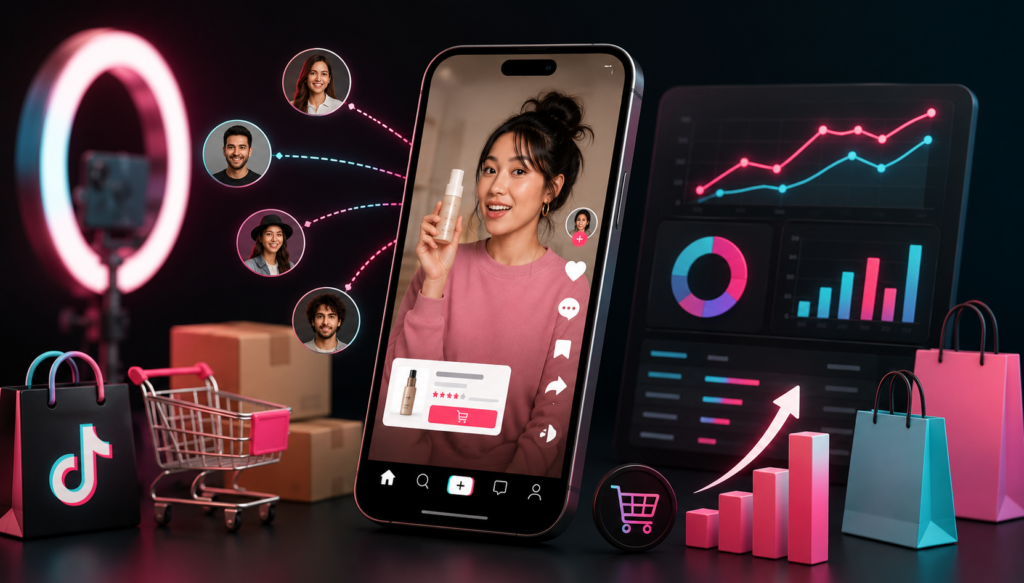
TikTok Shop is becoming one of the most important growth channels in ecommerce because it combines product discovery, creator influence, paid media, affiliate selling, and checkout in one social commerce experience.
For e-commerce brands, this creates a major opportunity, but it also creates a measurement challenge: TikTok Shop performance cannot be judged by views, likes, comments, or gross sales alone.
To scale TikTok Shop profitably, brands need to understand which creators, products, campaigns, and customers are driving real revenue and long-term value.
That requires first-party attribution, e-commerce performance tracking, and a clear reporting system that connects TikTok activity to store-side outcomes.
AdBeacon helps ecommerce brands, agencies, and media buyers use first-party data, real-time analytics, actionable insights, and performance tracking to make better decisions across paid media and social commerce.
What Is TikTok Shop?
TikTok Shop is TikTok’s native ecommerce experience that allows users to discover and buy products directly inside the app. Instead of sending every shopper to an external website, TikTok Shop lets brands sell through shoppable videos, livestreams, product cards, creator content, affiliate posts, and in-app checkout.
This matters because TikTok is not just a social platform in this model. It becomes a product discovery engine, creator marketplace, ad channel, and commerce platform at the same time.
That combination is why TikTok Shop is getting so much attention from ecommerce teams. EMARKETER projected TikTok Shop would reach $23.41 billion in U.S. ecommerce sales in 2026, representing 48 percent year-over-year growth. EMARKETER also noted that TikTok’s algorithm has made the platform a highly effective product discovery and recommendation engine.
Why TikTok Shop Is Growing So Quickly
TikTok Shop is growing because it removes friction from the ecommerce journey. A shopper can discover a product, watch a creator explain it, see comments from other users, compare the offer, and purchase without leaving the app.
Traditional ecommerce often requires more steps:
- See an ad
- Click to a website
- Browse a product page
- Read reviews
- Add to cart
- Complete checkout

TikTok Shop compresses that path. The content, social proof, product education, and checkout experience can all happen in one place.
That is especially powerful for products that benefit from demonstration, creator trust, impulse discovery, or social validation. Beauty, wellness, apparel, accessories, home goods, gadgets, food, and lifestyle products are especially well suited for creator-led commerce.
What Is Creator-Led Commerce?
Creator-led commerce is a sales model where creators influence product discovery and purchase decisions through content, recommendations, demonstrations, reviews, livestreams, and affiliate relationships.
In creator-led commerce, the creator is not just promoting a product. The creator often becomes part of the shopping experience itself.
A creator can:
- Introduce the product to a new audience
- Demonstrate how it works
- Explain why it is useful
- Answer objections in the comments
- Build trust through repeated exposure
- Offer social proof
- Drive direct sales through TikTok Shop
- Generate content that can be amplified through paid media
This is why TikTok Shop has become such an important topic for ecommerce brands. It blends performance marketing with influencer marketing, affiliate marketing, social proof, and native checkout.
Why TikTok Shop Changes Ecommerce Measurement
TikTok Shop changes measurement because the customer journey is not always easy to separate into clean steps.
A single creator video can act as:
- An awareness campaign
- A product demo
- A testimonial
- A sales page
- An affiliate link
- A paid ad asset
- A retargeting touchpoint
- A checkout path

That makes performance more difficult to evaluate. A TikTok Shop campaign may show strong sales inside TikTok, but ecommerce teams still need to know whether those sales are profitable, incremental, and valuable over time.
The core question is not only, “Did TikTok Shop generate GMV?”
The better question is, “Which TikTok Shop activity created profitable customers we should try to acquire again?”
The TikTok Shop Metrics Brands Should Not Overvalue
TikTok Shop creates a lot of visible engagement. Views, likes, shares, saves, comments, and creator follower counts can all look impressive. But those numbers do not always equal profitable growth.
Ecommerce teams should be careful about overvaluing:
- Video views without conversion context
- Engagement rate without purchase data
- Creator follower count without sales quality
- Gross merchandise value without margin
- Affiliate sales without customer quality
- Discount-driven orders without repeat purchase behavior
- Paid boosts without store-side revenue validation
Engagement can be useful. It can show that a product is resonating, that a hook is working, or that a creator has audience trust. But engagement should be treated as a signal, not the final measure of success.
What Is GMV Max and Why Does It Matter?
GMV Max is TikTok Shop’s automated advertising solution designed to optimize campaigns around gross merchandise value.
TikTok’s own help documentation says GMV Max is designed for TikTok Shop advertisers and can promote every product regardless of initial GMV scale or available creative volume.
TikTok also says that, starting July 2025, GMV Max became the default and only supported campaign type for TikTok Shop Ads when using the Sales objective with TikTok Shop as the sales destination.
TikTok’s documentation notes that advertisers would no longer be able to create, edit, or duplicate LIVE Shopping Ads, Product Shopping Ads, or Video Shopping Ads in that setup, while existing campaigns in those formats would remain active.
For ecommerce brands, this shift matters because TikTok Shop advertising is becoming more automated. The platform is increasingly deciding where budget should go based on where it expects to generate the most sales volume.
That creates efficiency, but it also creates a strategic challenge.
If the platform is optimizing toward GMV, brands still need to understand whether that GMV is producing profitable revenue, high-value customers, and sustainable growth.
Why GMV Alone Is Not Enough
GMV, or gross merchandise value, measures the total value of goods sold. It is useful, but it does not tell the full business story.
A campaign can drive high GMV while still creating problems if it depends on heavy discounting, expensive creator commissions, low-margin products, high return rates, or customers who do not buy again.
For ecommerce brands, profitable growth requires more context.
Brands should evaluate TikTok Shop performance against:
- Net revenue
- Contribution margin
- Product margin
- Customer acquisition cost
- Average order value
- New customer rate
- Repeat purchase rate
- Customer lifetime value
- Return and cancellation rates
- Creator commission costs
- Paid media spend
- Incrementality across channels

GMV can tell you that sales happened. It cannot tell you whether those sales were good for the business.
The Attribution Problem With TikTok Shop
TikTok Shop attribution is complicated because several parties can influence the same purchase.
A customer might:
- Watch an organic creator video
- See a paid Spark Ad
- Click a product card
- Watch a livestream
- Search for the product later
- Buy through TikTok Shop
- Return later through the Shopify store
- Purchase again after seeing a Meta ad
In that journey, TikTok Shop contributed to discovery, but it may not be the only channel that influenced the customer. Likewise, a purchase inside TikTok Shop may be the first order, but the customer’s future value may show up elsewhere.
That is why first-party attribution matters. Brands need a way to connect TikTok activity with broader ecommerce outcomes.
What E-commerce Brands Should Track for TikTok Shop
To evaluate TikTok Shop accurately, ecommerce teams should track metrics that connect social activity to business results.
Creator Performance
Brands should know which creators drive more than attention. The best creators generate qualified traffic, product interest, purchases, and customers who come back.
Track:
- Sales by creator
- New customers by creator
- Average order value by creator
- Refund or return rate by creator
- Repeat purchase rate by creator
- Product performance by creator
- Paid amplification results from creator assets
Product Performance
TikTok Shop is often product-led. One product can take off because it is easy to demonstrate, visually interesting, or highly shareable.
Track:
- Product-level GMV
- Product-level margin
- Add-to-cart rate
- Checkout completion rate
- Repeat purchase behavior
- Inventory availability
- Bundling opportunities
- Products that perform well in creator content versus paid ads
Creative Performance
A TikTok creative can succeed for many reasons. The hook, creator, offer, product angle, demonstration, trend format, and call to action can all affect results.
Track:
- Hook performance
- Watch time
- Click behavior
- Product page views
- Add-to-cart rate
- Purchase rate
- Revenue per creative
- New customer rate
- Creative fatigue
- Performance after paid amplification
Customer Quality
A sale is not always equal to a good customer. Brands need to understand whether TikTok Shop customers are becoming valuable long-term buyers.
Track:
- New versus returning customers
- First-order value
- Second purchase rate
- Time to second purchase
- Customer lifetime value
- Product category affinity
- Discount dependency
- Channel overlap
Profitability
TikTok Shop growth should be measured against business economics, not just sales volume.
Track:
- Product margin
- Creator commission
- Affiliate cost
- Ad spend
- Shipping cost
- Returns
- Discounts
- Net contribution margin
How AdBeacon Helps Brands Measure TikTok Shop More Accurately
AdBeacon helps ecommerce brands, agencies, and media buyers move beyond platform-only reporting by connecting marketing activity to first-party ecommerce data.
For brands investing in TikTok Shop, AdBeacon helps answer the questions that platform dashboards alone often cannot answer:
- Which TikTok-driven campaigns are producing actual ecommerce revenue?
- Which creators are driving high-quality customers?
- Which products are worth scaling?
- Which campaigns are acquiring new customers versus retargeting existing buyers?
- Which creative assets deserve more paid budget?
- Which audiences are generating repeat purchases?
- Which channels overlap with TikTok Shop on the customer journey?
- Which campaigns look strong in-platform but weak in store-side performance?
AdBeacon’s value is not just reporting. It is actionable insight. By connecting first-party data, attribution, real-time analytics, creative insights, and performance tracking, AdBeacon helps e-commerce teams optimize based on what actually drives revenue.

Why First-Party Data Is Essential for Creator-Led Commerce
Creator-led commerce introduces more uncertainty into attribution because influence is distributed across people, content, comments, shares, product pages, livestreams, ads, and checkout surfaces.
First-party data helps brands cut through that complexity.
With first-party ecommerce data, brands can identify:
- Which purchases actually happened
- Which customers are new
- Which customers return
- Which products are profitable
- Which campaigns support repeat purchase
- Which creatives drive high-value buyers
- Which paid channels overlap
- Which investments deserve more budget
This is especially important as privacy changes, platform attribution differences, and automated campaign types make it harder to rely on platform-reported metrics alone.
TikTok Shop vs Traditional E-commerce: What Is Different?

TikTok Shop is not just another paid media placement. It is a different kind of commerce environment. Brands need measurement that accounts for how social influence turns into sales.
Common TikTok Shop Measurement Mistakes
Mistake 1: Treating GMV as profit
GMV shows sales volume, not profitability. Brands need to account for margin, discounts, creator costs, ad spend, returns, and repeat purchase behavior.
Mistake 2: Choosing creators by follower count
Follower count does not guarantee sales quality. A smaller creator with stronger trust and better product fit may produce better customers than a larger creator with weaker intent.
Mistake 3: Scaling creative based only on engagement
Engagement can be misleading. A video can get comments and shares without producing profitable orders.
Mistake 4: Ignoring product-level data
TikTok Shop success is often product-specific. Brands should know which products are worth pushing through creator content, GMV Max, live shopping, and paid amplification.
Mistake 5: Measuring TikTok Shop in isolation
TikTok Shop can influence customers who later buy through Shopify, Meta, Google, email, or Amazon. Brands need a broader attribution view to understand the complete customer journey.
How Agencies Can Use TikTok Shop Attribution to Improve Client Reporting
Agencies managing TikTok Shop programs need to explain performance in a way that goes beyond platform screenshots.
Clients want to know:
- Which creators should we keep?
- Which products should we feature next?
- Which campaigns deserve more budget?
- Which TikTok Shop sales were profitable?
- Are we acquiring new customers or discounting to existing ones?
- How does TikTok Shop compare to Meta, Google, Amazon, and Shopify?
- What should we do next?
AdBeacon helps agencies deliver clearer reporting by connecting paid media activity, creator performance, ecommerce data, and revenue outcomes in a more actionable view.
That makes it easier to protect client trust, defend budget decisions, and turn TikTok Shop from an experimental channel into a measurable growth engine.
Best Practices for Scaling TikTok Shop Profitably
1. Build your creator program around performance, not popularity
Choose creators based on product fit, audience trust, conversion potential, and repeatable content quality. Do not rely only on follower count or engagement rate.
2. Track performance by creator, product, and creative
TikTok Shop success depends on the combination of creator, product, content angle, offer, and audience. Measure each layer.
3. Use GMV Max with profitability context
GMV Max can help automate sales growth, but brands should compare TikTok-reported GMV against first-party revenue, margin, and customer quality.
4. Separate new customer acquisition from repeat customer activity
A TikTok Shop campaign that brings in new customers may deserve different evaluation than one that mainly converts people who already know the brand.
5. Connect TikTok Shop to your broader attribution system
TikTok Shop should not sit in a silo. Compare it against Shopify, Meta, Google, Amazon, email, and retention channels.
6. Use creative insights to improve paid media
Creator content can reveal which hooks, claims, demonstrations, and objections matter most to customers. Use that insight to improve paid creative across channels.
7. Watch inventory and product availability closely
A product can spike quickly on TikTok Shop. Brands need to connect marketing performance with inventory planning so winning products do not run out of stock during peak demand.
What E-commerce Brands Should Do Next
TikTok Shop is no longer just a test channel for ecommerce brands. It is becoming a serious sales environment where creators, paid media, product discovery, and checkout all work together.
But growth without measurement can create waste.
Brands should build a TikTok Shop measurement strategy that answers four questions:
- What sold?
- Why did it sell?
- Was it profitable?
- Should we scale it?
AdBeacon helps ecommerce teams answer those questions with first-party attribution, real-time analytics, AI insights, and performance tracking designed for smarter marketing optimization.
Final Takeaway
TikTok Shop is changing ecommerce because it turns content into commerce. Creator-led videos, livestreams, affiliate posts, and automated Shop Ads can move shoppers from discovery to purchase faster than traditional funnels.
But faster sales do not automatically mean better growth.
To scale TikTok Shop profitably, e-commerce brands need to look beyond engagement and GMV. They need to understand which creators, creatives, products, and campaigns are producing real revenue, high-quality customers, and long-term value.
AdBeacon gives ecommerce brands and agencies the attribution foundation they need to make those decisions with more confidence.
Ready to understand which TikTok Shop campaigns, creators, and products are actually driving profitable growth?
Book a demo with AdBeacon to see how first-party attribution, real-time analytics, actionable insights, and e-commerce performance tracking can help your team scale smarter.
FAQs About TikTok Shop and Creator-Led Commerce
What is TikTok Shop?
TikTok Shop is TikTok’s in-app ecommerce experience that lets users discover and buy products through shoppable videos, livestreams, creator content, affiliate posts, product cards, and native checkout.
Why is TikTok Shop important for ecommerce brands?
TikTok Shop is important because it combines product discovery, creator influence, paid promotion, and checkout in one platform. This can shorten the customer journey and create new opportunities for social commerce growth.
What is creator-led commerce?
Creator-led commerce is a sales model where creators influence purchases through product recommendations, demonstrations, reviews, livestreams, and affiliate content. The creator becomes part of the buying journey, not just a promotional channel.
What is GMV Max on TikTok Shop?
GMV Max is TikTok Shop’s automated advertising solution that optimizes campaigns around gross merchandise value. TikTok says GMV Max is designed for TikTok Shop advertisers and can promote every product regardless of initial GMV scale or creative volume.
Is GMV the best way to measure TikTok Shop success?
No. GMV is useful, but it does not show profitability, margin, customer quality, repeat purchase behavior, or incrementality. Brands should evaluate TikTok Shop performance using first-party ecommerce data and profit-focused metrics.
How should brands measure creator performance?
Brands should measure creators by sales quality, new customer acquisition, product fit, average order value, repeat purchase behavior, return rates, and creative assets that can be scaled through paid media.
Why does first-party attribution matter for TikTok Shop?
First-party attribution matters because TikTok Shop journeys can include creator content, paid ads, livestreams, product cards, in-app checkout, and later purchases through other channels. First-party data helps brands understand what actually happened across the customer journey.
How does AdBeacon help with TikTok Shop performance?
AdBeacon helps ecommerce brands and agencies connect TikTok Shop activity to first-party ecommerce data, revenue outcomes, customer behavior, creative performance, and paid media optimization insights.