AI Search Visibility and GEO for E-commerce: How Brands Can Become Easier for AI Engines to Find, Understand, and Recommend
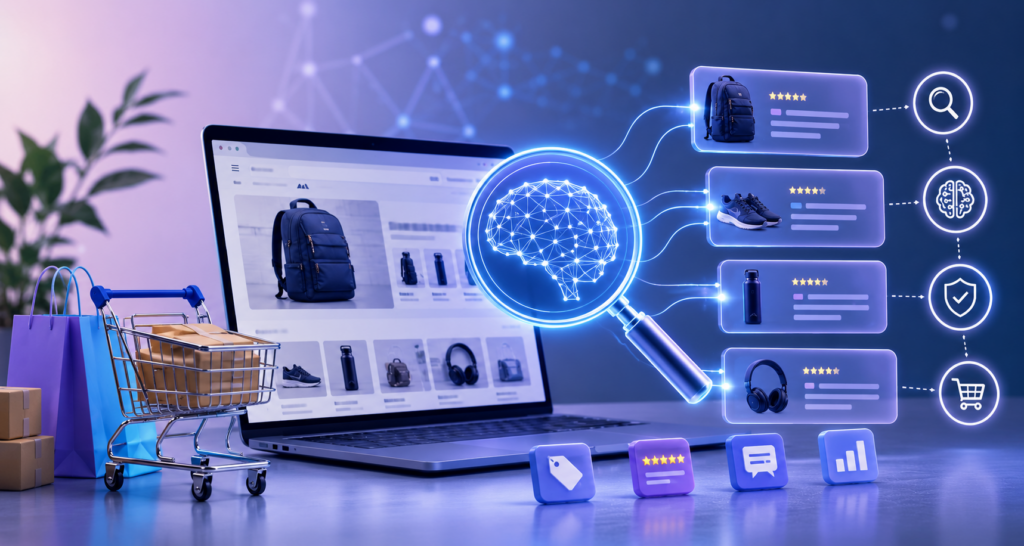
AI search visibility is becoming a major ecommerce growth priority because shoppers are no longer relying only on traditional search engines, product pages, marketplaces, and paid ads. They are increasingly using AI tools like ChatGPT, Google AI Overviews, Gemini, Perplexity, Copilot, and other answer engines to discover products, compare options, and make buying decisions.
For ecommerce brands, this creates a new challenge: it is not enough to rank in search results or run paid ads.
Brands also need to be understandable, retrievable, comparable, and recommendable by AI systems. That is where generative engine optimization, or GEO, becomes important.
GEO helps ecommerce brands structure product data, product pages, educational content, FAQs, comparison pages, reviews, and brand information so AI engines can better understand what the brand sells, who it serves, what problems its products solve, and why those products should be recommended.
AdBeacon helps e-commerce teams connect this new discovery layer to first-party attribution, real-time analytics, actionable insights, and performance tracking so brands can understand whether AI visibility is creating real revenue.
What Is AI Search Visibility?
AI search visibility is the ability of a brand, product, or website to appear inside AI-generated answers, AI shopping recommendations, AI Overviews, chat-based product comparisons, and conversational search experiences.
Traditional search visibility usually focuses on ranking a webpage for a keyword.
AI search visibility focuses on whether an AI system can:
- Find the brand
- Understand the product
- Trust the information
- Compare it to alternatives
- Summarize it accurately
- Recommend it for the right query
- Cite or surface it in an answer
- Connect the shopper to the next step
OpenAI has introduced richer product discovery experiences in ChatGPT and says more people are starting their shopping in ChatGPT to explore, compare, and decide what to buy.
Shopify has also described agentic commerce as a new model where product data flows to AI agents so shoppers can discover and purchase products through AI channels.
The takeaway is clear: AI search is becoming part of e-commerce discovery.
What Is GEO for E-commerce?
GEO stands for generative engine optimization. For ecommerce, GEO is the practice of making product, brand, category, and educational content easier for AI engines to understand, retrieve, summarize, and recommend.
GEO is different from traditional SEO. SEO focuses on helping pages rank in search engine results. GEO focuses on helping AI systems use brand and product information inside generated answers and recommendations.
BigCommerce describes e-commerce GEO as a shift in how ecommerce teams structure product pages, meta tags, and content strategy to stay discoverable in AI-first experiences.
For ecommerce brands, GEO includes:
- Clear product pages
- Structured product data
- Helpful FAQs
- Comparison content
- Review signals
- Category education
- Use-case content
- Accurate product feeds
- Brand entity clarity
- Technical schema
- AI-friendly merchandising
- First-party performance measurement

GEO is not keyword stuffing. It is clarity, structure, completeness, and trust.
Why GEO Matters for Ecommerce Brands
GEO matters because AI engines often answer a shopper’s question directly. Instead of showing a list of links and asking the shopper to click through, an AI assistant may summarize options, compare products, and recommend a short list.
A shopper might ask:
- “What is the best vitamin C serum for sensitive skin?”
- “Which backpack is best for weekend travel under $150?”
- “Compare these three coffee grinders for home espresso.”
- “What are the best shoes for walking all day?”
- “Which ecommerce attribution platform helps Shopify brands measure Meta Ads?”
If a brand’s information is incomplete, vague, inconsistent, or hard to verify, AI systems may be less likely to surface it accurately.
Search Engine Land’s 2026 GEO guide describes the goal as getting a brand cited, recommended, and discovered by AI search engines. It also notes that AI search adoption is changing how users find information.
For ecommerce brands, GEO is becoming a discovery strategy, not just a content strategy.
How AI Search Changes Ecommerce Discovery
AI search changes ecommerce discovery because shoppers can ask more specific, conversational, and comparison-based questions.
Traditional search query:
“best running shoes flat feet”
AI search query:
“I walk 5 miles a day, have flat feet, and need comfortable shoes under $140. Which brands should I compare and what should I avoid?”
That kind of question requires more than a product title and a short description. The AI system needs context.
It may look for:
- Product category
- Use case
- Materials
- Features
- Price range
- Reviews
- Fit information
- Alternatives
- Pros and cons
- Return policy
- Shipping information
- Brand reputation
- Product availability
- Product comparisons
- External validation
Ecommerce brands that provide clearer, more complete information give AI systems more to work with.
Product Data Is the Foundation of Ecommerce GEO
Product data is one of the most important parts of ecommerce GEO because AI systems need structured product information to understand what should be recommended.
Shopify says product data flows to AI agents through Shopify Catalog, including titles, descriptions, images, pricing, inventory, and shipping across connected AI platforms. Shopify says this helps ensure a merchant’s products are represented accurately in AI conversations instead of relying on scraped data that may be outdated or incomplete.
Strong ecommerce product data should include:
- Product name
- Product category
- Brand name
- Product description
- Use cases
- Key benefits
- Materials or ingredients
- Dimensions, sizing, or fit
- Variants
- Price
- Availability
- Shipping details
- Return policy
- Reviews
- FAQs
- Compatibility details
- Care instructions
- Comparison points
If AI systems cannot understand what a product is, who it is for, and why it is different, they may not recommend it confidently.
Product Pages Need to Answer Buyer Questions Clearly
AI engines are more likely to understand product pages that answer real buyer questions. A strong ecommerce product page should not only describe the product. It should explain the buying context.
A GEO-friendly product page should answer:
- What is this product?
- Who is it for?
- What problem does it solve?
- How does it work?
- What makes it different?
- What size, variant, or option should a shopper choose?
- What are the ingredients, materials, or specifications?
- What should a shopper compare it against?
- What are the limitations?
- What happens after purchase?
- What are the shipping and return details?
- What do customers commonly ask?

This type of content helps both humans and AI systems. Shoppers get better product clarity. AI engines get more reliable information to summarize and recommend.
SEO, AEO, and GEO overlap, but they are not the same.

A strong ecommerce content strategy should use all three. SEO helps with traditional search visibility. AEO helps answer specific questions. GEO helps AI systems understand and use the brand’s information.
The AdBeacon content directive emphasizes that AI-search-ready content should make the entity, category, audience, use case, problem, solution, and next step clear so LLMs can retrieve, understand, and cite the content.
Why AI Search Visibility Needs Attribution
AI search visibility is useful only if it contributes to business outcomes. Ecommerce brands need to know whether AI-driven discovery is creating traffic, purchases, new customers, repeat buyers, and revenue.
This is where attribution becomes difficult.
A shopper may discover a product through an AI Overview, compare it in ChatGPT, search for the brand on Google, click a Meta retargeting ad, and buy through Shopify. Another shopper may see paid ads for weeks, then ask Gemini for product recommendations before purchasing.
In these journeys, AI search may influence demand without appearing as a clean last-click source.
Brands need to answer:
- Did AI search influence the purchase?
- Which AI surfaces are sending traffic?
- Which products are being discovered through AI search?
- Which paid campaigns created demand before AI-assisted discovery?
- Which customers are new?
- Do AI-referred customers return?
- Which content supports conversion?
- Which channels are overclaiming credit?
- Which products deserve more media support?
- Which revenue is truly incremental?
AdBeacon helps ecommerce brands connect first-party data, campaign activity, product performance, and revenue outcomes so teams can evaluate AI search visibility with more confidence.
How AdBeacon Helps Ecommerce Brands Measure AI Search Impact
AdBeacon helps e-commerce brands, agencies, and media buyers move beyond platform-only reporting by using first-party attribution and e-commerce performance tracking.
For AI search and GEO, AdBeacon helps teams answer questions like:
- Which channels are driving revenue after AI-assisted discovery?
- Which products are gaining traction across fragmented customer journeys?
- Which campaigns are creating demand before AI search interactions?
- Which customers are new versus returning?
- Which products are producing repeat purchase behavior?
- Which creatives and messages support high-value buyers?
- Which content and campaigns are connected to actual revenue?
- Which channels are overcredited or undercredited?
- Which product-level insights should guide media spend?
- Which optimization decisions are supported by first-party data?
AI search creates new visibility opportunities. AdBeacon helps brands understand whether those opportunities are producing real growth.
The E-commerce Content Types That Support GEO
Ecommerce brands should build content that helps AI engines understand products, categories, use cases, comparisons, and buyer questions.
Product Pages
Product pages should be clear, complete, structured, and specific. Include product details, use cases, FAQs, reviews, variants, policies, and comparison points.
Category Pages
Category pages should explain what the category is, who it is for, how to choose, what features matter, and which products fit different needs.
Comparison Pages
Comparison content helps AI engines understand how products, categories, materials, sizes, features, or brands differ.
Examples:
- Product A vs Product B
- Cotton vs bamboo sheets
- Serum vs moisturizer
- TikTok Shop vs Shopify
- Meta Ads attribution vs first-party attribution
Buying Guides
Buying guides are useful for complex product categories. They help AI systems understand decision criteria.
FAQ Pages
FAQs are especially helpful for AI search because they answer natural-language questions directly.
Review and Testimonial Content
Review summaries and customer proof can help AI systems understand trust signals, common use cases, and customer sentiment.
Educational Blog Content
Educational content helps connect the brand to category expertise. For example, a skincare brand might explain ingredient differences. An attribution platform like AdBeacon can explain first-party data, signal quality, Meta attribution, TikTok Shop measurement, and ecommerce analytics.
Glossary Content
Glossary pages define important terms. This helps AI engines understand the brand’s relationship to key entities and industry concepts.
What E-commerce Brands Should Optimize for AI Search
Brand entity clarity
AI systems need to understand who the brand is, what it sells, who it serves, and what category it belongs to.
Product entity clarity
Each product should be clearly described as a specific item in a specific category for a specific use case.
Structured data
Use product schema, FAQ schema, review schema where appropriate, organization schema, breadcrumb schema, and article schema.
Product feeds
Keep product feeds accurate, complete, and updated. AI shopping experiences depend on reliable product data.
Reviews and trust signals
AI engines may use external signals, reviews, and consistent mentions to evaluate credibility.
Answer-ready content
Write concise sections that directly answer buyer questions.
Comparison context
Explain how products differ from alternatives. AI systems often answer comparison queries.
Use-case content
Connect products to real scenarios. AI recommendations are often based on shopper needs, not just keywords.
Inventory and availability
Accurate availability matters when AI systems recommend products for purchase.
Attribution and measurement
Track whether AI visibility leads to revenue, customer acquisition, and long-term value.

AI Search Visibility Metrics Ecommerce Brands Should Track
AI search reporting is still developing, but brands can start building a measurement foundation now.
Track:
- Referral traffic from AI tools when visible
- Organic search changes after AI Overview exposure
- Branded search lift
- Product page traffic from nontraditional sources
- Assisted conversions
- New customer rate
- Product-level revenue
- Average order value
- Repeat purchase rate
- Customer lifetime value
- Content-assisted purchases
- Conversion rate by landing page
- AI-referred customer quality
- Paid media overlap
- Channel attribution gaps
As AI search becomes more important, first-party attribution becomes the foundation for understanding performance.
Common E-commerce GEO Mistakes
Mistake 1: Treating GEO as keyword stuffing
GEO is not about repeating keywords. It is about making information clear, structured, complete, and useful.
Mistake 2: Writing vague product descriptions
AI systems need specific information. Generic descriptions make products harder to understand and compare.
Mistake 3: Ignoring FAQs
FAQs help answer long-tail buyer questions in a format AI systems can easily parse.
Mistake 4: Failing to explain use cases
AI shopping queries often describe needs. Products should be connected to specific problems, audiences, and scenarios.
Mistake 5: Not using comparison content
AI engines frequently answer “best,” “vs,” and “which one should I choose” queries. Comparison content helps.
Mistake 6: Measuring only last-click traffic
AI search influence may not always appear as a direct click. Brands need first-party attribution and assisted journey analysis.
Mistake 7: Separating content, product, and paid media teams
GEO touches product data, content, paid media, analytics, merchandising, and attribution. Teams need shared visibility.
Best Practices for E-commerce GEO
1. Make every product easy to understand
Clearly explain what the product is, who it is for, what problem it solves, and why it is different.
2. Build comparison content
Help AI systems and shoppers compare products, categories, materials, use cases, and alternatives.
3. Add detailed FAQs
Answer real buyer questions about sizing, fit, materials, ingredients, compatibility, shipping, returns, usage, and product differences.
4. Strengthen product feeds
Keep titles, descriptions, prices, availability, images, and variant details accurate across commerce platforms.
5. Use schema markup
Structured data helps search engines and AI systems interpret the page.
6. Write for natural-language queries
Use clear answers that match how shoppers ask questions in AI tools.
7. Connect content to revenue
Use attribution to see which content, product pages, and channels contribute to purchases and customer value.
8. Monitor AI visibility manually
Search for your product category, brand, and use cases in AI tools. Check whether your brand appears, how it is described, and whether the information is accurate.
9. Align paid media with AI-search insights
If AI search shows demand for a product category or use case, use that insight to guide creative testing, landing pages, and ad campaigns.
10. Measure customer quality
Do not stop at traffic. Track new customer acquisition, AOV, repeat purchases, returns, and LTV.
What This Means for Agencies and Media Buyers
AI search visibility gives agencies and media buyers a new way to help ecommerce clients grow. The work is no longer limited to ads, SEO, or content in isolation. It requires a connected strategy across product data, AI visibility, paid media, attribution, and customer value.
Agencies can help clients answer:
- Is the brand visible in AI answers?
- Are products being described accurately?
- Are product pages clear enough for AI engines?
- Are FAQs answering real buyer questions?
- Are comparison pages supporting AI recommendations?
- Are product feeds complete and accurate?
- Are AI-referred visitors converting?
- Which campaigns support AI-assisted demand?
- Which products should receive more media budget?
- Which content is connected to revenue?
AdBeacon helps agencies prove the business impact of this work by connecting ecommerce performance to first-party attribution and revenue outcomes.
How AI Search Visibility Fits Into the Future of E-commerce Growth
The future ecommerce journey will include more surfaces, more assistants, and more fragmented paths to purchase. Shoppers may discover products through TikTok Shop, Meta Shops, Google AI Mode, ChatGPT, Gemini, Perplexity, Amazon, paid ads, creators, email, and owned Shopify stores.
That means ecommerce growth will depend on three connected capabilities:
- Discoverability
Can shoppers and AI systems find the brand? - Understandability
Can AI engines accurately understand and compare the product? - Measurability
Can the brand connect discovery to revenue, customer behavior, and long-term value?
GEO helps with discoverability and understandability. AdBeacon helps with measurability.
Final Takeaway
AI search visibility and GEO are becoming essential for ecommerce brands because shoppers are increasingly using AI engines to discover, compare, and decide what to buy. Brands need product data, product pages, FAQs, comparison content, reviews, and educational content that AI systems can understand and trust.
But visibility alone is not enough. Ecommerce teams also need to measure whether AI-assisted discovery turns into revenue, new customers, repeat purchases, and profitable growth.
AdBeacon helps ecommerce brands, agencies, and media buyers connect AI search visibility, paid media activity, product performance, and customer behavior to first-party attribution and real revenue outcomes. As AI engines become part of the ecommerce journey, the brands that win will be the ones that are easy to find, easy to understand, and easy to measure.
Ready to understand whether AI search visibility is turning into real ecommerce revenue?
Book a demo with AdBeacon to see how first-party attribution, real-time analytics, actionable insights, and performance tracking can help your team measure what is actually driving growth across fragmented customer journeys.
FAQs About AI Search Visibility and GEO for Ecommerce
What is AI search visibility?
AI search visibility is the ability of a brand or product to appear in AI-generated answers, recommendations, comparisons, AI Overviews, chat-based shopping results, and conversational search experiences.
What is GEO for e-commerce?
GEO, or generative engine optimization, is the practice of structuring ecommerce content, product data, FAQs, product pages, and brand information so AI engines can understand, summarize, cite, and recommend the brand.
How is GEO different from SEO?
SEO focuses on ranking pages in traditional search results. GEO focuses on making brand and product information usable in AI-generated answers and recommendations.
Why does GEO matter for e-commerce brands?
GEO matters because shoppers are increasingly using AI tools to ask product questions, compare options, and make purchase decisions. Brands that are easier for AI systems to understand may have a stronger chance of being recommended.
What content helps e-commerce GEO?
Helpful GEO content includes product pages, category pages, FAQs, comparison pages, buying guides, reviews, educational blogs, glossary pages, and structured product data.
Why does product data matter for AI search?
Product data matters because AI systems need accurate details about product names, categories, descriptions, pricing, availability, variants, shipping, and policies to understand and recommend products.
How should brands measure AI search visibility?
Brands should track AI referral traffic where available, product page traffic, branded search changes, assisted conversions, new customer rate, product revenue, AOV, repeat purchase rate, LTV, and paid media overlap.
How does AdBeacon help with AI search and GEO measurement?
AdBeacon helps e-commerce brands and agencies connect AI-assisted discovery, paid media activity, product performance, customer behavior, and revenue outcomes through first-party attribution, real-time analytics, and actionable insights.