Meta's 2026 Click Definition Change: What Actually Counts as a Click Now
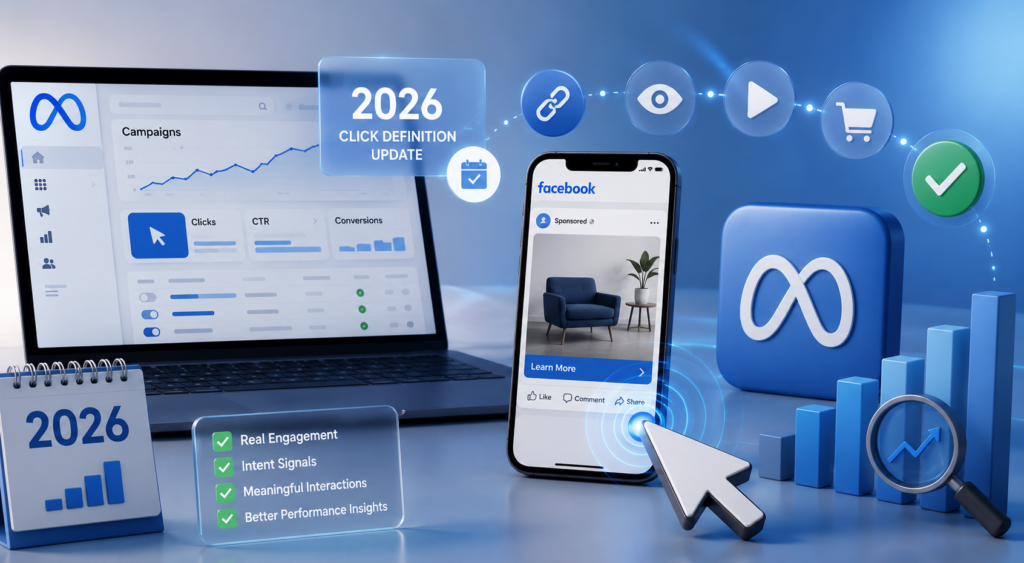
Meta changed the definition of a click. That sounds small. It is not.
On March 3, 2026, Meta announced it was narrowing click-through attribution for website and in-store conversions to include only link clicks: the kind that actually sends someone to your site, your app, a lead form, or a shop.
Likes, shares, saves, and comments no longer count. They moved to a new bucket called engage-through attribution. If your reported conversions dropped somewhere between March and April with no change in spend or creative, this is why.
Here is what changed, why your numbers moved, and what it means for how you read Meta’s data going forward.
What Meta Actually Changed
Before March 2026, Meta’s click-through attribution treated almost any interaction with an ad as a click. A like, a share, a save, a comment, even a profile tap could trigger a click-through conversion if the person bought something within the attribution window.
Meta’s own announcement framed the fix as closing the gap with tools like Google Analytics, which have always counted only link clicks, a gap that was a constant headache to explain in client reports.
Meta’s new definition closes that gap. Click-through attribution now requires a real link click, one that sends the user to a destination.
Everything else, the likes, shares, saves, and comments, moved into a category renamed engage-through attribution, which runs on a much shorter one-day window instead of the old seven-day click window.
Meta also lowered its engaged-view threshold for video from 10 seconds to 5 seconds, which will push more video conversions into the engage-through bucket going forward.
AdBeacon’s take: click-only attribution has been the right call since before this update. If that sounds familiar, it is the same argument AdBeacon has been making about click-based attribution since why AdBeacon only tracks clicks in the first place.
Meta narrowing its own definition toward link clicks is Meta admitting, in its own way, that a like is not a purchase signal worth billing credit against.
Why Your Click-Through Numbers Look Worse (They Are Not)
If you pulled up Ads Manager in late March or April and saw click-through conversions fall off a cliff, your campaigns did not suddenly stop working.
The reporting definition changed underneath them. Reported click-through conversions dropped anywhere from 15 to 60 percent depending on account and vertical, with remarketing and brand awareness campaigns hit hardest since they leaned most heavily on non-link engagement for credit.
This is reclassification, not a performance decline.
A conversion that used to get counted because someone liked your ad on Tuesday and bought on Friday is still happening. It just lives in engage-through now instead of click-through.
Add the two categories together and total attributed conversions land close to where they were before the change. AdBeacon covered the early signal quality implications of this shift in our Meta attribution changes breakdown shortly after Meta’s announcement, if you want the fuller picture.
Billing has not changed either. Meta has been clear that this update only affects how conversions are labeled and reported inside Ads Manager, not what you are charged.
The Part Worth Sitting With
Meta framing this as a transparency win is not wrong. Aligning click-through attribution with how GA4 and click-based tools have always measured is a genuine improvement, and it is one AdBeacon has argued for since the platform launched.
But there is a second motivation running alongside it. Engage-through attribution still credits Meta’s algorithm with conversions tied to likes, shares, and saves, interactions that are far weaker purchase signals than an actual link click. More attributed
conversions, even soft ones, give Meta’s delivery system more data to optimize against and give advertisers a reason to keep engage-through switched on.
Both things can be true at once: cleaner click definitions, and a structural nudge to keep crediting Meta for engagement that never sent anyone anywhere.
But a platform that grades its own homework does not stop grading its own homework just because it renamed the categories. It just found a second column to grade itself in, and it is now feeding that column straight into some of the attribution tools advertisers use to check its work.
What To Actually Do About It
Do not react to the March dip by cutting budget. Do this instead.
- Set a new baseline. Use the Compare Attribution feature in Ads Manager to see click-through plus engage-through combined against your pre-March click-through number, not click-through alone against click-through alone. That is the closer apples-to-apples read.
- Decide what engage-through is worth to you. For campaigns where the buying decision is fast and link-driven, like remarketing or bottom-funnel product ads, weight click-through heavily and treat engage-through as a secondary signal. For brand and top-funnel campaigns, engage-through is more legitimate, but still verify it against actual site traffic and orders.
- Reconcile against first-party data, not platform data. The safest way to know whether last month’s engagement-heavy campaign actually drove revenue is to check it against orders in your own store, tied to the ad that sent the click, not against what Meta says happened inside its own walled garden.
- Watch video benchmarks closely. The drop from a 10 to 5 second engaged-view threshold will inflate engage-through numbers on video and Reels campaigns specifically. Do not read that as a sudden creative win without checking it against real conversions.
This is exactly the kind of moment AdBeacon exists for. AdBeacon measures every click, every conversion, and every dollar of revenue from first-party data on your own store, independent of how Meta chooses to define, rename, or recategorize its own metrics this quarter or next.
If you want to see what your Meta performance actually looks like once it is measured independently of Meta’s own definitions, book a live AdBeacon demo and we will walk your account through it together.
—–
FAQ
What is Meta’s engage-through attribution?
Engage-through attribution is Meta’s category for conversions that follow a non-link interaction, like a like, share, save, comment, or an engaged video view, rather than an actual click to a destination. It runs on a one-day attribution window and is enabled by default.
Did Meta’s March 2026 update change how much I get billed?
No. Meta has confirmed billing is unaffected. The update only changes how conversions are classified and displayed inside Ads Manager reporting.
Why did my Meta ROAS drop after March 2026?
Meta narrowed the definition of a click-through conversion to require an actual link click, moving likes, shares, saves, and comments into a separate engage-through category. Reported click-through conversions dropped as a result, but this reflects a reporting change, not a real decline in performance.
Should I turn off engage-through attribution?
Not necessarily. It depends on your campaign objective. For fast, link-driven purchase decisions, click-through is the more reliable signal. For brand and awareness campaigns, engage-through can capture real value, but it should still be checked against your own first-party conversion data before you trust it for budget decisions.
How is AdBeacon different from Meta’s own reporting?
AdBeacon uses click-based attribution tied to first-party data collected directly from your store, so a conversion only counts when there is a verified click and a verified sale. That stays consistent no matter how any ad platform redefines its own metrics.
—-
Sources
Search Engine Land: Meta Introduces Click and Engage-Through Attribution Updates
AdExchanger: Meta Has A New Way To Measure Social Engagement
Growth Hackers: Meta’s Click Attribution Update 2026
Lucid Media: Meta Ads March 2026 Attribution Update