
The EU's New €3 Customs Duty Isn't a Flat Fee, and Most Sellers Are Still Pricing Like It Is
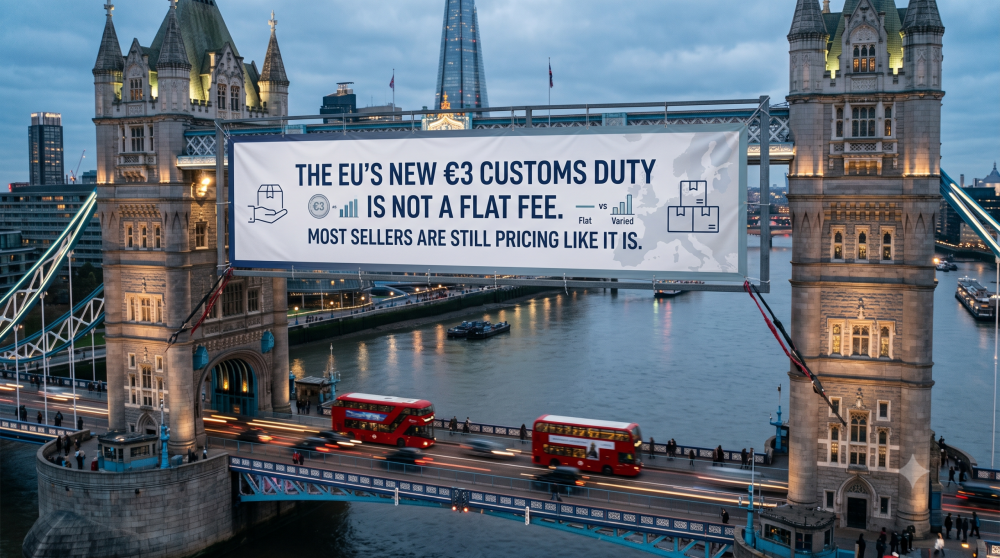
If you sell into Europe, your margins just got quietly more complicated. And it is not a flat fee like everyone assumed.
The EU’s new three euro customs duty on parcels under 150 euros is not charged per package. It’s charged per item classification inside that package.
So a shipment with three different product categories in it gets hit three separate times. That’s nine euros, not three, and most sellers are still pricing like it’s a flat rate.
What Actually Changed
As of July 1, 2026, the EU ended the long-standing customs duty exemption that let goods with an intrinsic value of €150 or less enter the EU duty-free.
In its place, Council Regulation (EU) 2026/382 introduced a temporary customs duty of €3 per item, running from July 1, 2026 to July 1, 2028, the date scheduled for the launch of the EU’s new Customs Data Hub, according to the European Commission’s own Access2Markets notice.
EU member states reached agreement on the measure in December 2025, and the Council formally adopted it on February 11, 2026, moving the original 2028 timeline up by two years.
The change follows growing pressure from individual member states that had been considering their own national parcel fees, and it also mirrors a similar move by the United States to end its own low-value import duty exemption.
The Part Everyone’s Getting Wrong: Per Item, Not Per Parcel
Here is the detail that trips up almost every seller reading the headline number.
The €3 duty is charged per distinct item, identified by its individual tariff classification or HS code, not per parcel or per shipment.
The European Commission’s own guidance is explicit that the new duty applies per item based on tariff classification, not quantity of parcels, according to the Commission’s official explainer.
The Commission’s own worked example makes this concrete: a parcel containing one smartphone, a charger, and a pair of earphones is treated as three distinct items, each carrying its own tariff heading, resulting in a total duty of €9, not €3, according to Global VAT Compliance’s breakdown of the mechanics.
Multiple identical units within the same tariff classification are charged on a per-unit basis, but the moment an order spans different classifications, the per-parcel assumption stops holding.
Do the Math on Your Own Product Mix
If you sell a single product category, a t-shirt brand shipping only t-shirts, this change is close to the flat €3 most sellers assumed.
If your typical order spans categories, apparel plus an accessory plus a skincare add-on, for example, you are looking at three separate tariff classifications and a €9 duty on that same order.
The duty scales with how many distinct classifications sit inside a single shipment, not with how many boxes you ship or how many units are in each box.
This is exactly why pricing by assumption instead of by actual product mix is the mistake to avoid right now.
A brand that bundles or cross-sells across categories, which describes a large share of DTC checkout flows, needs to calculate this per order composition, not extrapolate from a single flat number.
Who This Actually Hits
The duty targets goods sold by non-EU sellers registered under the EU’s Import One-Stop Shop, or IOSS, for VAT purposes.
IOSS-registered non-EU sellers account for an estimated 93 percent of all cross-border ecommerce imports into the EU, which means this measure touches the overwhelming majority of current trade flows, according to VATcalc’s analysis of the scope.
The Commission has also said it will monitor whether the scope should extend to non-IOSS sellers, so this is not necessarily the final word on who it applies to.
It’s Not the Only New Cost Coming
This is one of at least two changes hitting shipment costs this year, and neither of them shows up as a single clean line item you can plan around once and forget.
A separate EU-wide handling fee, expected to run around €2 per consignment, is anticipated to arrive around November 2026, stacking on top of the €3 per-item duty rather than replacing it, according to VATupdate’s coverage of the relationship between the two measures.
The new regime also raises the stakes on product data accuracy.
Importers and carriers now need to submit standardized electronic shipment data before goods enter the EU, including precise product descriptions and correct HS classification codes.
Generic catalog descriptions like “accessories” are now considered risky, since vague product data makes correct duty calculation and customs clearance harder, according to Avalara’s analysis of the reform.
Why This Matters Beyond the Fee Itself
A miscalculated duty is not just a margin problem. Under the new data requirements, a vague or incorrect tariff classification increases the risk of a parcel getting flagged, delayed, or reassessed at the border, which turns a pricing mistake into a delivery-promise problem too. Getting product data, classification, and customs documents in order before shipping determines whether a parcel clears cleanly or the customer sees an unexpected charge land on their doorstep after checkout, according to nShift’s ecommerce readiness guide for the change.
What To Actually Do Right Now
Go actually calculate this per SKU, not per order, if you’re shipping into the EU and your product mix spans multiple categories.
- Pull a sample of your recent EU orders and count the distinct tariff classifications inside each one, not just the number of items or the number of parcels.
- Audit your product catalog for HS classification accuracy. Generic or bundled category descriptions that used to be harmless are now a direct input into how much duty a given order actually owes, and into how likely that order is to get flagged at the border.
- Revisit checkout pricing and duty disclosures if your current setup was built assuming a flat €3 per parcel. A multi-category order needs to reflect the real per-item math, not the headline number.
- Budget for the separate handling fee expected around November 2026 now, rather than treating the €3 duty as the full cost of this transition. Stack both into your Q4 EU margin projections rather than adjusting twice.
- If consolidating orders into fewer tariff classifications per shipment is realistic for your catalog, it directly reduces per-shipment duty exposure under this specific structure.
None of this is optional if a meaningful share of your revenue ships into the EU. The sellers who get hurt here are not the ones facing the new duty. They are the ones still pricing it like the headline number, three months after it actually changed.
If you want to see how a cost change like this actually shows up in your margins by market, independent of what any single dashboard estimates, book a live AdBeacon demo and look at the real numbers.
FAQ
What is the EU’s new €3 customs duty?
It is a temporary customs duty of €3 per item, based on tariff classification, applied to low-value ecommerce consignments with an intrinsic value of €150 or less imported into the EU from outside countries, effective July 1, 2026 through July 1, 2028.
Is the €3 duty charged per parcel or per item?
Per item, based on each product’s individual tariff classification, not per parcel. A shipment containing multiple products with different tariff classifications is charged €3 for each distinct classification, not a single flat €3 for the whole parcel.
How much duty would a mixed-category order actually owe?
It depends on how many distinct tariff classifications the order contains. The European Commission’s own example shows a parcel with a smartphone, a charger, and earphones, three separate classifications, owing €9 total, not €3.
Who does the EU’s €3 customs duty apply to?
Primarily non-EU sellers registered under the EU’s Import One-Stop Shop for VAT purposes, who account for an estimated 93 percent of cross-border ecommerce imports into the EU, though the Commission has said it may extend the scope to non-IOSS sellers.
Is the €3 duty the only new cost coming for EU-bound shipments?
No. A separate EU-wide handling fee of roughly €2 per consignment is expected around November 2026, stacking on top of the per-item duty, in addition to new requirements for precise product descriptions and accurate tariff classification data.
Sources
- European Commission Access2Markets: EU Applies €3 Customs Duty per Item on Low-Value E-Commerce Consignments
- European Commission: Ensuring Fairness and Safety, €3 Customs Duty for Low-Value Parcels
- VATcalc: EU €3 Duty, Low-Value E-Commerce Parcel Imports, July 1 2026
- Global VAT Compliance: EU Low-Value Customs Duty Set at €3 From July 2026
- VATupdate: European Commission Issues Guidance on €3 Customs Duty
- Avalara: EU €150 Customs Duty Exemption Ended July 2026
- nShift: EU Customs Changes 2026, An Ecommerce Readiness Guide