
Brands Are Actively Switching Between BigCommerce and WooCommerce in 2026. Does Your Attribution Survive the Move?
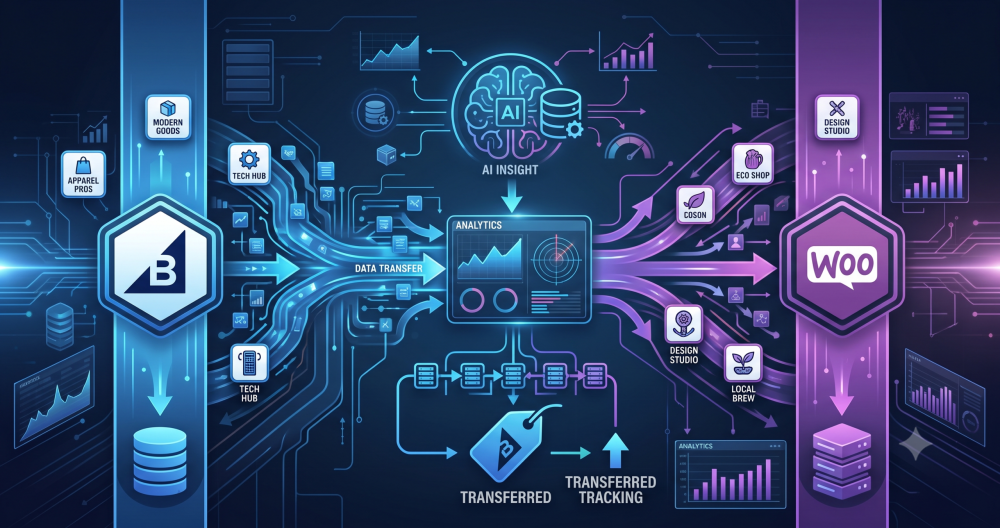
Multi-platform ecommerce attribution isn’t a niche concern in 2026, it’s the thing most migration checklists forget to plan for.
There’s an active, ongoing wave of brands moving between BigCommerce and WooCommerce this year, and it’s happening in both directions.
Some are leaving BigCommerce for the ownership and customization WooCommerce’s open-source model gives them.
Others are moving toward BigCommerce specifically for its continued investment in headless and composable architecture.
Whichever direction a brand is headed, the same problem shows up on the other side: attribution software for non-Shopify stores is thinner across the industry to begin with, and a platform migration is exactly the moment a fragile setup breaks silently.
Most migration checklists are built around catalog, checkout, and SEO redirects, and rightly so, those are the things that visibly break if you get them wrong.
Attribution breaks quietly instead. Historical comparisons lose their baseline, tracking scripts get dropped or duplicated, and nobody notices until three months later when someone asks why last quarter’s ROAS doesn’t reconcile with anything.
Why Brands Are Actively Migrating Between BigCommerce and WooCommerce Right Now
The decision to migrate rarely comes from one breaking point, it usually builds from several small limitations stacking up until they start blocking growth.
For brands moving from BigCommerce to WooCommerce, the pull is ownership:
- WooCommerce gives a brand full control over hosting
- Performance setup
- Integrations
- And development roadmap
- With no dependency on a platform’s update schedule or feature availability.
BigCommerce’s pricing model scales with sales volume, plans that cap around specific annual revenue tiers with extra charges beyond them, which pushes fast-growing stores into pricier tiers as a direct consequence of the growth they’re trying to achieve.
Brands leaning on organic traffic also cite WooCommerce’s deeper control over technical SEO, page speed, structured data, and URL architecture, as a real differentiator that compounds over 12 to 24 months.
BigCommerce isn’t standing still in response.
It continues to invest heavily in headless commerce, composable architecture, and native multi-storefront capabilities, including its Catalyst framework for Next.js-based composable builds and a Channels API for managing multiple storefronts from a single backend.
That’s exactly what pulls some brands the other direction, typically larger, multi-brand, or multi-region operations that need a single commerce backend serving several distinct storefronts, a shape BigCommerce’s architecture is built for more natively than WooCommerce’s plugin-based model.
Neither platform is broken.
This is a genuine two-way migration driven by what a brand’s specific growth stage and technical needs require, and that’s precisely why attribution continuity can’t be an afterthought bolted onto whichever direction a brand happens to be moving.
What Typically Breaks in Attribution and Tracking During a Platform Migration
Property IDs and pixel IDs survive a migration. Almost everything wrapped around them doesn’t. The code that fires the pixel, the events that trigger it, and the consent logic that gates it all need to be rebuilt from scratch on the new platform, they don’t carry over automatically just because the identifier is the same.
A few specific failure patterns show up repeatedly:
- Dual-run inflation. If both the old and new platform’s tracking fire simultaneously during a transition window, GA4 and ad platforms will show inflated, duplicated event counts for that period, corrupting any comparison that includes it.
- Silent tag loss. Meta Pixel, Conversions API, TikTok Events API, and Google Ads conversion tags all need to be manually reinstalled and verified on the new platform. None of them migrate automatically with a domain or theme change.
- Data-layer mismatches. GA4 and most attribution tools depend on a standardized ecommerce data layer firing on key events. A new platform’s checkout flow often structures that data differently, which can produce zero-value purchase events or missing conversion values that look like tracking is working when it’s actually reporting garbage.
- Consent and cross-domain gaps. Consent mode configuration and cross-domain tracking rules are platform-specific setups, not settings that transfer. A payment processor or checkout subdomain that wasn’t re-added to the new platform’s cross-domain list will silently break the funnel at exactly the step that matters most.
Every one of these breaks quietly. Traffic still shows up. Orders still get created. The dashboards just stop agreeing with each other, and by the time someone notices, the migration is old news and the root cause is hard to isolate.
How to Preserve Historical Performance Data and Reporting Continuity Across the Switch
The fix isn’t preventing the baseline shift, some discontinuity is unavoidable when the underlying platform changes.
The fix is documenting it deliberately instead of discovering it accidentally.
Export and archive your pre-migration reporting, platform-native revenue, ad-platform-reported conversions, and GA4 data, as a frozen snapshot before cutover, so you have a clean “before” to compare against rather than trying to reconstruct it later from a system that’s already been replaced.
Run both platforms’ tracking in parallel for a defined window wherever possible, with clear timestamps marking exactly when the cutover happened, so any analyst looking at a dip or spike months later can immediately rule out whether it’s a real performance change or a measurement discontinuity.
Treat the migration date the same way you’d treat a major platform attribution change: as a line on the chart that gets annotated, not buried.
Setting Up First-Party, Platform-Agnostic Tracking Before Migration Day, Not After
The brands that come through a platform migration with clean attribution are the ones who set up first-party, platform-agnostic tracking before migration day, not the ones who scramble to rebuild it after go-live.
A tracking layer tied to your own first-party data, rather than to whichever e-commerce platform happens to be running the storefront, doesn’t need to be rebuilt from scratch every time the underlying platform changes.
It’s the same infrastructure question whether you’re moving from BigCommerce to WooCommerce or the other direction: the measurement layer should sit above the platform, not be rebuilt inside it.
Practically, that means validating tracking in a staging environment before the new store goes live, confirming every pixel and event fires correctly on the new domain before disabling the old platform’s tracking, and monitoring real-time reports closely for the first 48 hours after cutover, since that’s when zero-value purchase bugs and duplicate events are easiest to catch before they contaminate a full reporting period.
This is the same discipline we cover in why Shopify’s own data is accurate but isolated, a platform’s native reporting is only ever a translation of what happened on that platform, and a migration is the moment that translation layer changes entirely.
Why Non-Shopify Attribution Content Is Thinner Industry-Wide, and What That Means for You
Most attribution guidance, tooling, and case studies in ecommerce are written Shopify-first, because Shopify has the largest, most vocal merchant base and the deepest third-party app ecosystem.
That leaves a real gap for brands running BigCommerce or WooCommerce, platforms that together power a substantial share of e-commerce, but generate a fraction of the attribution content and tooling documentation Shopify does.
When something breaks during a BigCommerce-to-WooCommerce migration, the troubleshooting resources available are thinner, less specific, and less battle-tested than what a Shopify brand would find for the equivalent problem.
That gap is exactly why first-party data quality matters more, not less, on these platforms.
If the industry’s collective troubleshooting knowledge is thinner for your platform, your own measurement setup has to be more self-sufficient, less dependent on finding the right forum post or plugin workaround, and more built around first-party data you control directly rather than platform-native reporting you have to hope was configured correctly.
This is also where fragmented customer journeys across platforms become harder to piece back together if your attribution tooling was only ever built with one platform in mind.
If you’re mid-migration or planning one, AdBeacon natively supports Shopify, BigCommerce, and WooCommerce, which means your attribution layer doesn’t need to be rebuilt from scratch no matter which direction you’re moving. Book a live AdBeacon demo to see how attribution continuity works across a platform switch.
—-
FAQ
Why are brands migrating between BigCommerce and WooCommerce in 2026?
Brands moving to WooCommerce typically want fuller ownership of hosting, integrations, and technical SEO than a managed SaaS platform allows. Brands moving toward BigCommerce are often drawn by its investment in headless and composable architecture and native multi-storefront support for larger or multi-region operations.
Does my Google Analytics or ad platform tracking carry over automatically during a platform migration?
No. Property and pixel IDs can often be reused, but the code that fires them, the events that trigger them, and the consent configuration around them all need to be rebuilt on the new platform.
How do I compare performance before and after a platform migration?
Export and archive a frozen snapshot of your pre-migration reporting before cutover, and run both platforms’ tracking in parallel with clear timestamps where possible, so you have a documented baseline rather than a reconstructed guess.
Why is attribution content thinner for BigCommerce and WooCommerce than for Shopify?
Shopify has the largest merchant base and the deepest third-party app ecosystem, which means most attribution guidance and tooling gets written Shopify-first, leaving less specific, less tested guidance available for brands on other platforms.
What should I set up before migration day rather than after?
First-party, platform-agnostic tracking that isn’t rebuilt from scratch inside whichever platform is running the storefront, validated in staging, confirmed on the new domain before the old platform’s tracking is disabled, and monitored closely for the first 48 hours after go-live.
Sources
- WisdmLabs: Why More Brands Are Considering BigCommerce to WooCommerce Migration in 2026
- BigCommerce: Headless Commerce in 2026 (Everything You Need to Know)
- WeltPixel: Magento to Shopify Migration: The Conversion Tracking Checklist
- Ecommony: GA4 Ecommerce Tracking Not Working? What Breaks, Why It Matters