
Fragmented Customer Journeys in E-commerce: How Modern Media Buyers Measure Cross-Platform Performance
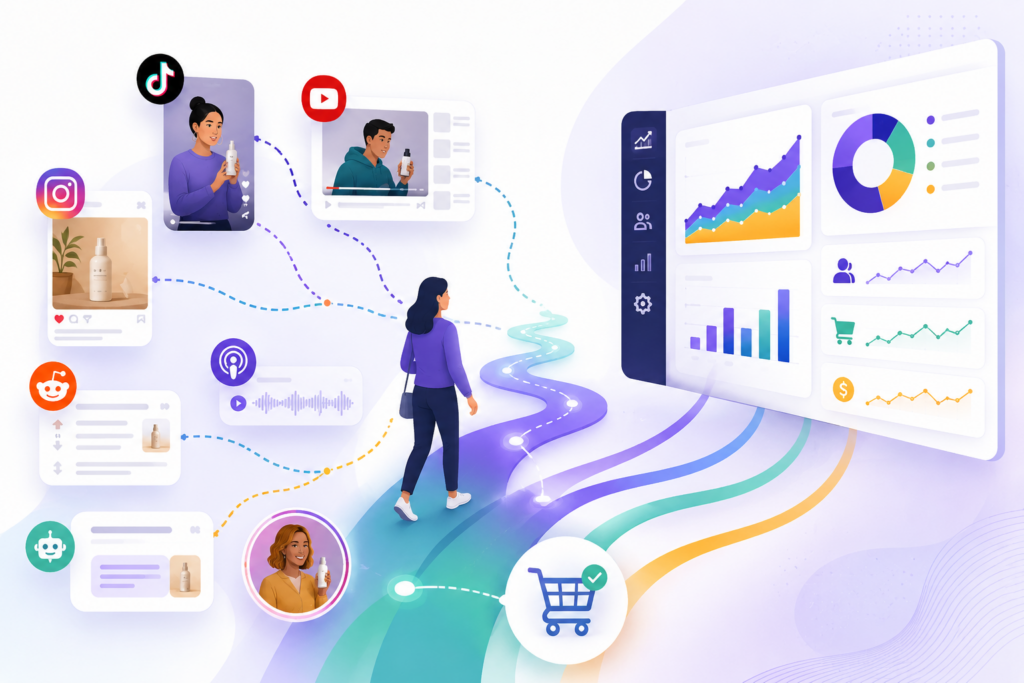
The modern ecommerce customer journey no longer follows a clean, predictable path.
For years, digital advertising operated on a relatively simple assumption:
- a customer clicks an ad
- visits a website
- converts shortly afterward
- the platform receives attribution credit
That model still exists in some cases, but it no longer reflects how most ecommerce buying behavior actually works.
Today, customer journeys are increasingly fragmented across:
- Meta
- TikTok
- YouTube
- creator ecosystems
- email flows
- SMS campaigns
- AI search tools
- community platforms
- direct traffic
- repeat touchpoints
Consumers now move fluidly between platforms, devices, creators, algorithms, and recommendation systems before making purchase decisions.
A customer may:
- Discover a product through TikTok
- Watch creator reviews on YouTube
- Search Reddit for opinions
- Visit the website through Meta retargeting
- Subscribe to email
- Return later through branded Google search
- Purchase days or weeks later on another device
Every platform involved in that journey may attempt to claim credit for the conversion.
At the same time, privacy restrictions and tracking limitations increasingly obscure parts of the buying process altogether.
This creates a major challenge for ecommerce brands:
How do you measure performance accurately when customer journeys are fragmented across dozens of touch points?
That question is becoming one of the most important problems in modern ecommerce advertising.
The brands that solve it effectively often gain a major advantage in:
- media buying efficiency
- customer acquisition
- budget allocation
- retention optimization
- long-term profitability
Because in modern ecommerce, attribution is no longer just a reporting function.
It is a strategic visibility system.

Why E-commerce Customer Journeys Became So Fragmented
Several major industry shifts have transformed how consumers discover and purchase products online.
Discovery Is No Longer Centralized
Historically, ecommerce discovery relied heavily on:
- Google search
- Meta ads
- direct website visits
Today, discovery is decentralized across multiple ecosystems.
Consumers increasingly discover products through:
- TikTok creators
- YouTube Shorts
- Reddit communities
- Instagram Reels
- AI assistants
- podcasts
- influencers
- recommendation algorithms
- creator-led commerce
In many categories, consumers encounter products long before they actively search for them.
Discovery is increasingly:
- algorithmic
- creator-driven
- entertainment-based
- socially influenced
That dramatically expands the number of touchpoints involved in customer acquisition.
Consumer Research Behavior Has Expanded
Modern consumers rarely trust a single source before purchasing.
Instead, shoppers frequently:
- compare reviews
- watch demonstrations
- read community discussions
- evaluate creator opinions
- ask AI assistants for recommendations
- research competitors
- revisit products multiple times
This creates nonlinear customer journeys where influence happens gradually across multiple environments.
Importantly, many of these touchpoints are not directly measurable inside traditional platform attribution systems.
A creator video may influence demand without generating a direct click. A Reddit discussion may shape trust weeks before conversion. An AI-generated recommendation may influence consideration without leaving a clear attribution trail.
As ecommerce ecosystems become more interconnected, customer journeys become harder to simplify into single-channel conversion paths.
Privacy Changes Reduced Visibility
Privacy updates have significantly reduced tracking visibility across digital advertising ecosystems.
This includes:
- iOS App Tracking Transparency
- browser cookie restrictions
- consent frameworks
- ad blockers
- cross-device tracking limitations
Historically, platforms had broader visibility into user behavior across websites and applications.
Today, large portions of the customer journey are increasingly hidden or incomplete.
This creates:
- attribution overlap
- missing conversion data
- delayed reporting
- fragmented measurement
- inconsistent platform reporting
As a result, many ecommerce brands are operating with incomplete visibility into what is actually driving growth.
Why Platform Attribution Alone No Longer Tells the Full Story
Most advertising platforms still report performance primarily from their own perspective.
Meta reports Meta-attributed conversions.
Google reports Google-attributed conversions.
TikTok reports TikTok-attributed conversions.
The problem is that customer journeys rarely happen inside only one ecosystem anymore.
A single conversion may be claimed simultaneously by:
- Meta
- TikTok
- email marketing
- affiliate campaigns
This creates inflated reporting and overlapping attribution windows across platforms.
At the same time, platforms often have limited visibility into:
- cross-channel influence
- assisted conversions
- retention behavior
- customer lifetime value
- repeat purchase activity
- off-platform engagement
That means platform dashboards often provide only partial views of actual business performance.
This is one reason many modern ecommerce media buyers are shifting toward first-party attribution and broader customer journey analysis.
They need a more complete picture of how acquisition actually works.
Why Modern Media Buying Requires Cross-Platform Visibility
Media buying has evolved far beyond simple campaign management.
Today’s ecommerce media buyers increasingly operate as:
- growth strategists
- attribution analysts
- customer journey interpreters
- profitability operators
To scale effectively, they need to understand:
- which channels influence discovery
- which campaigns drive profitable customers
- how touchpoints interact
- which creatives generate retention
- how acquisition affects long-term LTV
- where budget allocation creates incremental growth
This requires visibility across the full customer journey instead of isolated platform snapshots.
Modern media buying increasingly depends on understanding: how ecosystems work together.
Not just how individual ads perform independently.

How AdBeacon Helps Ecommerce Brands Measure Fragmented Customer Journeys
AdBeacon helps ecommerce brands improve cross-platform attribution visibility using first-party customer data infrastructure.
This helps brands better understand:
- how customers move across channels
- which campaigns influence revenue
- which touchpoints contribute to acquisition
- which audiences generate long-term value
- how retention impacts profitability
- how paid and organic channels interact
AdBeacon supports:
- first-party attribution tracking
- Shopify attribution visibility
- customer journey analysis
- cross-channel reporting
- revenue-focused measurement
- media buying optimization
- retention visibility
- customer acquisition intelligence
As ecommerce ecosystems become more fragmented, brands increasingly need independent visibility into the full customer journey instead of relying solely on isolated platform reporting.
What High-Performing Ecommerce Media Buyers Are Doing Differently
Modern high-performing media buyers increasingly think beyond:
- platform ROAS
- click attribution
- isolated dashboards
Instead, they focus on:
- customer quality
- blended performance
- incrementality
- retention economics
- cross-platform influence
- first-party attribution
- customer journey analysis
Importantly, they understand that ecommerce growth is no longer driven by single-channel optimization alone.
Growth increasingly happens through:
- ecosystem coordination
- creator influence
- retention systems
- content networks
- customer intelligence infrastructure
The strongest media buyers today are often the operators with the clearest customer visibility.
Common Mistakes E-commerce Brands Make with Attribution
Many e-commerce brands still approach attribution using outdated assumptions.
One common mistake is treating platform dashboards as complete sources of truth despite increasingly fragmented customer journeys.
Another issue is evaluating channels independently without understanding how they influence each other across the buying process.
Brands also frequently optimize too heavily for short-term conversion metrics without analyzing:
- retention
- LTV
- customer quality
- assisted conversions
- blended business performance
Finally, many ecommerce companies still underinvest in first-party data infrastructure even as third-party visibility continues declining.
As attribution complexity increases, these gaps become more costly.
What E-commerce Brands Should Do Next
To improve cross-platform performance visibility, ecommerce brands should focus on:
- strengthening first-party attribution infrastructure
- improving customer journey visibility
- measuring blended performance
- analyzing retention and LTV
- improving server-side tracking
- connecting acquisition to long-term profitability
- evaluating assisted conversions
- reducing reliance on isolated platform reporting
Modern ecommerce customer journeys will likely become even more fragmented as:
- AI commerce expands
- creator ecosystems grow
- social discovery evolves
- privacy restrictions continue increasing
The brands that build the clearest customer visibility systems today will likely have a major strategic advantage tomorrow.
Final Thoughts…
Modern e-commerce customer journeys are becoming increasingly fragmented, nonlinear, and difficult to measure through platform reporting alone.
Consumers now move fluidly across:
- creators
- social platforms
- AI systems
- communities
- paid ads
- retention channels
before making purchase decisions.
The ecommerce brands that succeed in this environment will not simply optimize campaigns in isolation.
They will build stronger visibility into how the entire customer ecosystem works together.
That means investing in:
- first-party attribution
- customer journey analysis
- cross-platform visibility
- retention measurement
- blended performance evaluation
- customer intelligence infrastructure
AdBeacon helps ecommerce brands improve visibility into the fragmented customer journeys driving modern ecommerce growth, helping media buyers make more informed and profitable scaling decisions across increasingly complex digital ecosystems.
Want clearer visibility into how your customers move across platforms before converting?
Discover how AdBeacon helps e-commerce brands improve first-party attribution, measure cross-platform performance, and optimize media buying decisions with more accurate customer journey intelligence.
FAQs About Fragmented Customer Journeys and Cross-Platform Attribution
What is a fragmented customer journey?
A fragmented customer journey occurs when consumers interact with multiple platforms, creators, devices, and touchpoints before making a purchase decision.
Why are ecommerce customer journeys becoming more fragmented?
Discovery is increasingly happening across social platforms, creator ecosystems, AI search tools, community discussions, email flows, and multiple devices instead of centralized search environments.
What is cross-platform attribution?
Cross-platform attribution measures how multiple channels and touchpoints contribute to customer acquisition and revenue outcomes across the customer journey.
Why is platform attribution becoming less reliable?
Privacy restrictions, fragmented discovery behavior, cross-device usage, and overlapping attribution windows reduce the completeness of platform-reported performance data.
Why does first-party attribution matter?
First-party attribution helps brands create a broader, more independent understanding of customer journeys, acquisition quality, retention behavior, and profitability.
How does AdBeacon help ecommerce brands improve attribution visibility?
AdBeacon helps ecommerce brands improve first-party attribution, customer journey analysis, cross-channel reporting, and revenue-focused measurement across fragmented commerce ecosystems.
Why does retention matter in attribution analysis?
Retention visibility helps brands understand which acquisition sources produce high-value, profitable customers instead of evaluating campaigns only through short-term conversion metrics.