
Google Meridian Just Made Geo Incrementality Testing a Lot More Accessible, Here's How It Works
Incrementality testing has always sat behind a wall of statistical expertise and engineering time most ecommerce teams don’t have.
Google’s latest additions to Meridian, its open-source media mix modeling framework, are aimed squarely at that wall.
Meridian GeoX brings ground-truth geo incrementality testing into the same ecosystem as the MMM itself, and Meridian Studio cuts the time to a refreshed model from months to days.
Together they’re part of a broader 2026 push Google product VP Gaurav Bhaya has framed as moving measurement away from last-click thinking toward something closer to a real growth engine.
Here’s what each tool actually does, how geo holdouts produce genuine incrementality proof instead of a modeled estimate, and where independent first-party data fits into making any of it trustworthy.
What Meridian GeoX Does Differently From a Standard MMM Model
A standard MMM model, Meridian included, estimates each channel’s contribution using statistical relationships in historical data.
That’s genuinely useful, but it’s still correlation dressed up in Bayesian math.
GeoX adds an incrementality layer on top: an open-source, publisher-agnostic tool for running geographic experiments that produce causal, not modeled, proof of what media spend actually caused.
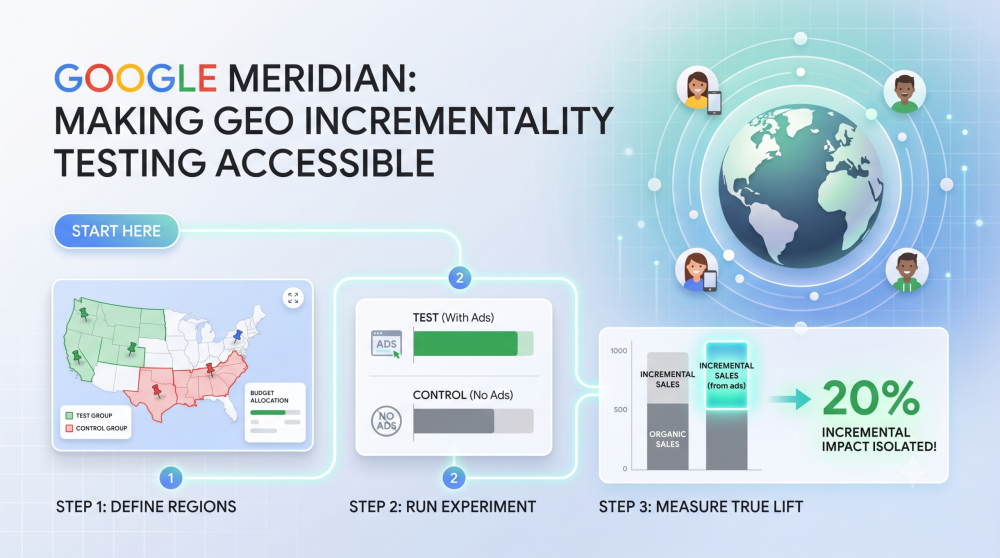
The mechanism is a holdout design.
You run a channel normally in some regions and hold it back, go dark, or scale it up in others, then compare what actually happened in each group.
GeoX results then feed back into Meridian as calibration priors, which means the MMM stops guessing at a relationship and starts anchoring itself to a real, regional experiment.
Google has described this as making budget planning “anchored in proven, incremental performance” rather than a purely modeled one.
GeoX began limited testing in 2026, building on geo-matching methodology Google has run internally on GitHub for years, now packaged as a formal Meridian product.
What Meridian Studio Changes About the Time and Technical Lift to Run MMM
Meridian itself has never been simple to operate.
It’s a Python framework that takes real statistical expertise to configure priors, validate outputs, and avoid misleading results, which is exactly why most ecommerce teams without in-house data science have stayed on the sidelines.
Meridian Studio is Google’s answer: an enterprise platform built on Google Cloud designed to take a team from raw data to a refreshed, working model in days rather than the months a from-scratch build typically takes.
That matters more than it might sound. Survey data from EMARKETER and Rakuten found only about 12 percent of US marketers currently feed MMM insights into live campaigns on a weekly basis, with the largest share updating only quarterly or ad hoc.
A model that takes months to refresh can’t keep pace with a channel mix that shifts every few weeks. Studio is explicitly built to turn MMM from a periodic analytics project into something closer to a continuous decision engine.
How Geo Holdouts Produce Ground-Truth Incrementality Proof
The reason geo experiments work as ground truth is straightforward: they isolate cause from correlation in a way pure statistical modeling can’t.
If sales rise in a region running a campaign, that alone doesn’t prove the campaign caused it. Demand could already be climbing, a competitor could have pulled back, or a distribution change could be doing the work.
A geo holdout controls for that by comparing a treatment region against a matched control region that experienced everything else identically, except the media spend being tested.
That’s a materially different kind of proof than what any platform’s self-reported ROAS gives you.
As Google’s own framing puts it, attribution shows impact quickly, but incrementality is how you understand what’s actually working.
A geo test doesn’t care what a platform’s algorithm decided to credit. It measures what happened against what would have happened anyway.
Where First-Party Attribution Data Fits Into Feeding an Accurate Model
Geo holdouts solve the causality problem. They don’t solve the input-quality problem.
A GeoX experiment still needs to align regional media spend against actual regional revenue to calculate a real incremental ROAS, and that alignment is only as good as the store data behind it.
If the revenue side of that comparison comes from platform-reported conversions instead of verified orders, the “ground truth” experiment inherits the same measurement gap it was built to eliminate.
This is exactly where independent, first-party, click-verified attribution data matters.
Feeding GeoX and Meridian with your own order and revenue data, not a platform’s version of what converted, means the calibration priors flowing back into your MMM are anchored to what your store actually sold, not what a platform decided to credit.
AdBeacon’s Meridian media mix modeling integration exists to make that connection direct: first-party attribution data feeding straight into the geo-experimentation and MMM layer, so the ground-truth check on platform-reported ROAS is actually ground truth.
Who Should Try This Now vs. Wait for More Tooling Maturity
GeoX is still in limited testing, and Google hasn’t said when broader availability arrives, so the honest answer depends on what you’re solving for.
- Brands running meaningful spend across multiple geographies now have a real reason to start building the geo-testing muscle today, even with the current preview-stage tooling, since the underlying methodology (matched-market holdouts) isn’t new and can be run manually while waiting for GeoX itself.
- Smaller or single-market brands are likely better served waiting for GeoX to mature and for Studio to lower the operational lift, since a geo experiment needs enough regional scale to produce a statistically meaningful result.
- Anyone already running Meridian without in-house data science should look at Studio or a managed platform now, since the wait for GeoX doesn’t need to block getting a properly calibrated MMM running in the meantime.
- Everyone, regardless of scale, should prioritize getting first-party, click-verified data into whatever measurement stack they’re running before adding geo experiments on top, since better inputs improve every layer downstream.
If you want to see how independent first-party attribution data feeds directly into Meridian’s media mix modeling, book a live AdBeacon demo.
—-
FAQ
What is Meridian GeoX?
Meridian GeoX is Google’s open-source, publisher-agnostic tool for running geographic incrementality experiments. It holds media spend back, runs it dark, or scales it up across matched regions, then feeds the causal results back into Meridian as calibration priors.
How is GeoX different from regular attribution or MMM?
Attribution and standard MMM estimate relationships from observed data. GeoX produces causal proof through controlled geographic experiments, comparing what happened in a treatment region against a matched control region, rather than modeling a statistical relationship.
What is Meridian Studio?
Meridian Studio is a Google Cloud-powered enterprise platform designed to reduce the technical lift of running Meridian, cutting the time from raw data to a refreshed marketing mix model from months to days.
Do I need a data science team to use Meridian GeoX or Studio?
Meridian itself still requires real statistical expertise to configure correctly. Studio reduces the operational burden of managing the model at scale, but most ecommerce teams without in-house data science get a faster, more reliable path through a managed platform.
Why does first-party data matter for a geo incrementality test?
A geo test’s revenue side is only as accurate as the data feeding it. If regional revenue comes from platform-reported conversions rather than verified store orders, the experiment inherits the same measurement gap it’s meant to eliminate.