Amazon vs Shopify: Which E-commerce Platform Is Better for Growth in 2026?
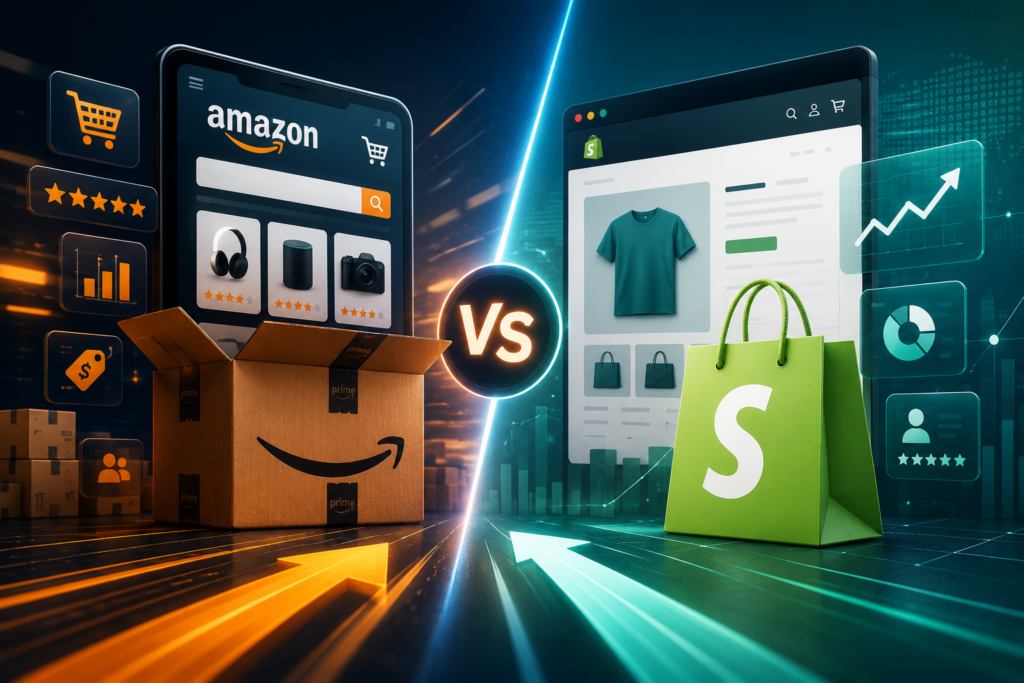
For ecommerce brands, choosing between Amazon and Shopify is one of the biggest decisions that impacts growth, profitability, customer acquisition, and long-term brand strategy.
Both platforms are powerful, but they serve very different purposes.
Amazon gives brands immediate access to massive built-in customer demand, while Shopify provides ownership, branding control, customer data visibility, and long-term scalability.
The challenge is that modern ecommerce growth rarely happens on a single platform anymore.
Many of today’s fastest-growing brands operate across:
- Shopify
- Amazon
- Meta Ads
- Google Ads
- TikTok
- Klaviyo
- Influencer channels
- Retail marketplaces
As customer journeys become increasingly fragmented, brands need more than just a storefront. They need accurate attribution, performance visibility, and actionable optimization insights across every sales channel.
That’s why ecommerce brands increasingly rely on first-party attribution platforms like AdBeacon to unify reporting, improve ROAS visibility, and optimize performance across both Shopify and Amazon ecosystems.
In this guide, we’ll compare:
- Amazon vs Shopify pricing
- Branding and ownership differences
- Traffic and customer acquisition
- Fulfillment and operations
- Scalability and integrations
- Attribution and analytics visibility
- Which platform is best for different business models
- Why many brands now use both platforms together
What Is Shopify?
Shopify is an ecommerce platform that allows brands to build and manage their own online store.
Unlike marketplace platforms, Shopify gives businesses full control over:
- Branding
- Customer experience
- Website design
- Checkout flow
- Customer data
- Marketing strategy
- Retention campaigns
Shopify is designed for brands that want to create a long-term ecommerce business with stronger ownership and direct customer relationships.
Modern Shopify brands often combine:
- Paid media
- Email marketing
- SMS marketing
- Influencer campaigns
- SEO
- Subscription programs
- Retention marketing
to drive growth beyond marketplace dependence.
Shopify also offers integrations with:
- Meta
- TikTok
- Amazon
- Klaviyo
- Recharge
- Gorgias
- Attribution platforms like AdBeacon
This makes Shopify highly flexible for scaling ecommerce operations.
What Is Amazon?
Amazon is an ecommerce marketplace where businesses can list and sell products to Amazon’s built-in audience.
Instead of building an independent storefront, brands sell within Amazon’s marketplace ecosystem.
The biggest advantage of Amazon is immediate customer reach.
Amazon receives billions of monthly visits from high-intent shoppers actively searching for products.
For many brands, Amazon provides:
- Faster initial visibility
- Built-in purchase intent
- Simplified fulfillment options
- Strong conversion rates
- Access to Prime customers
However, Amazon also limits:
- Brand ownership
- Customer relationship visibility
- Attribution transparency
- Customer data access
- Design customization
This creates a tradeoff between customer reach and long-term brand control.
Amazon vs Shopify: Key Differences

Amazon vs Shopify: Pricing and Fees
Both platforms offer relatively accessible pricing, but their fee structures are very different.
Amazon Pricing
Amazon sellers typically pay:
- Monthly seller fees
- Referral fees
- Fulfillment fees
- Transaction fees
- Storage fees for FBA
Amazon’s standard plans include:
Amazon Plan | Pricing |
Individual Seller | $0.99 per item sold |
Professional Seller | $39.99/month |
While Amazon offers enormous customer reach, many sellers experience margin compression due to marketplace competition and fees.
Shopify Pricing
Shopify uses subscription-based pricing tiers.
Shopify Plan | Pricing |
Basic | $29/month |
Advanced | $79/month |
Grow | $299/month |
Plus | Enterprise pricing |

Shopify generally provides better margin control because brands avoid marketplace referral fees and retain greater ownership over customer acquisition and retention strategies.
However, Shopify brands often invest more heavily in:
- Paid advertising
- SEO
- Content marketing
- Email retention
- Attribution tools
- Creative production
to drive traffic independently.
Brand Ownership and Customer Control
One of the biggest differences between Amazon and Shopify is ownership.
Amazon Prioritizes Marketplace Visibility
On Amazon, the marketplace owns much of the customer relationship.
Brands compete directly beside:
- Other sellers
- Similar products
- Amazon-owned products
- Sponsored listings
Customer loyalty often remains tied to Amazon rather than the individual brand.
This limits:
- Retention visibility
- Direct customer engagement
- Customer journey insights
- Long-term audience ownership
Shopify Prioritizes Brand Ownership
Shopify gives brands significantly greater control over:
- Website experience
- Customer journeys
- Branding
- Product positioning
- Retention marketing
- Customer data
This allows ecommerce businesses to build stronger long-term brand equity and customer loyalty.
For brands focused on scaling beyond marketplace dependency, Shopify often becomes the foundation for long-term growth.
Traffic and Customer Acquisition
Traffic acquisition works very differently across Amazon and Shopify.
Amazon Provides Built-In Demand
Amazon’s biggest advantage is built-in customer intent.
Consumers already visit Amazon ready to purchase.
This often leads to:
- Faster conversions
- Higher purchase intent
- Strong marketplace visibility
- Lower acquisition friction
However, competition is extremely high.
Brands frequently compete directly against:
- Similar sellers
- Counterfeit products
- Aggressive pricing
- Amazon-sponsored listings
This can reduce profitability despite strong conversion volume.
Shopify Requires Active Marketing
Shopify does not provide built-in traffic.
Brands must actively generate demand using:
- Meta Ads
- Google Ads
- TikTok
- SEO
- Influencer marketing
- Email campaigns
- Content marketing
While this requires more effort, it also gives brands significantly more control over:
- Customer acquisition
- Attribution visibility
- Audience building
- Retention strategy
- Long-term profitability
This is why attribution and analytics become far more important for Shopify-first brands.
Attribution and Analytics Visibility
Attribution visibility is becoming one of the most important differences between Shopify and Amazon.
Amazon Attribution Visibility Is More Limited
Amazon controls much of the marketplace data.
Brands often struggle to fully understand:
- Cross-channel customer journeys
- Media buying impact
- Customer acquisition paths
- Off-platform attribution
- Retention behavior
This creates optimization limitations for media buyers running campaigns across Meta, Google, TikTok, and Amazon simultaneously.
Shopify Enables Stronger Attribution Infrastructure
Shopify offers significantly stronger attribution flexibility because brands control the storefront and customer experience.
This allows integrations with:
- First-party tracking tools
- Server-side attribution
- Advanced analytics platforms
- Customer journey reporting
- Unified attribution systems
Platforms like AdBeacon help Shopify brands:
- Improve attribution accuracy
- Unify reporting across channels
- Reduce platform reporting discrepancies
- Track customer journeys more effectively
- Optimize ROAS with greater confidence
As privacy restrictions continue reshaping ecommerce advertising, first-party attribution visibility is becoming increasingly important.
Fulfillment and Shipping
Amazon FBA Simplifies Logistics
Fulfillment by Amazon (FBA) allows Amazon to handle:
- Storage
- Packing
- Shipping
- Customer service
- Prime delivery eligibility
This dramatically simplifies operations for many sellers.
However, FBA fees can significantly impact margins over time.
Shopify Offers More Operational Flexibility
Shopify does not directly handle fulfillment but integrates with:
- Third-party logistics providers
- Dropshipping systems
- Warehouse management tools
- Shipping software
This creates greater operational flexibility but requires more infrastructure management from the brand.

Shopify vs Amazon for SEO
SEO works very differently on both platforms.
Amazon SEO Focuses on Marketplace Search
Amazon SEO primarily revolves around:
- Product titles
- Product reviews
- Pricing
- Marketplace ranking signals
- Conversion rates
The goal is marketplace visibility within Amazon’s internal search engine.
Shopify Supports Long-Term SEO Growth
Shopify gives brands much greater SEO flexibility through:
- Content marketing
- Blogging
- Product page optimization
- Technical SEO
- Landing pages
- Structured metadata
This allows brands to build long-term organic traffic independently.
For many ecommerce companies, SEO becomes one of the most profitable acquisition channels over time.
Which Platform Is Better for Scaling?
The answer depends heavily on your business model.
Choose Amazon If:
- You want immediate customer reach
- You prioritize fast marketplace visibility
- You sell commodity-driven products
- You prefer operational simplicity
- You rely heavily on Prime fulfillment
- You are focused primarily on sales volume
Choose Shopify If:
- You want full ownership of your brand
- You prioritize customer relationships
- You want stronger attribution visibility
- You plan to scale long term
- You invest heavily in paid media
- You want more control over profitability
Why Many Brands Use Both Amazon and Shopify
Increasingly, ecommerce brands are combining both platforms.
This hybrid strategy allows businesses to:
- Capture Amazon demand
- Build long-term customer ownership on Shopify
- Expand acquisition channels
- Diversify revenue streams
- Improve attribution visibility
- Reduce dependence on a single platform
A common strategy looks like this:
- Use Amazon for customer acquisition and visibility
- Use Shopify for retention and brand ownership
- Use AdBeacon to unify attribution and performance reporting across both ecosystems
This gives brands stronger scalability while maintaining broader visibility into customer journeys.
How AdBeacon Helps Shopify and Amazon Brands
AdBeacon is a first-party attribution and optimization platform built for ecommerce brands, agencies, and media buyers that need clearer visibility into marketing performance.
For brands operating across both Shopify and Amazon, AdBeacon helps unify performance visibility by providing:
- Cross-channel attribution reporting
- First-party tracking infrastructure
- Paid media optimization insights
- Unified customer journey visibility
- Cleaner ROAS measurement
- More accurate conversion attribution
As ecommerce brands increasingly diversify across platforms, first-party attribution becomes essential for making smarter optimization decisions.
Final Thoughts
The Amazon vs Shopify decision is no longer simply about choosing one platform over another.
Modern ecommerce growth requires:
- Cross-channel visibility
- Accurate attribution
- Customer ownership
- Scalable acquisition strategies
- Unified performance reporting
Amazon provides reach.
Shopify provides ownership.
The most effective ecommerce brands increasingly combine both while using first-party attribution platforms like AdBeacon to improve visibility, optimize performance, and scale more efficiently.
Ready to Improve E-commerce Attribution?
Explore how AdBeacon helps e-commerce brands unify attribution, optimize campaign performance, and scale across Shopify, Amazon, Meta, Google, TikTok, and more.
FAQs About Amazon vs Shopify
Is Shopify better than Amazon?
Shopify is often better for long-term brand ownership, customer retention, and attribution visibility. Amazon is often better for immediate customer reach and marketplace demand.
Can you use Amazon and Shopify together?
Yes. Many ecommerce brands use Amazon for marketplace visibility while using Shopify to build long-term customer relationships and brand ownership.
Which platform is more profitable?
Profitability depends on margins, acquisition costs, and business strategy. Shopify often provides better long-term margin control, while Amazon may deliver faster initial sales volume.
Which platform is better for attribution tracking?
Shopify generally offers stronger attribution flexibility because brands control the customer journey and can integrate advanced first-party attribution platforms like AdBeacon.
Is Amazon easier for beginners?
Amazon is often easier for brands that want fast access to customers without building an independent storefront.
Why do ecommerce brands use AdBeacon?
AdBeacon helps e-commerce brands improve attribution accuracy, unify reporting across channels, optimize paid media performance, and make more confident scaling decisions.