Attribution Modeling for Ecommerce: How to Choose the Right Attribution Model in 2026

Attribution modeling helps marketers understand which marketing touchpoints actually drive conversions, revenue, and customer growth.
For e-commerce brands, agencies, and media buyers, choosing the right attribution model can directly impact ad spend efficiency, campaign optimization, and profitability.
The challenge is that modern customer journeys are no longer linear. A customer might discover a brand through TikTok, click a Meta ad later, search Google days afterward, and finally convert through email or direct traffic.
Traditional platform reporting often misses that complexity.
That is why modern attribution modeling has evolved beyond simple last-click reporting. Today’s leading e-commerce brands rely on first-party attribution platforms like AdBeacon to measure performance across channels with greater accuracy, deeper visibility, and actionable insights.
In this guide, we’ll explain:
- What attribution modeling is
- The most important attribution models
- How each model works
- The strengths and limitations of each approach
- How to choose the best attribution model for your business
- How AdBeacon helps brands improve attribution accuracy and campaign optimization
What Is Attribution Modeling?
Attribution modeling is the process of assigning credit to marketing touchpoints that influence a conversion or sale.
An attribution model acts as the framework that determines how conversion credit is distributed across channels, campaigns, ads, keywords, emails, influencers, and other customer interactions.
For example, a customer journey may look like this:
- Sees a TikTok ad
- Clicks a Meta retargeting ad
- Searches Google for the brand
- Opens an email promotion
- Completes a purchase
Different attribution models assign value to those touchpoints differently.
Some models give all credit to the first interaction. Others prioritize the final conversion touchpoint. More advanced models distribute credit across the full customer journey.
The right attribution model helps marketers:
- Improve campaign optimization
- Reduce wasted ad spend
- Understand customer behavior
- Measure true ROI
- Scale profitable channels
- Make better media buying decisions
For modern ecommerce brands, attribution modeling is now essential because platform-reported data alone is often incomplete due to privacy changes, tracking limitations, and cross-device behavior.
Why Attribution Modeling Matters More Than Ever
Attribution has become more difficult in the post-cookie era.
Changes from Apple’s ATT framework, browser privacy restrictions, ad platform data loss, and fragmented customer journeys have created major reporting gaps for marketers.
This has led to:
- Inflated platform-reported ROAS
- Missing conversion paths
- Duplicate attribution
- Inconsistent reporting between channels
- Poor budget allocation decisions
Modern attribution modeling helps solve these problems by combining first-party data, server-side tracking, and cross-channel analytics to create a more accurate picture of performance.
This is why ecommerce brands increasingly rely on first-party attribution platforms like AdBeacon instead of depending solely on Meta Ads Manager or Google Ads reporting.
The Main Types of Attribution Models
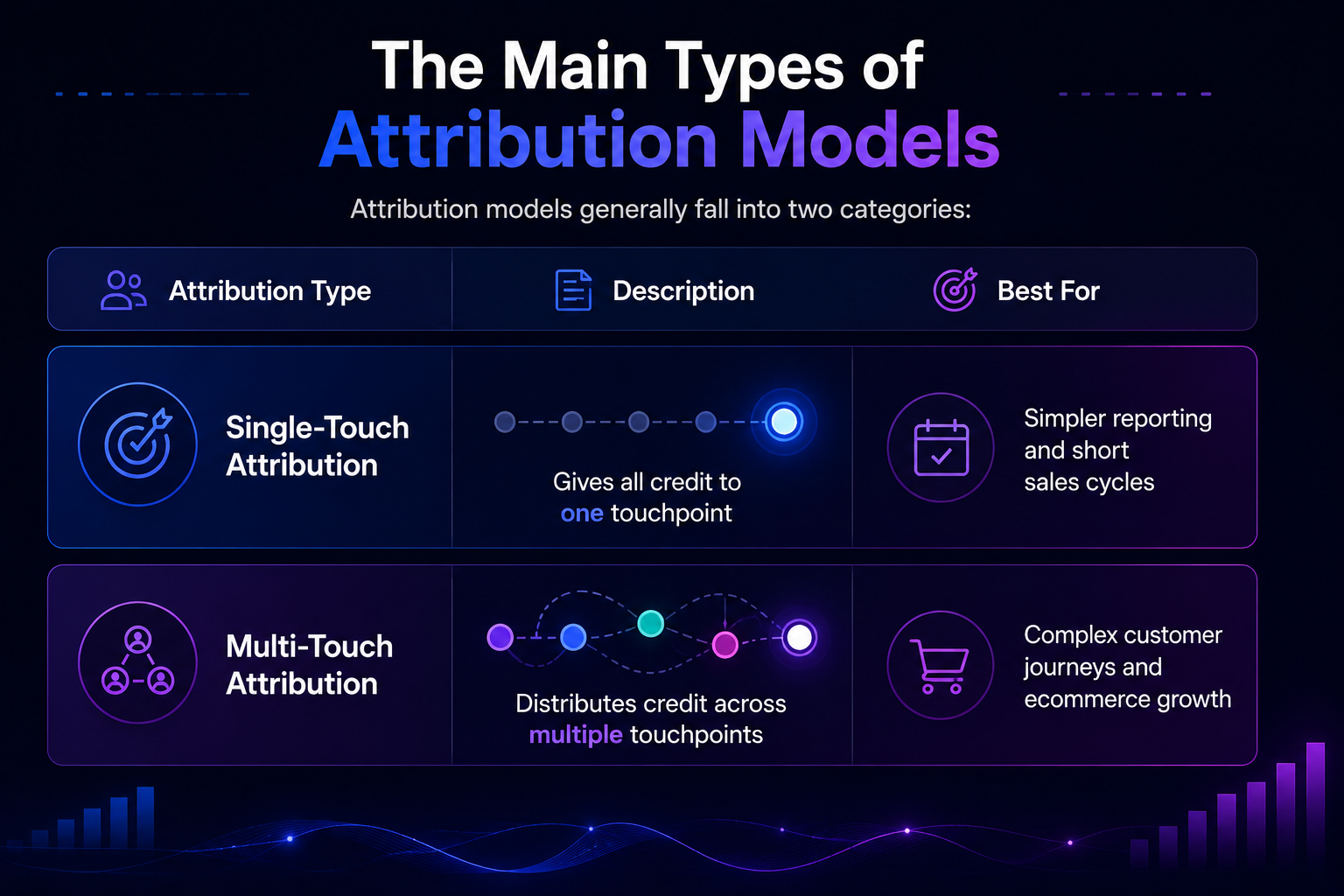
Attribution models generally fall into two categories:
Single-Touch Attribution Models
First-Touch Attribution
First-touch attribution gives 100% of the conversion credit to the very first interaction a customer had with your brand.
Example…
A customer:
- Discovers your brand through TikTok
- Later clicks a Google ad
- Then purchases through email
With first-touch attribution, TikTok receives all the credit.
Benefits
- Measures top-of-funnel acquisition performance
- Helps identify awareness-driving channels
- Simple to understand and implement
Limitations
- Ignores nurturing touchpoints
- Overlooks retargeting influence
- Can oversimplify complex journeys
Best For
- Brand awareness campaigns
- Customer acquisition analysis
- Businesses focused on new audience growth
Last-Touch Attribution
Last-touch attribution assigns all conversion credit to the final interaction before purchase.
Using the same example above, email would receive all the credit.
Benefits
- Highlights conversion-driving channels
- Easy to analyze
- Useful for short buying cycles
Limitations
- Ignores earlier customer interactions
- Can overvalue branded search or direct traffic
- Often misses discovery-stage influence
Best For
- Direct response campaigns
- Short ecommerce sales cycles
- Conversion-focused reporting
Multi-Touch Attribution Models
Linear Attribution
Linear attribution distributes credit equally across every touchpoint in the customer journey.
Example
If a customer interacted with:
- TikTok
- Meta
Each channel receives 25% attribution credit.
Benefits
- Acknowledges the full customer journey
- Easier to implement than advanced models
- Reduces overreliance on last-click reporting
Limitations
- Assumes every touchpoint has equal influence
- May dilute high-impact interactions
Best For
- Multi-channel e-commerce brands
- Brands with longer buying journeys
- Holistic campaign analysis
Time Decay Attribution
Time decay attribution gives more credit to touchpoints closer to the conversion event.
Benefits
- Emphasizes high-intent interactions
- Better reflects purchase momentum
Limitations
- May undervalue awareness campaigns
- Requires more sophisticated tracking
Best For
- Longer sales cycles
- Retargeting-heavy strategies
- Lead nurturing funnels
Position-Based Attribution
Position-based models assign heavier weight to key touchpoints in the journey.
These include:
- U-Shaped Attribution
- W-Shaped Attribution
- Z-Shaped Attribution
Benefits
- Balances acquisition and conversion influence
- Provides more strategic visibility
Limitations
- More complex setup
- Requires strong journey mapping
Best For
- Advanced marketing teams
- Enterprise attribution strategies
- Multi-stage funnels
AdBeacon Attribution Models Explained
AdBeacon provides multiple attribution models designed specifically for ecommerce brands, agencies, and media buyers that need more accurate first-party attribution and campaign visibility.
Unlike platform-only reporting, AdBeacon helps marketers analyze performance across channels using first-party tracking, server-side attribution, and unified reporting.
Below is a comparison of AdBeacon’s attribution models and how they work.
AdBeacon Attribution Model Comparison

What Makes First-Party Attribution Different?
First-party attribution uses customer interaction data collected directly by your business rather than relying entirely on ad platform reporting.
This matters because platforms like Meta and Google often operate within their own attribution ecosystems, which can create overlapping or incomplete reporting.
AdBeacon’s first-party attribution approach helps ecommerce brands:
- Reduce attribution blind spots
- Improve tracking accuracy
- Unify reporting across channels
- Measure customer journeys more effectively
- Optimize campaigns using centralized insights
This becomes especially important for brands running campaigns across Meta, Google, TikTok, Amazon, Shopify, Klaviyo, and other ecommerce marketing platforms.
How to Choose the Right Attribution Model
There is no universal “best” attribution model.
The right model depends on your:
- Business goals
- Sales cycle
- Marketing channels
- Customer journey complexity
- Data quality
- Reporting needs
- Budget allocation strategy
Here’s a simple framework.
Choose First-Touch Attribution If:
- You prioritize customer acquisition
- You run heavy awareness campaigns
- You want to identify discovery channels
Choose Last-Touch Attribution If:
- Your sales cycle is short
- You prioritize conversion efficiency
- You focus heavily on direct response
Choose Linear Attribution If:
- Your customers interact across multiple channels
- You need balanced reporting
- You want visibility across the entire funnel
Choose Paid Linear Attribution If:
- You primarily optimize paid media
- You want cleaner paid-channel attribution
- You need campaign-level optimization insights
Choose Full Impact Attribution If:
- You want full customer journey visibility
- You need cross-channel attribution insights
- You rely on first-party data
- You want broader marketing performance analysis
- You need more accurate revenue attribution
- You optimize across multiple marketing channels
Choose Lighthouse Attribution If:
- You need faster paid media optimization decisions
- You want cleaner platform-level attribution signals
- You optimize campaigns daily across paid channels
- You need more accurate scaling insights
- You want stronger first-party optimization data
- You focus heavily on ROAS and media buying efficiency
Common Attribution Modeling Mistakes
Relying Only on Platform Reporting
Meta, Google, and TikTok each report conversions differently. Relying on siloed dashboards can create duplicated or misleading data.
Ignoring Assisted Conversions
Many conversions happen because of multiple interactions, not a single click.
Overvaluing Direct Traffic
Direct traffic often receives excessive attribution credit because users revisit a site before purchasing.
Failing to Adapt to Privacy Changes
Modern attribution requires server-side tracking and first-party data strategies to maintain accuracy.
Using Only One Attribution Perspective
Many advanced marketers compare multiple attribution models simultaneously to gain a fuller understanding of campaign performance.
The Future of Attribution Modeling
Attribution modeling is evolving rapidly due to:
- AI-powered analytics
- Predictive modeling
- First-party data infrastructure
- Privacy-first measurement
- Cross-channel customer journey analysis
- Server-side tracking technologies
Modern attribution platforms increasingly combine:
- Machine learning
- Incrementality analysis
- Probabilistic modeling
- Deterministic tracking
- Unified e-commerce analytics
The goal is no longer simply tracking clicks. The goal is understanding true revenue impact and marketing efficiency.
Why Ecommerce Brands Use AdBeacon for Attribution
AdBeacon is a first-party attribution and optimization platform built for ecommerce brands, agencies, and media buyers that need clearer visibility into campaign performance and customer journeys.
AdBeacon helps marketers:
- Track attribution more accurately
- Analyze campaign performance across channels
- Reduce wasted ad spend
- Optimize media buying decisions
- Improve customer acquisition efficiency
- Understand true revenue impact
With advanced attribution models, unified analytics, and actionable insights, AdBeacon gives brands the clarity needed to scale profitably in an increasingly fragmented advertising ecosystem.
Final Thoughts
Attribution modeling is no longer optional for e-commerce growth.
As customer journeys become more fragmented and privacy restrictions reduce platform visibility, brands need more accurate ways to measure performance and optimize marketing spend.
The right attribution model helps marketers understand what is actually driving revenue, customer acquisition, and long-term profitability.
For e-commerce brands and agencies looking for clearer attribution visibility, first-party tracking, and actionable campaign insights, AdBeacon provides a modern attribution solution designed for today’s advertising landscape.
Ready to Improve Attribution Accuracy? Create your free account today to experience AdBeacon for yourself!
FAQs About Attribution Modeling
What is the best attribution model for e-commerce?
The best attribution model depends on your customer journey and business goals. Ecommerce brands with multi-channel marketing strategies often benefit from multi-touch models like Linear, Paid Linear, Full Impact, or Lighthouse attribution.
Why is last-click attribution no longer enough?
Last-click attribution ignores earlier touchpoints that influence purchasing decisions. Modern customer journeys involve multiple channels and interactions before conversion.
What is first-party attribution?
First-party attribution uses data collected directly from your customers and website interactions rather than relying only on ad platform reporting.
What is the difference between linear and paid linear attribution?
Linear attribution distributes credit across all touchpoints equally, while paid linear attribution focuses only on paid media interactions.
Why does direct traffic distort attribution reporting?
Direct traffic often receives inflated credit because users revisit websites directly before purchasing, even if earlier channels drove the original interest.
How does AdBeacon improve attribution accuracy?
AdBeacon combines first-party tracking, unified reporting, and advanced attribution models to provide a clearer view of customer journeys and campaign performance.