First-Party vs. Second-Party vs. Third-Party Data: A Practical Guide for Ecommerce Brands
Google spent six years and untold engineering hours building a replacement for third-party cookies. In October 2025, it shut the project down. Privacy Sandbox is retired, third-party cookies are still technically alive in Chrome, and there is still no universal system to replace them.
If you were waiting for a clean industry-wide answer before getting serious about your own data, that answer isn’t coming.
Meanwhile, third-party cookies are already unreliable for a large share of your traffic regardless of what Chrome decides. Safari and Firefox have blocked them for years, and roughly 40 percent of web traffic never sees a third-party cookie fire in the first place.
Add three new state privacy laws that took effect January 1, 2026 in Indiana, Kentucky, and Rhode Island, bringing the total to 20 states with comprehensive privacy statutes on the books, and the practical case for understanding exactly what data you’re using, and where it came from, has never been stronger.
Most marketers can define first-party data in a sentence. Fewer can explain, clearly, where second-party data fits, when third-party data is still worth using, and why the difference actually changes what you can do with each one. Here’s the practical version.
First-Party, Second-Party, and Third-Party Data, Defined
First-party data…
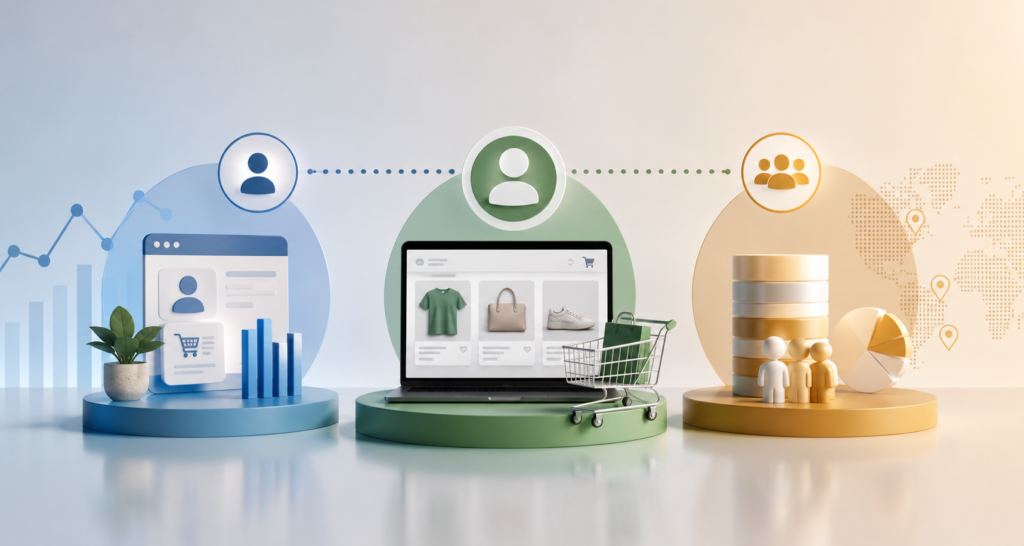
is anything you collect directly from your own customers through your own channels: your website, your app, your checkout, your email list, your loyalty program. Nobody hands it to you.
You own the relationship, you control how it’s collected, and you’re the only business that has it.
Second-party data…
is someone else’s first-party data, shared with you directly through a partnership. Think of a fitness brand exchanging customer insight with a supplement company that serves the same audience, or a hotel chain trading loyalty data with an airline partner. It’s still collected first-hand, just by a different company, and it usually comes with a formal agreement attached.
Third-party data…
is data aggregated by a company that has no direct relationship with the people it describes. Data brokers compile it from many sources, package it into audience segments, and sell access to anyone willing to pay. It offers scale nobody else can match, but nobody defines “a view” or “an interested shopper” the same way twice.
A fourth term, zero-party data…
comes up often enough to name here. It’s information a customer volunteers on purpose, like quiz answers or stated preferences in a loyalty signup. It’s technically a subset of first-party data, and it carries the highest degree of consent of any type.
Why the Difference Isn’t Just Academic Anymore
For most of the last decade, this distinction lived mostly in slide decks. It mattered for compliance training, less so for day-to-day media buying.
Two things changed that.
First, the infrastructure that made third-party data cheap and easy to activate is gone. Google’s decision to retire Privacy Sandbox wasn’t a delay, it was an admission that no browser-level replacement for third-party tracking is coming.
Combined with Safari and Firefox’s existing blocks, brands that built their targeting and measurement around third-party signals are now missing a meaningful and growing share of the picture.
Second, the compliance stakes went up. Twenty states now enforce comprehensive privacy laws, and the newest three (Indiana, Kentucky, Rhode Island) carry penalties up to $7,500 per violation, with Rhode Island offering no cure period at all.
Third-party data sourcing is often opaque enough that you can’t always verify how consent was originally obtained, which is precisely the kind of gap regulators are now positioned to act on.
If you haven’t audited your own CCPA and GDPR compliance posture recently, this is a good prompt to do it.
There’s a third reason this matters specifically in ecommerce attribution: platforms don’t all define a “click” or a “view” the same way, and that inconsistency compounds when the underlying data itself came from three different collection methods with three different accuracy profiles.
AdBeacon sees this constantly in raw account data.
It’s common for Meta to report a ROAS in the 3x range on an account where AdBeacon’s click-based, first-party-verified measurement lands closer to 1x, because Meta is crediting view-through activity nobody can actually verify happened.
The gap isn’t a rounding error. It’s the difference between a first-party signal and a platform’s self-reported estimate.
What to Actually Do About It
Understanding the three categories is step one. Here’s how to act on it.
Make first-party data the foundation, not the supplement. Every serious ecommerce data strategy now starts with what you collect directly: purchase history, email and SMS engagement, on-site behavior, loyalty activity.
This is the layer that’s most accurate, most durable against platform and browser changes, and the only layer competitors can’t buy access to.
Use second-party partnerships selectively, and manage the data like it’s your own. Once you receive second-party data, store it securely, validate it, and integrate it the same way you would first-party data. It’s higher quality than anything you’d buy from a broker, but it still needs the same governance.
Agencies managing multiple client accounts have an added angle here, since first-party data can double as a client growth lever, not just a compliance requirement.
Treat third-party data as a reach tool, not a targeting foundation. It’s genuinely useful for prospecting into cold audiences and enriching existing customer profiles with demographic context.
It’s a poor foundation for measuring what’s actually working, because you can’t verify how it was collected or how current it is.
Take a hard look at the free walled-garden tools now available. Amazon Marketing Cloud went free for all Sponsored Ads advertisers in September 2025, giving ecommerce brands a no-cost way to match first-party CRM data against Amazon’s own purchase signals without exposing raw records.
If you’re spending meaningfully on Amazon, this is worth activating before evaluating a paid clean room.
Get your measurement layer off platform-reported numbers. If your attribution still leans on what Meta or Google says happened, you’re layering a first-party decision on top of a third-party-grade estimate.
Click-based, first-party-verified attribution won’t be perfect, but it gets you far closer to what actually drove revenue than a platform grading its own homework. The same gap shows up in Meta’s own attribution changes, where click data and engage-through conversions tell very different stories about what actually drove a sale.
If you want to see what independent, first-party attribution actually looks like on your own account, book a live AdBeacon demo and compare it against what your ad platforms are currently telling you.
FAQ
What’s the main difference between first-party and third-party data?
First-party data comes directly from your own customers through channels you control. Third-party data is aggregated by a company with no direct relationship to those customers and sold to anyone who buys it.
Is second-party data the same as first-party data?
No. Second-party data is another company’s first-party data, shared with you through a direct partnership. It’s higher quality than third-party data but still one step removed from your own customer relationship.
Is third-party data still useful in 2026?
Yes, mainly for prospecting into new audiences and enriching existing customer profiles with demographic or firmographic context. It’s not a reliable foundation for attribution or measurement, since accuracy and consent provenance vary widely by source.
What is zero-party data?
Zero-party data is information a customer proactively shares with you on purpose, like quiz answers or stated preferences. It’s a subset of first-party data and carries the clearest consent of any data type.
Do I still need third-party cookies if I have good first-party data?
No. A solid first-party data foundation, paired with server-side tracking, holds up regardless of what any single browser decides about cookies.
Sources
Segwise: Google Privacy Sandbox Update 2026, Why Google Shut It Down
SignalBridge: The Death of Third-Party Cookies, What E-Commerce Needs to Know
MultiState: 20 State Privacy Laws in Effect in 2026
Usercentrics: Google Privacy Sandbox Officially Shuts Down
Koley Jessen: New State Privacy Laws Effective January 1, 2026
Osmos: First-Party Shopper Data in Retail Media, 2026 Playbook