Meta Advantage+ Catalog Ads and Shops Updates: What E-commerce Brands Need to Track Before Scaling

Meta Advantage+ Catalog Ads and Shops updates are making ecommerce advertising more automated, more product-driven, and more connected across Facebook, Instagram, Reels, Stories, Shops, and website retargeting.
For e-commerce brands, this creates a major opportunity to scale product ads faster, but it also creates a measurement challenge: automated product delivery is only valuable if brands can tell which products, audiences, creatives, and campaigns are actually driving profitable revenue.
Meta’s Advantage+ Catalog Ads use a product catalog to automatically deliver product images, descriptions, and prices in ads, while Meta Pixel or app events help measure actions such as purchases and other customer behaviors.
Meta’s business help documentation also notes that advertisers can create catalog custom audiences and use recommendations when eligible during setup.
For e-commerce teams, the key takeaway is simple: as Meta automates more of the catalog ad experience, brands need stronger first-party attribution to validate what the platform is optimizing toward.
AdBeacon helps e-commerce brands, agencies, and media buyers connect Meta campaign activity to real store-side revenue, customer behavior, product performance, and actionable optimization insights.
What Are Meta Advantage+ Catalog Ads?
Meta Advantage+ Catalog Ads are product-based ads that use a connected catalog to dynamically show relevant products to shoppers across Meta placements.
Instead of building every product ad manually, e-commerce brands can use their catalog to populate ads with product images, names, descriptions, prices, and other product data.
Meta’s developer documentation explains that Advantage+ Catalog Ads allow advertisers to create a feed from a catalog and automatically deliver product images, descriptions, and prices in ads. Meta also recommends setting up Meta Pixel or app events to measure customer actions such as purchases.
This matters because catalog ads are built for ecommerce scale. A brand with hundreds or thousands of SKUs cannot manually build every product ad, update every price, replace every out-of-stock item, and personalize every product recommendation by hand.
Catalog automation makes that process faster and more dynamic.
Why Meta Catalog Ads Matter for Ecommerce Brands
Catalog ads matter because ecommerce performance is often product-specific. A campaign may look healthy overall, but only a small group of products may be responsible for profitable revenue. Another group of products may drive clicks but low conversion rates, high return rates, low margins, or weak repeat purchase behavior.
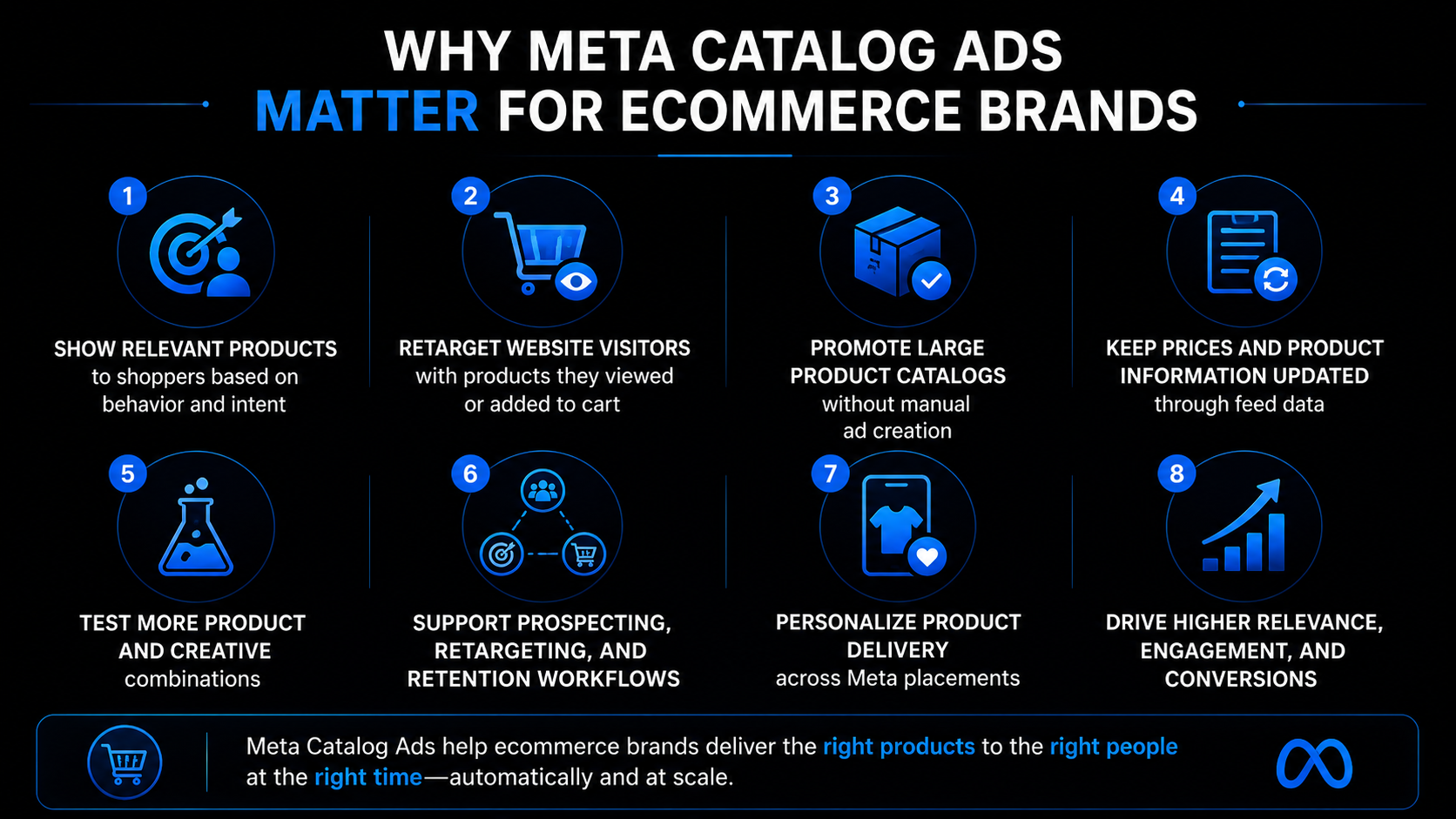
Catalog ads can help ecommerce brands:
- Show relevant products to shoppers based on behavior and intent
- Retarget website visitors with products they viewed or added to cart
- Promote large product catalogs without manual ad creation
- Keep prices and product information updated through feed data
- Test more product and creative combinations
- Support prospecting, retargeting, and retention workflows
- Personalize product delivery across Meta placements
But catalog automation also raises a critical question:
Is Meta scaling the products that are best for the business, or just the products that produce the easiest platform-reported conversions?
That is where first-party data becomes essential.
What Changed With Meta Advantage+ Catalog and Shops Updates?
Recent Meta Ads discussion on LinkedIn has focused on two ecommerce-specific updates: automatic image cropping for catalog ads through Advantage+ creative Image Touch-ups, and the ability for Website Custom Audiences to include Facebook and Instagram Shop visitors. A LinkedIn post from Jump Smartly described Catalog Ads support for automatic image cropping in Feed, Reels, and Stories, plus expanded Website Custom Audiences that may include Facebook and Instagram Shop visitors.
These updates are important because they point to Meta’s larger direction: more automation, more commerce data, and more connected audience building across ads, Shops, and ecommerce interactions.
For ecommerce brands, that means Meta is not just helping brands run ads. It is increasingly helping brands connect product catalogs, creative formats, audience signals, and commerce activity across the Meta ecosystem.
Why Automatic Image Touch-Ups Matter
Catalog ads need strong product visuals. A product image that works on a website grid may not work well in Feed, Reels, or Stories. Different placements have different aspect ratios, formats, and creative expectations.
The reported Image Touch-ups update allows catalog ads to automatically crop product images for formats such as Feed and Reels or Stories. This matters because ecommerce brands often struggle to adapt catalog assets across placements without creating manual creative production bottlenecks.
Automatic creative adjustments can help brands:
- Improve placement fit
- Reduce manual resizing work
- Expand catalog ad delivery across more surfaces
- Keep product ads visually consistent
- Move faster with large catalogs
- Support more dynamic creative testing
But automation should not replace creative analysis. Cropping an image to fit a placement does not mean the ad is driving profitable growth.
Brands still need to know:
- Which product images drive purchases?
- Which placements produce high-quality customers?
- Which products perform better in Feed versus Reels or Stories?
- Which catalog ads attract new customers rather than existing buyers?
- Which products generate repeat purchase value?
- Which automated creative treatments are helping or hurting conversion?
Meta can help format and deliver catalog ads. Ecommerce teams still need first-party performance data to understand the business impact.
Why Shops Visitor Audiences Matter
The reported expansion of Website Custom Audiences to include Facebook and Instagram Shop visitors is especially important for ecommerce retargeting. If brands can include Shop visitors in Website Custom Audiences, they may be able to build more complete retargeting pools based on both website activity and Shop engagement.
This reflects an important shift. Ecommerce discovery does not happen only on a brand’s website anymore. Shoppers may interact with a product on Instagram Shop, Facebook Shop, a catalog ad, a Reel, a product tag, a creator post, or a website product page.
That means audience strategy needs to account for more commerce touchpoints.
A shopper who visits an Instagram Shop may be showing product intent even if they never visits the ecommerce website. A shopper who browses a Facebook Shop may be valuable for retargeting even if they have not added anything to cart.
For ecommerce teams, this creates a broader retargeting opportunity. It also creates a measurement challenge.
Brands need to understand whether Shop visitor audiences produce:
- New customers
- Returning customers
- Higher conversion rates
- Higher average order values
- Stronger repeat purchase behavior
- Better product-level revenue
- Lower acquisition costs
- Higher profitability
Without first-party attribution, brands may know that a Shop visitor audience performed inside Meta, but not whether it produced valuable customers for the business.
The Bigger Trend: Meta Is Making Ecommerce Ads More Automated
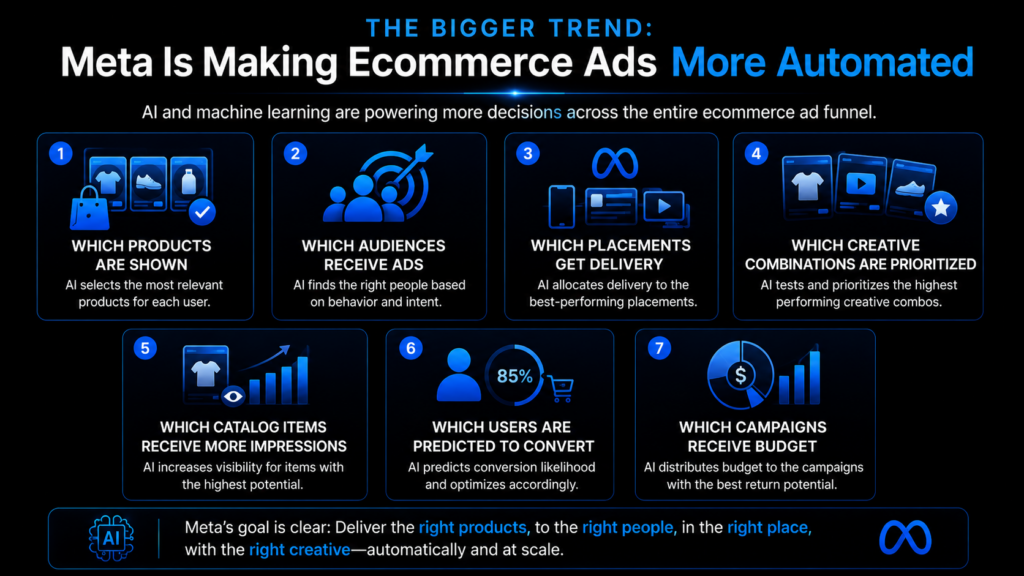
Meta’s Advantage+ ecosystem is built around automation. Meta describes Advantage+ as a suite of AI and automation tools designed to enhance and optimize campaign performance.
For e-commerce brands, this means more campaign decisions are being influenced by Meta’s AI systems, including:
- Which products are shown
- Which audiences receive ads
- Which placements get delivery
- Which creative combinations are prioritized
- Which catalog items receive more impressions
- Which users are predicted to convert
- Which campaigns receive budget
Automation can improve efficiency, but it also shifts the media buyer’s role. Instead of manually controlling every campaign detail, media buyers need to focus more on inputs, signal quality, creative strategy, catalog quality, and first-party validation.
The better the data, the better the automation can become.
The Measurement Problem With Automated Catalog Ads
Automated catalog ads can create a false sense of clarity. Meta may report strong ROAS, purchases, or conversion volume. But ecommerce brands still need to know whether those results reflect profitable growth.
Catalog ads can overstate success if they are mainly:
- Retargeting shoppers who were already likely to buy
- Promoting low-margin products
- Converting existing customers instead of acquiring new ones
- Driving sales through discounts that reduce profit
- Favoring products with high click appeal but low repeat purchase value
- Taking credit for purchases influenced by other channels
- Delivering spend toward easy conversions rather than strategic growth
This does not mean Meta catalog ads are ineffective. It means brands need stronger performance context.
A product ad that drives a low-cost purchase may look good in Meta. But if that product has a low margin, high return rate, or weak customer lifetime value, scaling it may not be the best business decision.
What Ecommerce Brands Should Track for Meta Catalog Ads
To evaluate Meta Advantage+ Catalog Ads accurately, ecommerce teams should track product, customer, creative, and revenue signals together.
Product-level revenue
Brands should know which products are driving actual revenue from catalog ads. Product-level reporting helps identify winners, weak performers, and items that deserve more or less paid support.
Product margin
Revenue does not equal profit. Catalog ads should be evaluated against product margin, discounts, shipping costs, returns, and contribution margin.
New versus returning customers
A catalog ad campaign may perform well because it retargets existing customers. That can be valuable, but it should be measured differently from new customer acquisition.
Average order value
Some products may drive single-item low-value orders, while others may support bundles, upsells, or higher cart value.
Repeat purchase behavior
A catalog ad that introduces customers to a product with strong repeat purchase behavior can be more valuable than one that drives a one-time purchase.
Creative format performance
With automatic image touch-ups and multi-placement delivery, brands should evaluate how product visuals perform across Feed, Reels, Stories, and other Meta placements.
Shop visitor performance
If Shop visitors are included in retargeting audiences, brands should compare those customers against website visitors, add-to-cart audiences, purchasers, and broader retargeting groups.
Cross-channel overlap
Catalog ads may influence shoppers who also interact with Google, TikTok, Amazon, email, direct traffic, or organic social. Brands should evaluate Meta catalog performance in the context of the full customer journey.
How AdBeacon Helps With Meta Advantage+ Catalog Ads
AdBeacon helps ecommerce brands, agencies, and media buyers move beyond platform-only reporting by connecting Meta performance to first-party ecommerce data.
For Meta catalog campaigns, AdBeacon helps answer questions like:
- Which products are actually driving revenue?
- Which catalog ads are acquiring new customers?
- Which products are profitable after margin, discounts, and returns?
- Which creative formats are connected to purchases?
- Which campaigns are converting existing customers versus expanding reach?
- Which Meta-reported wins are supported by store-side data?
- Which audiences deserve more budget?
- Which products should be excluded, bundled, or promoted differently?
AdBeacon’s value is not just in reporting what happened. It helps teams turn performance data into optimization decisions.
With first-party attribution, real-time analytics, actionable insights, and ecommerce performance tracking, AdBeacon gives media buyers a clearer view of how Meta catalog ads affect actual revenue, customer behavior, product performance, and profitable growth.
Why First-Party Data Is Essential for Meta Shops and Catalog Advertising
First-party data is data collected directly from your own ecommerce store, customer activity, checkout behavior, and purchase history. For catalog advertising, first-party data is especially important because product delivery and audience targeting are increasingly automated.
Meta can help decide which product to show, who to show it to, and where to place the ad. But ecommerce brands need to understand what happens after that exposure.
First-party data helps brands measure:
- Store-side purchases
- Product revenue
- Customer acquisition
- Repeat purchase behavior
- Average order value
- Product-level profitability
- Customer lifetime value
- Returns and refunds
- Channel overlap
- Campaign incrementality
As Meta Shops, catalog ads, Reels, Stories, and website activity become more connected, brands need a measurement layer that connects those interactions to real business outcomes.
Meta Catalog Ads vs Traditional Product Ads
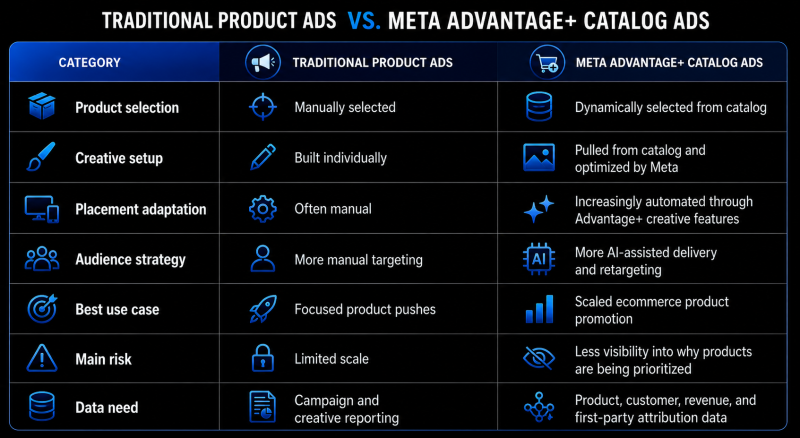
The goal is not to choose one forever. The goal is to use each format intentionally.
AI creative can help brands discover winning angles quickly. Real creators can add trust, specificity, product experience, and audience credibility.
What E-commerce Brands Should Use AI Creative For
AI creative generation is most useful when brands need speed, variation, and structured testing.
Hook testing
AI can generate multiple versions of the first three seconds of an ad. This helps brands test problem-led hooks, benefit-led hooks, social proof hooks, founder hooks, comparison hooks, and curiosity hooks.
Script testing
Brands can test different ways to explain the same product. For example, one script might focus on convenience, another on savings, another on quality, and another on a common customer frustration.
Offer testing
AI creative can help package offers in different ways, such as bundles, limited-time offers, free shipping, first-order discounts, subscriptions, or product education.
Product angle testing
A single product may appeal to different audiences for different reasons. AI can help generate creative angles for use cases, pain points, customer segments, seasons, gifting, and problem-solution messaging.
Creative refreshes
Paid social creative can fatigue quickly. AI-generated variations can help brands refresh campaigns faster while maintaining a consistent testing structure.
Localization
Some AI tools can support different languages, voiceovers, and regional messaging. This can help brands test international creative faster when the brand has the right review process in place.
What E-commerce Brands Should Not Use AI Creative For
AI creative is powerful, but brands should not use it without guardrails.
Unsupported product claims
AI can generate claims that sound persuasive but are not accurate. Ecommerce teams should review every claim for accuracy, compliance, and brand fit.
Fake testimonials
Brands should avoid presenting AI-generated testimonials as real customer experiences. If content is synthetic, teams should be careful about transparency and platform policy compliance.
Sensitive product categories
Health, financial, legal, children’s products, supplements, and regulated categories require extra caution. AI-generated claims can create compliance risk if not reviewed carefully.
Brand-defining hero content
AI can help ideate, but major brand storytelling, founder content, launch videos, and high-trust content often benefit from real people, real customers, and real product experience.
Replacing all customer insight
AI can remix patterns, but it should not replace customer research, reviews, support tickets, surveys, and real buyer conversations.
Why First-Party Attribution Matters for AI Creative Testing
First-party attribution connects advertising activity to data the brand collects directly from its ecommerce store and customer journey. This can include purchases, add-to-cart events, checkout behavior, revenue, products purchased, customer records, repeat purchases, and customer lifetime value.
For AI creative testing, first-party attribution matters because platform metrics can be misleading.
A creative may get high engagement but low revenue. Another creative may have a lower click-through rate but attract better customers. A third creative may drive purchases that later turn into refunds. A fourth creative may perform modestly on first purchase but produce high repeat purchase behavior.
AdBeacon helps ecommerce brands evaluate creative performance against first-party data so teams can understand which AI-generated assets, UGC-style ads, hooks, offers, and product angles are connected to real revenue.
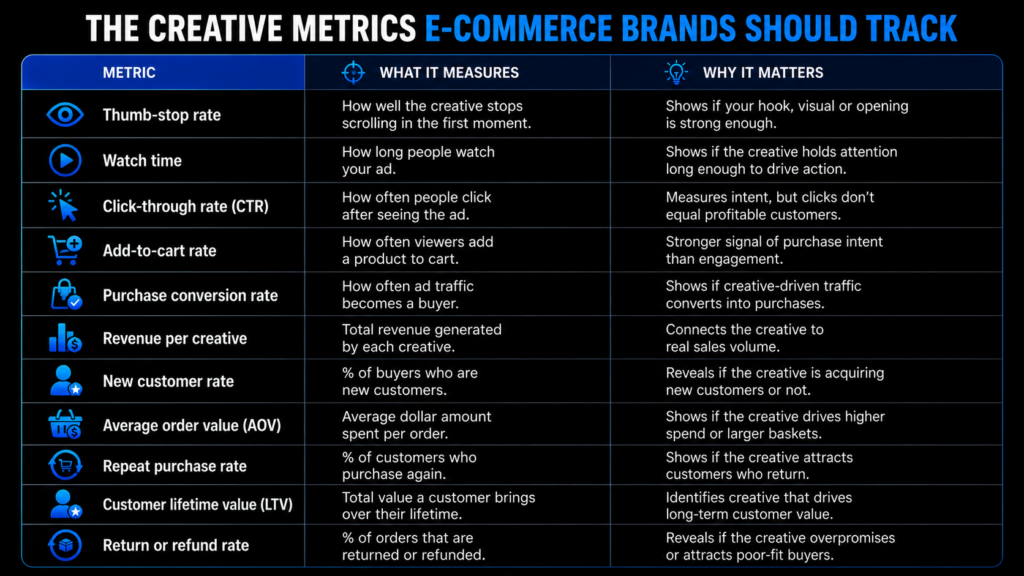
The Creative Metrics Ecommerce Brands Should Track
AI creative generation creates more assets, which means brands need a clear measurement framework.
Thumb-stop rate
Thumb-stop rate helps show whether the first moment of the creative is strong enough to interrupt scrolling. It is useful for evaluating hooks, visuals, and opening lines.
Watch time
Watch time helps show whether the creative holds attention. A strong opening is useful, but the ad still needs to build enough interest to drive action.
Click-through rate
Click-through rate shows whether the creative is motivating people to take the next step. But it should not be interpreted alone because clicks do not always become profitable customers.
Add-to-cart rate
Add-to-cart rate shows whether the creative is attracting shoppers with purchase intent. This is a stronger signal than engagement alone.
Purchase conversion rate
Purchase conversion rate shows whether creative-driven traffic converts into buyers.
Revenue per creative
Revenue per creative connects the asset to actual sales volume.
New customer rate
New customer rate helps brands understand whether a creative is acquiring fresh customers or mainly converting existing buyers.
Average order value
AOV shows whether certain creative angles attract customers who buy more or bundle products.
Repeat purchase rate
Repeat purchase rate shows whether the creative is attracting customers who return after the first order.
Customer lifetime value
LTV helps brands identify which creative concepts produce long-term customer value, not just first-order sales.
Return or refund rate
Return and refund data can reveal whether a creative overpromises, attracts poor-fit buyers, or creates mismatched expectations.
Catalog ads are built for scale. First-party attribution helps ensure that scale is profitable.
Common Meta Catalog Ad Mistakes
Mistake 1: Scaling based only on platform ROAS
Meta ROAS is useful, but it should be validated against first-party revenue, margin, product performance, and customer quality.
Mistake 2: Letting the catalog feed go stale
Catalog ads depend on product data. Inaccurate prices, missing images, weak product names, unavailable inventory, or poor descriptions can limit performance.
Mistake 3: Ignoring product-level profitability
Some products may drive sales but weak margin. Others may drive fewer purchases but stronger lifetime value. Treat products differently based on business impact.
Mistake 4: Treating Shop visitors the same as website visitors
Shop visitors may show intent, but their behavior can differ from website visitors. Measure how each audience performs before scaling retargeting spend.
Mistake 5: Overlooking creative quality
Automation can crop or adapt images, but it cannot guarantee that the product image, angle, offer, or message is persuasive.
Mistake 6: Measuring catalog ads in isolation
Meta catalog ads often interact with Google, TikTok, Amazon, email, affiliates, and direct traffic. Brands need a broader attribution view to avoid overcrediting one channel.
How Agencies Can Use Catalog Attribution to Improve Client Reporting
For agencies, Meta catalog automation can create reporting tension. Clients may see strong Meta performance but still ask why total revenue, margin, or new customer growth is not improving at the same rate.
Agencies need to show more than platform screenshots.
A stronger catalog ad report should answer:
- Which products drove revenue?
- Which products drove profit?
- Which campaigns acquired new customers?
- Which campaigns mostly retargeted existing customers?
- Which Shop visitor audiences performed best?
- Which creative formats helped conversion?
- Which products should receive more budget?
- Which products should be excluded or deprioritized?
- How does Meta catalog performance compare to other channels?
AdBeacon helps agencies connect Meta catalog activity to first-party ecommerce outcomes, making client reporting clearer, more credible, and more actionable.
Best Practices for Meta Advantage+ Catalog Ads
1. Keep your product catalog clean
Make sure product titles, images, prices, variants, availability, descriptions, and product categories are accurate and updated.
2. Use first-party attribution to validate performance
Do not rely only on Meta-reported conversions. Compare catalog performance against actual ecommerce revenue, customer behavior, and product-level results.
3. Evaluate products by profit, not just sales
A product that sells frequently may still be a weak scaling candidate if margin is low or return rates are high.
4. Separate new and returning customers
Measure whether catalog ads are driving acquisition, retention, or both. Each outcome deserves a different optimization strategy.
5. Monitor Shop visitor audience quality
If Shop visitors are part of retargeting audiences, evaluate them separately from website visitors, add-to-cart audiences, and purchasers.
6. Test creative formats by placement
Feed, Reels, and Stories behave differently. Review how automated image touch-ups and placement-specific formats affect performance.
7. Connect catalog ads to inventory data
Do not scale ads for products with limited inventory, weak margins, or supply issues. Product-level marketing should be connected to operational reality.
8. Use catalog insights to guide merchandising
Catalog ad data can reveal which products are attracting demand. Use that insight to inform bundles, offers, landing pages, and inventory planning.
What This Means for the Future of Ecommerce Advertising
Meta’s catalog and Shops updates point toward a more connected commerce ecosystem. Product catalogs, Shops, website audiences, automated creative formatting, and AI-powered delivery are becoming more tightly linked.
For ecommerce brands, this means the future of Meta advertising will depend on three things:
- Better product data
- Better conversion signals
- Better first-party attribution
The brands that win will not simply upload a catalog and let automation run. They will use automation to scale delivery while using first-party data to guide strategy.
Final Takeaway
Meta Advantage+ Catalog Ads and Shops updates are making ecommerce advertising more dynamic and automated. Automatic image touch-ups can help product ads fit more placements, while expanded audience possibilities around Shop visitors may give brands more ways to retarget high-intent shoppers.
But automation does not remove the need for measurement. It increases it.
Ecommerce brands need to know which catalog ads are driving actual revenue, which products are profitable, which customers are new, which audiences are valuable, and which campaigns deserve more budget.
Ready to understand which Meta catalog campaigns, products, and audiences are actually driving profitable ecommerce growth?
Book a demo with AdBeacon to see how first-party attribution, real-time analytics, actionable insights, and performance tracking can help your team scale smarter.
FAQs About Meta Advantage+ Catalog Ads and Shops Updates
What are Meta Advantage+ Catalog Ads?
Meta Advantage+ Catalog Ads are dynamic product ads that use a connected catalog to automatically show product images, descriptions, prices, and other product information across Meta placements. They are designed to help ecommerce brands promote products at scale.
Why are Meta catalog ads important for ecommerce brands?
Meta catalog ads are important because they allow ecommerce brands to promote large product catalogs dynamically, retarget product viewers, and personalize product delivery across Facebook, Instagram, Reels, Stories, and other placements.
What are Meta Shops visitor audiences?
Meta Shops visitor audiences are audiences based on people who interact with a brand’s Facebook or Instagram Shop. Recent LinkedIn discussion noted that Website Custom Audiences may now include Facebook and Instagram Shop visitors, which could expand retargeting reach.
What are Advantage+ creative Image Touch-ups?
Advantage+ creative Image Touch-ups are automated creative adjustments that can help adapt catalog images to different placements. Recent LinkedIn discussion noted support for automatic image cropping for Feed, Reels, and Stories.
Should ecommerce brands trust Meta catalog ad ROAS?
Meta catalog ad ROAS is useful, but it should not be the only source of truth. Brands should compare Meta results against first-party revenue, product margin, new customer acquisition, repeat purchase behavior, and customer lifetime value.
What should ecommerce brands track for catalog ads?
Brands should track product-level revenue, product margin, average order value, new versus returning customers, repeat purchase behavior, creative format performance, Shop visitor audience quality, and cross-channel overlap.
Why does first-party attribution matter for Meta catalog ads?
First-party attribution matters because Meta’s automated systems optimize based on the signals they can see. Ecommerce brands need their own store-side data to understand actual revenue, customer value, product profitability, and campaign impact.
How does AdBeacon help with Meta Advantage+ Catalog Ads?
AdBeacon helps ecommerce brands and agencies connect Meta catalog ad performance to first-party ecommerce data, including purchases, revenue, product performance, customer behavior, creative insights, and actionable optimization opportunities.