TikTok Shop Strategy for E-commerce Brands: How Creator-Led Commerce Is Changing Online Sales
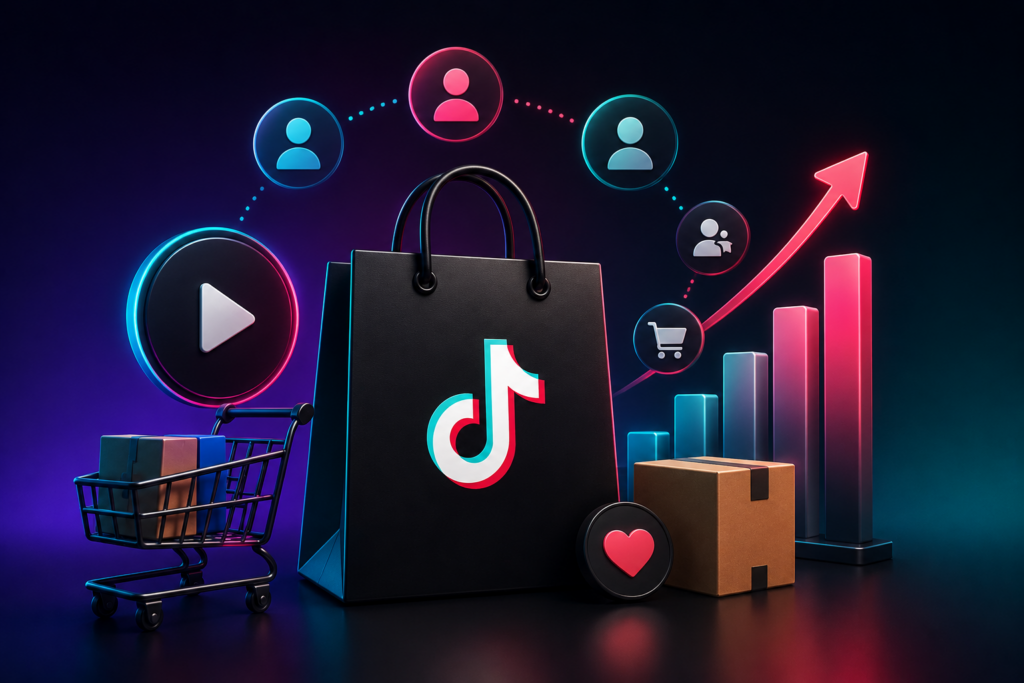
TikTok Shop is fundamentally changing how ecommerce brands acquire customers online.
For years, ecommerce growth largely depended on a familiar sequence:
- run ads
- drive traffic to a website
- optimize landing pages
- improve conversion rates
- retarget visitors
- repeat the process at scale
TikTok Shop disrupts that traditional ecommerce model by collapsing discovery, trust, entertainment, and purchasing into a single platform-native experience.
Instead of pushing consumers off-platform toward external storefronts, TikTok increasingly enables users to discover products, evaluate them through creator content, and complete purchases directly inside the app.
That shift is accelerating the rise of creator-led commerce, where creators become primary drivers of:
- product discovery
- consumer trust
- purchase intent
- conversion behavior
- social proof
For ecommerce brands, TikTok Shop is not simply another acquisition channel.
It represents a much larger shift in how modern consumers shop online.
Discovery is becoming entertainment-driven. Trust is increasingly creator-driven. Purchasing is becoming frictionless and platform-native. And content itself is rapidly replacing the traditional ecommerce storefront.
Brands that understand these shifts early will be significantly better positioned to scale customer acquisition in the next generation of ecommerce.
What Is TikTok Shop?
TikTok Shop is TikTok’s integrated ecommerce marketplace that allows users to discover and purchase products directly inside the platform through videos, livestreams, creator content, and in-app storefronts.
Instead of treating content and commerce as separate experiences, TikTok merges them together into a continuous discovery environment.
Users can:
- watch product demonstrations
- interact with creators
- browse products
- view reviews
- engage with livestreams
- purchase instantly without leaving the app
This creates a highly immersive commerce experience where entertainment and shopping operate simultaneously.
TikTok Shop combines several powerful ecommerce dynamics into one ecosystem:
- short-form content
- influencer marketing
- recommendation algorithms
- livestream commerce
- affiliate-style creator promotion
- platform-native purchasing
That combination is one reason TikTok Shop has expanded so quickly across ecommerce categories.

What Is Creator-Led Commerce?
Creator-led commerce is a model where creators become central drivers of product discovery and purchasing behavior through content-driven recommendation systems.
Historically, ecommerce brands relied heavily on:
- search engines
- display advertising
- static product pages
- centralized brand messaging
Today, consumers increasingly buy products because:
- a creator demonstrated them
- a recommendation felt trustworthy
- the content created emotional engagement
- social proof reduced buying friction
- the product appeared naturally inside relevant content
This shift changes the role creators play within ecommerce ecosystems.
Creators are no longer functioning only as awareness channels. They increasingly act as:
- product educators
- recommendation engines
- trust builders
- conversion drivers
- entertainment channels
- customer acquisition assets
That transition is reshaping how ecommerce brands think about marketing strategy entirely.
Why TikTok Shop Is Growing So Quickly
TikTok Shop aligns extremely well with modern consumer behavior.
Consumers increasingly prefer shopping experiences that feel:
- fast
- visual
- entertaining
- personalized
- frictionless
- socially validated
Traditional ecommerce often requires users to:
- search intentionally
- compare multiple websites
- evaluate product pages
- navigate checkout flows
- research reviews independently
TikTok compresses much of that process into a single content feed.
A user may discover a product unexpectedly while consuming entertainment content. Within seconds, they can:
- watch demonstrations
- see social proof
- hear creator opinions
- evaluate comments
- purchase immediately
That dramatically changes how purchase intent forms online. In many cases, TikTok creates demand before a consumer actively searches for a product.
This is one reason unknown brands can scale extraordinarily fast on the platform. Discovery is algorithmic instead of purely intent-driven.
How TikTok Shop Changes Ecommerce Customer Acquisition
TikTok Shop changes several core assumptions around how ecommerce growth works.
Discovery Happens Before Search Intent
Traditional ecommerce often depends on active search behavior.
Consumers typically search for products using phrases such as:
- “best protein powder”
- “standing desk for small office”
- “best running shoes for marathon training”
TikTok Shop works differently.
Users frequently discover products before they ever search for them intentionally.
A creator video may introduce:
- a problem
- a trend
- a use case
- a product category
- a lifestyle aspiration
- a social proof signal
This creates purchase consideration much earlier in the buying journey.
In many cases, TikTok functions more like a demand-generation engine than a traditional search engine.
That distinction matters because it changes how brands build visibility.

Content Becomes the Storefront
One of the biggest shifts inside TikTok commerce is that content itself increasingly functions as the product page.
A creator video may simultaneously act as:
- a demonstration
- a testimonial
- a review
- an ad
- an educational asset
- an entertainment experience
- a purchase trigger
This compresses the traditional ecommerce funnel dramatically.
Historically, brands separated:
- advertising
- product education
- reviews
- conversion experiences
TikTok blends them together into a single piece of content.
That is one reason highly engaging creator content often outperforms polished brand creative inside social commerce environments.
Creators Become Customer Acquisition Channels
TikTok Shop decentralizes ecommerce marketing.
Instead of brands controlling all product messaging centrally, creators increasingly distribute:
- product education
- brand storytelling
- social proof
- demonstrations
- emotional positioning
- buying motivation
This changes how ecommerce brands scale.
Many successful TikTok Shop brands now rely on networks of:
- affiliate creators
- micro influencers
- niche communities
- creator partnerships
- UGC contributors
rather than relying only on traditional advertising structures.
In many ways, creators are becoming modern ecommerce distribution infrastructure.
Why TikTok Shop Creates New Attribution Challenges
As creator-led commerce expands, attribution becomes significantly more complicated.
Customer journeys inside TikTok ecosystems are often fragmented and highly nonlinear.
A consumer may:
- Discover a product through creator content
- See retargeting ads later
- Visit the website independently
- Watch additional creator reviews
- Purchase days later through direct traffic
- Return later for repeat purchases
This creates visibility gaps across:
- creator content
- affiliate campaigns
- TikTok Ads
- organic discovery
- paid social retargeting
- email flows
- repeat customer journeys
Platform-reported attribution alone often struggles to capture this complexity accurately.
That makes it difficult for brands to answer critical questions such as:
- Which creators actually drive revenue?
- Which campaigns generate profitable customers?
- Which products scale sustainably?
- Which customer segments retain best?
- Which content drives repeat purchase behavior?
As TikTok commerce scales, independent attribution infrastructure becomes increasingly important.

Why First-Party Attribution Matters for TikTok Shop Brands
First-party attribution helps ecommerce brands understand how creator-driven customer journeys actually influence revenue outcomes.
This becomes increasingly valuable because TikTok discovery paths rarely follow simple linear funnels anymore.
First-party attribution helps brands:
- track customer journeys more accurately
- connect creator activity to actual revenue
- measure blended performance
- evaluate customer acquisition quality
- analyze retention behavior
- improve campaign optimization decisions
- reduce dependence on isolated platform reporting
This matters because virality alone does not always equal profitability.
A creator campaign may generate:
- massive engagement
- high traffic volume
- strong view counts
while still producing:
- weak retention
- poor margins
- low customer lifetime value
Conversely, smaller creator ecosystems may generate lower visibility but significantly stronger long-term customer economics.
Without stronger attribution visibility, brands may struggle to identify those differences accurately.
How AdBeacon Helps E-commerce Brands Measure TikTok Shop Performance
AdBeacon helps ecommerce brands improve attribution visibility across creator-led commerce, paid social campaigns, and modern ecommerce customer journeys.
Using first-party attribution infrastructure, AdBeacon helps brands better understand:
- which creators influence revenue
- which campaigns drive profitable acquisition
- how customers move across channels
- which audiences convert most effectively
- how paid and organic touchpoints interact
- which campaigns generate long-term customer value
AdBeacon supports:
- first-party attribution tracking
- cross-channel visibility
- customer journey analysis
- Shopify attribution insights
- media buying optimization
- revenue-focused reporting
- campaign performance analysis
As creator-led commerce becomes more complex, accurate attribution becomes increasingly valuable for scaling intelligently.
What Makes TikTok Shop Different from Traditional E-commerce
Traditional ecommerce platforms are typically:
- search-driven
- website-centric
- intent-based
- product-page focused
TikTok Shop operates differently.
Discovery becomes algorithmic instead of search-driven. Content replaces traditional storefront behavior. Creators distribute trust instead of brands controlling every message directly.
This changes ecommerce optimization priorities significantly.
Brands that perform well on TikTok Shop often prioritize:
- creative velocity
- platform-native storytelling
- creator ecosystems
- social proof
- short-form demonstrations
- emotional engagement
- frictionless purchasing behavior
rather than relying only on traditional ecommerce conversion optimization strategies.
The Most Effective TikTok Shop Strategies for E-commerce Brands
Prioritize Native Platform Content
Highly polished ads often underperform on TikTok because users expect content to feel native to the platform environment.
Strong TikTok Shop content usually feels:
- conversational
- creator-driven
- fast-paced
- personality-led
- visually engaging
- experience-based
The goal is not to make content look like an ad.
The goal is to make the product feel naturally relevant within the content experience.
Build Diversified Creator Ecosystems
Many ecommerce brands make the mistake of relying too heavily on one creator or one viral product moment.
The brands that scale more sustainably often work with:
- micro creators
- affiliate creators
- niche communities
- performance-focused partnerships
- creator testing systems
Diversified creator ecosystems reduce dependency risk while increasing:
- content volume
- testing opportunities
- audience reach
- platform adaptability
Focus on Creative Velocity
Creative fatigue happens extremely quickly on TikTok.
Winning brands continuously test:
- hooks
- messaging angles
- creator styles
- storytelling formats
- product positioning
- CTAs
- video structures
Creative iteration speed increasingly functions as a competitive advantage inside social commerce ecosystems.
Optimize Products for Demonstration Value
Products that perform well on TikTok Shop often demonstrate clearly in short-form video environments.
Strong TikTok products frequently:
- solve visible problems
- generate emotional reactions
- create curiosity quickly
- show transformation clearly
- communicate value visually
This is one reason categories like:
- beauty
- fitness
- wellness
- home organization
- gadgets
- food and beverage
often scale rapidly on TikTok.
Demonstrability matters significantly in creator-led commerce.
Why Creator-Led Commerce Is Expanding Beyond TikTok
TikTok accelerated creator-led commerce, but the broader trend extends far beyond one platform.
Similar commerce behaviors are expanding across:
- YouTube Shorts
- Amazon Live
- livestream commerce ecosystems
- AI-assisted recommendation environments
This reflects a larger shift toward:
- recommendation-driven discovery
- creator-led trust systems
- content-first purchasing behavior
- personality-driven commerce
The traditional ecommerce funnel is evolving rapidly.
Brands that adapt early to these new discovery models will likely gain significant long-term advantages.
Common Mistakes E-commerce Brands Make with TikTok Shop
Many ecommerce brands still approach TikTok using outdated paid social assumptions.
One common mistake is overproducing creative. Highly polished ads often feel disconnected from how users naturally consume content on TikTok.
Another mistake is prioritizing vanity metrics like views and engagement without analyzing actual customer quality or long-term profitability.
Brands also frequently underestimate how quickly creative fatigue happens on TikTok. What works today may decline rapidly within days or weeks.
Finally, many ecommerce companies still underinvest in attribution infrastructure even though TikTok-driven customer journeys are increasingly fragmented across creators, paid campaigns, and repeat touchpoints.
What E-commerce Brands Should Do Next
To build stronger TikTok Shop strategies, ecommerce brands should focus on:
- investing in creator ecosystems
- increasing creative testing velocity
- building platform-native content systems
- improving first-party attribution visibility
- measuring customer acquisition quality
- optimizing products for short-form demonstration
- connecting creator activity to revenue outcomes
- scaling based on profitability instead of vanity metrics
TikTok Shop is not simply another acquisition channel.
It represents a larger transformation happening across ecommerce where:
- content drives conversion
- creators drive trust
- algorithms drive discovery
- platforms compress purchase funnels
The ecommerce brands that understand these shifts early will likely outperform competitors as creator-led commerce continues expanding.
In Closing…
TikTok Shop is reshaping ecommerce faster than many brands expected.
As creators, content, entertainment, and purchasing become increasingly interconnected, ecommerce growth strategies are evolving beyond traditional paid media funnels and search-driven discovery.
AdBeacon helps ecommerce brands improve visibility into how creator-led campaigns influence customer acquisition, revenue performance, and long-term growth across modern social commerce ecosystems.
Want clearer visibility into how TikTok campaigns, creators, and paid social efforts actually drive ecommerce revenue?
Discover how AdBeacon helps brands improve first-party attribution, optimize media buying decisions, and measure customer journeys more accurately across creator-led commerce environments.
FAQs About TikTok Shop and Creator-Led Commerce
What is TikTok Shop?
TikTok Shop is TikTok’s integrated ecommerce marketplace that allows users to discover and purchase products directly inside the platform through creator content, videos, livestreams, and in-app storefronts.
What is creator-led commerce?
Creator-led commerce is a model where creators influence product discovery and purchasing behavior through content, demonstrations, reviews, recommendations, and social proof.
Why is TikTok Shop important for e-commerce brands?
TikTok Shop changes how consumers discover and purchase products by combining entertainment, trust, creator influence, and frictionless purchasing into a single platform-native experience.
Why does attribution become harder with TikTok Shop?
TikTok-driven customer journeys are often fragmented across creators, paid social campaigns, retargeting flows, organic discovery, and repeat purchases, making platform-only reporting less reliable.
Why does first-party attribution matter for TikTok Shop brands?
First-party attribution helps brands track customer journeys more accurately, measure creator-driven revenue impact, analyze acquisition quality, and improve cross-channel visibility.
How does AdBeacon help e-commerce brands with TikTok attribution?
AdBeacon helps ecommerce brands improve first-party attribution visibility, customer journey tracking, and revenue-focused reporting across creator-led commerce and paid social environments.
What products perform best on TikTok Shop?
Products that demonstrate clearly on video, solve visible problems, generate emotional engagement, or create strong curiosity often perform especially well on TikTok Shop.