
AI Media Buying Automation for E-commerce Brands: How Teams Are Scaling Paid Ads Without Losing Control
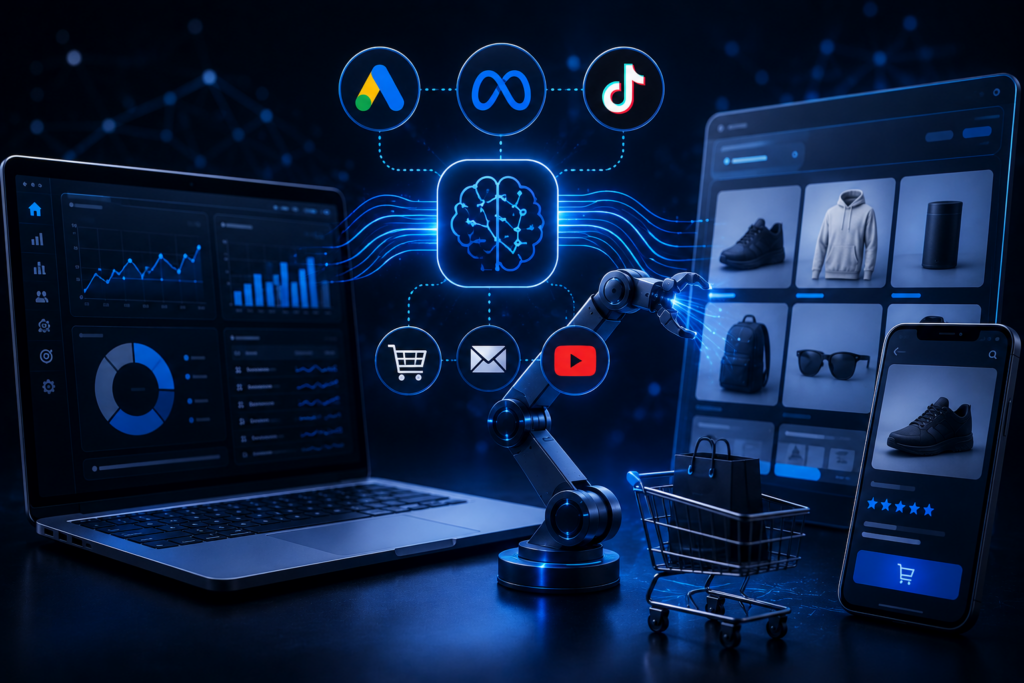
Let’s be honest: the way ecommerce advertising works has changed dramatically over the past few years, and most brands are still catching up to what that actually means for how they run campaigns.
For a long time, media buying was deeply manual. Skilled buyers spent their days building audiences, adjusting bids, rotating creatives, and tweaking optimization rules across Meta, Google, TikTok, Amazon, and whatever other platforms their brands were running. It was labor-intensive, but it gave teams a clear sense of control.
That’s not really the world we’re operating in anymore.
Today, the platforms themselves are doing a lot of that work automatically. Bids are optimized algorithmically. Audiences are identified and expanded by machine learning. Creative testing, pacing, placement decisions – all increasingly handled by the platform’s own AI systems. And on top of that, brands are layering in their own AI tools for creative generation, reporting, forecasting, and attribution modeling.
The result is a fundamentally different environment: faster, more complex, and significantly less transparent than what most media buyers grew up learning.
The Question Teams Are Actually Asking
The most common thing we hear from ecommerce operators right now isn’t “how do I use AI?” It’s “how do I automate without completely losing control of what’s happening?”
That’s the right question. Because automation without visibility isn’t a growth strategy. It’s a gamble.
The brands that are actually winning with AI-powered media buying aren’t just handing their campaigns over to algorithms and hoping for the best. They’re building structured systems where automation handles the operational complexity, human teams stay focused on strategic direction, and first-party attribution keeps everything measurable and accountable.
Why Platforms Are Pushing Hard Toward Automation
It helps to understand why this shift is happening so fast. Modern advertising environments have simply become too complex for purely manual optimization at any meaningful scale.
Think about what Meta, Google, and TikTok are processing: hundreds of millions of behavioral signals, purchase events, engagement patterns, and contextual data points, all in real time. No human team can analyze that volume manually and translate it into fast enough optimization decisions. AI systems can, and they do it continuously.
Features like Advantage+ Shopping Campaigns, Performance Max, broad targeting, and dynamic creative optimization all reflect the same underlying philosophy: let the algorithms make more decisions.
For ecommerce advertisers, this creates real efficiency gains. But it also creates a transparency problem that a lot of brands haven’t fully reckoned with yet.
The Complexity Problem Isn’t Getting Simpler
At the same time, the operational load on media buying teams has grown significantly.
It’s not unusual now to see brands running campaigns across Meta, TikTok, Google, YouTube, Amazon, retail media networks, and creator ecosystems, all simultaneously.
And the creative side has exploded.
Many brands are testing dozens of creatives every week, rotating hooks daily, producing UGC-style assets, and running AI-generated content in parallel with traditional production. Creative velocity has become a genuine competitive advantage.
Managing that level of complexity manually doesn’t scale.
AI automation helps teams move faster, surface patterns more efficiently, and reduce the operational bottlenecks that slow growth down. That’s why adoption is accelerating so quickly across the industry.
The Misconception That’s Hurting a Lot of Brands
Here’s where things get tricky: a lot of e-commerce teams assume that turning on automation will automatically improve performance. It won’t.
AI systems are only as good as the data and signals you’re feeding them. If your attribution is incomplete or your optimization goals are off, automation doesn’t solve the problem. It amplifies it.
A classic example: an AI system optimizing purely for low CPA or short-term ROAS might look like it’s crushing it on platform dashboards.
But if it’s systematically acquiring discount buyers with low lifetime value and high refund rates, you’re not building a profitable business. You’re scaling a problem.
Automation improves execution speed. It doesn’t automatically improve business judgment.
Why First-Party Data Matters More in an Automated World
As platforms take on more of the optimization work, your first-party customer data becomes one of your most important competitive assets.
Platforms optimize based on the signals they receive.
If those signals only reflect surface-level conversion events, you’ll get surface-level optimization: lots of conversions, maybe decent short-term ROAS, but not necessarily the customers you actually want to acquire.
Brands that are feeding richer signals back to platforms, data around customer quality, repeat purchase behavior, subscription retention, and lifetime value – are getting meaningfully better optimization outcomes. Instead of just acquiring converters, they’re acquiring the right customers.
That distinction matters enormously at scale.
Why Attribution Is the Thing Most Brands Underinvest In
One of the counterintuitive effects of AI automation is that it actually increases how much you need independent measurement infrastructure, not decreases it.
As campaigns become more algorithmically managed, you naturally lose granular visibility into what’s driving results.
Platform dashboards give you summarized outputs, automated recommendations, and black-box optimization behavior. What they don’t give you is a clear view into which audiences are actually profitable, which creatives are influencing conversion decisions, or how retention is affecting your acquisition economics.
Brands scaling aggressively on automation without solid attribution often end up with a dangerous blind spot: they’re spending more, the platform metrics look healthy, but they have no real clarity on whether they’re building a sustainable business.
The faster automation moves, the more important your measurement infrastructure becomes.
Human Judgment Still Has a Clear Role
None of this means media buyers are going away. The role is evolving, not disappearing.
AI is genuinely exceptional at pattern recognition, optimization speed, and operational execution. What it doesn’t understand is brand identity, emotional resonance, category positioning, or what makes a customer relationship worth building for the long term.
The strongest ecommerce brands right now are combining AI operational efficiency with human strategic oversight, customer intelligence, and clear attribution visibility.
Those three things working together is what produces durable growth rather than short-term metric wins.
Modern media buyers are increasingly functioning as growth strategists, attribution analysts, and customer intelligence managers rather than tactical campaign operators. The value they bring comes from interpreting data, guiding strategy, and connecting media investment to actual business outcomes.
What the Best E-commerce Teams Are Doing Differently
High-performing brands aren’t automating everything blindly.
They’re building structured systems around first-party data, strong attribution infrastructure, customer intelligence, creative testing frameworks, and profitability measurement, and then using AI automation to scale those systems.
The most common mistakes on the other side of the equation:
- Assuming platform automation will solve profitability problems on its own
- Optimizing too hard for short-term ROAS without tracking retention and LTV
- Underinvesting in attribution while increasing reliance on platform-reported metrics.
Automation is a force multiplier. But it multiplies whatever system you already have. If the underlying strategy is solid, automation makes it more powerful. If it’s not, automation makes the problems harder to see and faster to scale.
Where This Is All Going
AI media buying automation is becoming foundational to ecommerce advertising. That’s not a trend that’s slowing down.
But the brands that come out ahead won’t be the ones that simply automated fastest. They’ll be the ones that built the clearest visibility into customer behavior, profitability, attribution, and retention, and used AI to scale those insights more intelligently.
The future of media buying isn’t humans versus AI. It’s humans and AI working together inside systems that are actually built to produce profitable, sustainable growth.
Want to know how AdBeacon can help you build that visibility? We help e-commerce brands improve first-party attribution, analyze customer journey data across platforms, and make better media buying decisions based on actual business performance rather than platform-reported outputs.
FAQs About AI Media Buying Automation
What is AI media buying automation?
AI media buying automation uses artificial intelligence systems to optimize advertising workflows such as bidding, targeting, budget allocation, campaign pacing, and creative testing.
Why are e-commerce brands adopting AI automation?
Brands use AI automation to improve scalability, optimize campaigns faster, reduce operational complexity, and process large amounts of performance data more efficiently.
Does AI automation replace media buyers?
No. AI increasingly automates operational execution, but human teams still play critical roles in strategy, creative direction, customer analysis, attribution interpretation, and profitability planning.
Why does first-party data matter in AI media buying?
First-party data improves optimization quality by providing platforms with stronger signals around customer value, retention behavior, and long-term profitability.
Why is attribution important in automated advertising?
Attribution visibility helps brands understand whether automated campaigns are actually driving profitable customers, retention, and incremental business growth.
How does AdBeacon help e-commerce brands improve AI media buying?
AdBeacon helps ecommerce brands improve first-party attribution, customer journey visibility, cross-platform performance analysis, and revenue-focused media buying optimization.
Will AI fully automate e-commerce advertising in the future?
AI will likely automate more operational workflows over time, but strategic oversight, brand positioning, customer understanding, and profitability analysis will still require human decision-making.