
Third-Party Cookies Aren't Dead Google Just Made Them Optional, and Your Dashboard Doesn't Know the Difference
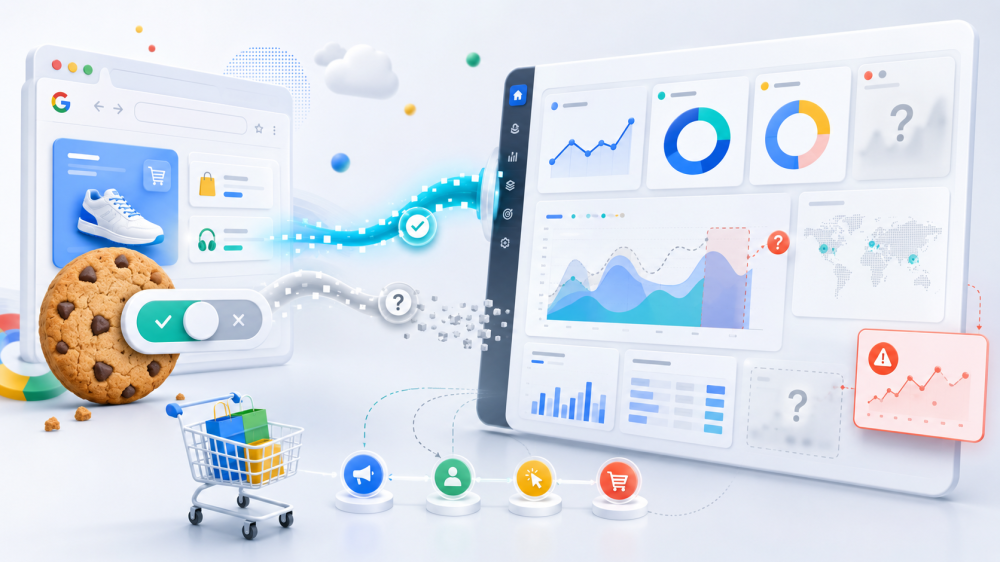
Most of this industry has been talking about third-party cookies like they’re already gone. They’re not, and what actually happened is stranger than a simple death.
Google walked back its forced deprecation of third-party cookies in Chrome and quietly moved to a user-choice model instead. Cookies didn’t disappear. They just became optional, sitting behind a browser setting most people will never touch.
That leaves two completely different measurement realities sitting inside the same ad account, and most reporting setups have no idea which one they’re looking at for any given session.
What Actually Happened
On April 22, 2025, Google confirmed it was abandoning its plan to deprecate third-party cookies in Chrome, ending a rollout that had already been delayed from 2022 to 2023 to 2024. Instead of a forced cutoff, Chrome adopted a user-choice model: people can block third-party cookies if they want to, but the default, allowing them, stayed unchanged, and Google did not add a new consent prompt to push users toward that choice. Most Chrome users will never see a screen asking them to decide.
The reversal took the rest of Google’s cookieless roadmap down with it. In October 2025, Google shut down the remaining Privacy Sandbox APIs, Topics, Protected Audience, Attribution Reporting, and the rest of the replacement technologies the industry had spent years preparing for. Six years of planning around a Chrome-led cookieless future ended without the future arriving.
Two Browsers, Two Different Tracking Realities
Here’s what most marketers still have backwards. Safari and Firefox already block third-party cookies by default, and have for years. Chrome never did, and now isn’t going to. Chrome holds roughly 65 to 69 percent of global browser traffic depending on which panel measures it, while Safari sits around 15 to 18 percent globally and considerably higher on mobile, where it’s the default on every iPhone.
That split means a meaningful share of any store’s traffic, the Safari and Firefox share, has effectively been cookieless for years already, while the much larger Chrome share is still trackable the old way for any user who hasn’t gone digging through browser settings to turn cookies off. Two different tracking realities, sitting inside the same campaign, the same ad account, and often the same reporting dashboard, with nothing in most setups distinguishing which session came from which world.
Why Most Dashboards Can’t Tell the Difference
Standard attribution setups tend to assume traffic behaves uniformly, one tracking method, one measurement logic, applied evenly across every visitor. That assumption was already shaky given how differently iOS and Android traffic get measured. It’s shakier still now that Chrome and Safari represent two structurally different cookie environments living inside the same reported numbers.
A campaign that looks like it’s underperforming on one browser and overperforming on another might not be a targeting or creative problem at all. It might simply be that a large share of Safari sessions were never going to generate a reliable third-party cookie signal in the first place, while the equivalent Chrome sessions mostly still are, and a blended ROAS number that doesn’t separate the two is averaging together two different data-quality realities as if they were the same thing.
What to Check Before You Trust the Blended Number
Worth doing this audit before assuming a browser-level pattern is a targeting issue:
- Pull a browser breakdown of your traffic and conversion rates, Chrome versus Safari versus Firefox, for the last 30 days
- Compare the gap between reported conversions and backend order data separately for Chrome sessions and for Safari and Firefox sessions, since the gap size should differ meaningfully if cookie availability is driving it
- Check whether your tagging setup relies on third-party cookies anywhere in the funnel, and confirm what happens to that signal on a browser that blocks them by default
- Segment ROAS by browser the same way it’s worth segmenting by device, since a browser-level pattern hiding inside a blended number looks a lot like a targeting problem until you isolate it
This is the same discipline behind why “just trust the pixel” quietly stopped being a viable approach in 2026.
A single tracking method was never going to hold up evenly across every browser a customer might use, and Chrome’s reversal doesn’t change that, it just means the fragmentation is going to persist longer than most teams planned for.
Why First-Party Data Doesn’t Have This Problem
First-party, click-based attribution ties a conversion back to a click on your own domain, using data your own store generated directly. It doesn’t depend on a third-party cookie surviving a browser’s default privacy settings, because there’s no third-party cookie in the chain to begin with.
Whether a customer is on Chrome with cookies fully enabled or Safari with cookies blocked since the day they got their phone, a click on your own site and a purchase that follows it get measured the same way.
The distinction between first, second, and third-party data isn’t just a compliance detail. It’s the difference between a measurement layer that has to survive whatever a browser decides to allow this year, and one that doesn’t have to ask permission in the first place.
This is the same reason first-party data matters for paid social specifically, not just for cookie-based web tracking.
Before scaling budget off a blended ROAS number this quarter, check which browsers your actual buyers are using and whether your attribution setup was ever built to treat them differently. If you want to see what your traffic looks like broken out by real tracking conditions, not assumed ones, book a live AdBeacon demo.
—-
FAQ
Did Google actually kill third-party cookies in Chrome?
No. Google reversed its plan to deprecate third-party cookies in Chrome, announcing the change on April 22, 2025. Chrome moved to a user-choice model instead, where cookies remain enabled by default and users can opt to block them, but no new prompt was added encouraging that choice.
Are third-party cookies dead in 2026?
Not uniformly. Safari and Firefox have blocked third-party cookies by default for years, making that share of traffic effectively cookieless. Chrome, which holds roughly two-thirds of global browser traffic, still allows third-party cookies by default for users who haven’t changed their settings.
What happened to Google’s Privacy Sandbox after the reversal?
Google shut down the remaining Privacy Sandbox APIs in October 2025, including Topics, Protected Audience, and Attribution Reporting, the technologies that had been positioned as cookie replacements.
How do I know if my attribution setup is affected by the Chrome and Safari split?
Segment traffic and conversion data by browser and compare the gap between platform-reported conversions and backend order data for each. A meaningfully larger gap on Safari and Firefox traffic than on Chrome traffic suggests cookie availability, not targeting or creative, is driving the difference.