
Conversions API Event Match Quality: Why Your Score Is Low and How to Raise It
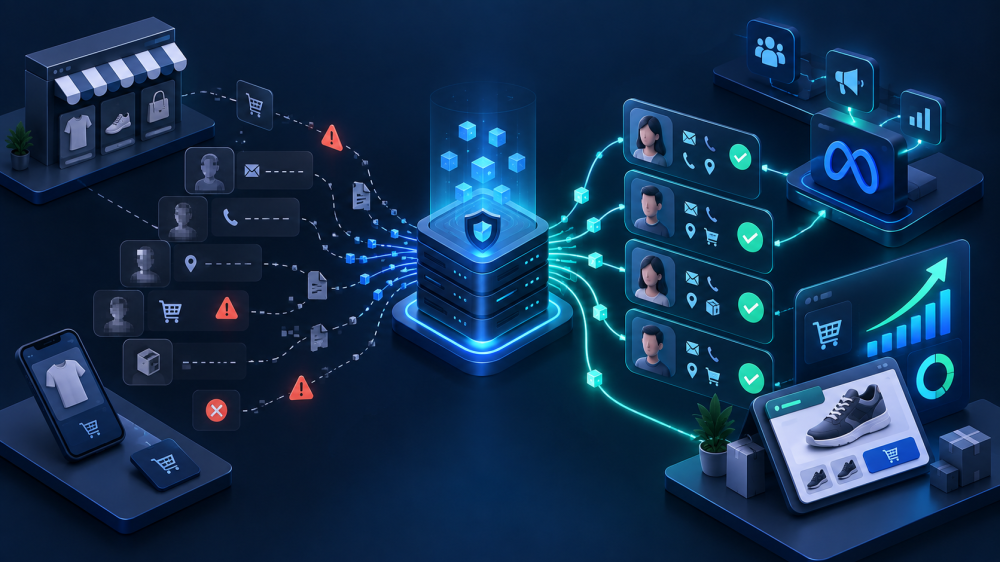
Your Conversion API setup can be technically perfect and still hand Meta events it cannot use. Event Match Quality is the score that tells you how often that is happening, and on most ecommerce stores it is sitting between 5 and 7 when it could be above 8.
That gap is not cosmetic.
A purchase Meta receives but cannot match to a person is a purchase that never reaches your ROAS, never trains delivery, and never enters a retargeting audience. Lets dive into what the score measures, the specific reasons it runs low in 2026, and the order in which to fix it.
What is Event Match Quality?
Event Match Quality (EMQ) is a 0 to 10 score, shown per event type in Events Manager, that estimates how well the customer information attached to your Conversions API events lets Meta connect each event to a real account.
It updates on a rolling 48-hour window and blends two kinds of matching: deterministic, where a hashed email or phone lines up with an account directly, and probabilistic, where Meta infers the match from IP address, browser ID, and user agent, as PixelFlow’s breakdown of the scoring explains.
Two things about the score are worth holding onto. It measures events that arrived, not events that were attributed, so a high EMQ means Meta knows who converted, not that an ad caused it.
And it is a Meta-side estimate.
You can see the number and the diagnostics.
You cannot see the matching logic.
The practical thresholds, per Niblin’s 2026 EMQ diagnostic guide:
- 1 to 3: under 30 percent of events matched. Something is broken.
- 4 to 5: 30 to 50 percent. Usually email only, or browser identifiers only.
- 6 to 7: 50 to 70 percent. Where most Shopify native setups land.
- 8 to 9: 70 to 90 percent. A well-configured server-side setup.
- 10: rare in practice.
Purchase should be your highest-scoring event because it is the one where you hold the most customer data. If Purchase is below 8, that is where to start.
Why is my Event Match Quality low?
EMQ is low because the Meta Conversion API is receiving events without enough identity attached, and in 2026 there are four common reasons that happens, most of them not the fault of whoever set up tracking.
1. The Shopify native integration doesn’t send the parameters that score
- Shopify’s stock Meta channel reliably passes browser identifiers (fbp, fbc, IP, user agent) but typically omits hashed email, phone, and address, because the browser pixel fires before checkout data is available client-side, as WeltPixel’s Shopify EMQ guide describes.
- Those are precisely the parameters that carry the most matching weight. A store on the native channel alone tends to plateau at 6 to 7 on Purchase regardless of how clean everything else is.
2. The click ID is being stripped before it reaches you
- fbc is the click identifier that ties a conversion back to a specific ad click, and it is one of the two highest-value matching parameters alongside email.
- Safari’s Link Tracking Protection now strips fbclid from URLs in Private Browsing, Mail, Messages, and the Instagram in-app browser, per CapConvert’s 2026 CAPI migration guide.
- A meaningful share of your Meta traffic arrives with no click ID to pass along, and your EMQ reflects it.
3. The browser cookies aren’t being forwarded server-side
- Even when fbp and fbc exist in the browser, a server-side event only carries them if your implementation reads them and includes them in the payload.
- Many setups, especially ones built quickly around the August Shopify checkout changes, don’t.
- The server event arrives with an email and nothing else, and the score drops accordingly.
4. Formatting and duplication problems
- Email hashed without lowercasing or trimming first.
- Phone numbers without a country code.
- Two Conversions API integrations running at once (a Shopify app plus a tag-manager setup, say), each sending a partial version of the same event.
- All three are silent and all three pull the score down.
One more: if the score fell sharply in January 2026 and never recovered, that is likely Shopify’s switch to the Optimized App Pixel default rather than anything you changed.
Polar Analytics saw stores lose 20 to 40% of Meta purchase events overnight that month while orders stayed flat. Our post on why iOS ROAS still looks wrong after CAPI covers that failure mode.

How to raise your Event Match Quality score
Raise EMQ by adding identity parameters in order of matching weight, then confirming they actually arrive. Stape’s parameter ranking puts email and click ID at the top, phone, external ID, and browser ID in the middle, and name, city, and zip at the bottom.
The progression Niblin documents matches what we see on client accounts:
- Email only: 5 to 6
- Email plus phone: 6 to 7. Phone is the single biggest jump.
- Email, phone, name, zip, plus fbp and fbc: 7 to 8
- All of the above plus external_id, IP, and user agent: 8 to 9
Practically, that means:
- Send hashed email and phone on every Purchase, from your order data. Lowercase and trim email before hashing. Phone in E.164 format with country code. If your current integration cannot send these, that is the reason to change it.
- Forward fbp and fbc from the browser to the server event. Capture them at landing, store them with the session, attach them at order time. This is the step most often skipped.
- Add external_id. A stable customer ID from your store. It lets Meta match returning buyers even when other parameters shift.
- Run exactly one Conversions API integration. Audit Events Manager for multiple server sources sending the same event. Remove all but one.
- Verify with a test order. Events Manager’s Test Events tab shows you every parameter that arrived. Do not trust the score until you have seen the payload. Then wait 24 to 48 hours for the rolling window to catch up.
Our server-side tracking overview covers the setup context for all three major platforms if you need it.
What a high EMQ does not fix
An EMQ of 9 means Meta can identify almost everyone who converts on your store. It does not mean the attribution that follows is right.
- Once matched, the purchase still passes through Meta’s attribution setting, which decides whether a 1-day view or a 5-second video engagement earns the credit.
- It still gets counted alongside Google’s and TikTok’s claims on the same order, with no deduplication between platforms.
- And it still lives inside Meta, where you can read the score but not the logic.
That is the reason to hold two numbers.
A well-tuned Conversion API is how you give Meta the best first party data it can have, and it improves delivery, which is real money.
A first-party, click-only attribution record on your own domain is how you keep a number Meta didn’t produce: the click ID captured at landing, the session followed on your site, the order tied to the ad that sent it.
It will not credit view-through, and it will undercount some upper-funnel influence. What it gives you is a conversion count you can reconcile against your orders and hold Meta’s Purchase number against. First-party data and signal quality covers how the two layers fit together.
EMQ is the fastest measurable improvement in most Meta accounts, and phone number is usually the first hour’s work. Get Purchase above 8, then remember what the score does and does not tell you. If you want to see how your Meta-matched purchases compare with a click-only, first-party record on the same store, book a live AdBeacon demo.
—-
FAQ
What is a good Event Match Quality score?
Above 8 on Purchase is good and achievable with a full server-side setup. 6 to 7 is typical for Shopify’s native integration. Below 6 usually means email or phone is missing from your Conversions API events.
Why is my Event Match Quality low on Shopify?
The native Shopify Meta channel sends browser identifiers but usually not hashed email, phone, or address, which are the highest-weight matching parameters. Adding them through a server-side integration is what moves the score above 7.
What parameters improve Event Match Quality the most?
Hashed email and the click ID (fbc) carry the most weight, followed by phone, external ID, and browser ID (fbp). Adding phone to an email-only setup is typically the single largest improvement.
How long does it take for Event Match Quality to update?
EMQ is calculated on a rolling 48-hour window, so allow one to two days after changing parameters before judging the result.
Does a high Event Match Quality mean my Meta attribution is accurate?
No. EMQ measures whether Meta can identify who converted, not whether an ad caused the conversion. Attribution settings, view-through credit, and cross-platform double counting all apply after the match.
Sources
- PixelFlow: How Facebook Generates Event Match Quality Scores
- Niblin: Meta CAPI Event Match Quality, How to Diagnose and Fix Low EMQ (2026)
- WeltPixel: Meta EMQ on Shopify, How to Get to 8+ (2026 Guide)
- CapConvert: Meta CAPI in 2026, Browser Pixel Alone No Longer Works
- Stape: How to Improve Event Match Quality for Facebook