Facebook Ads Frequency: How to Know When You're Burning Out Your Audience
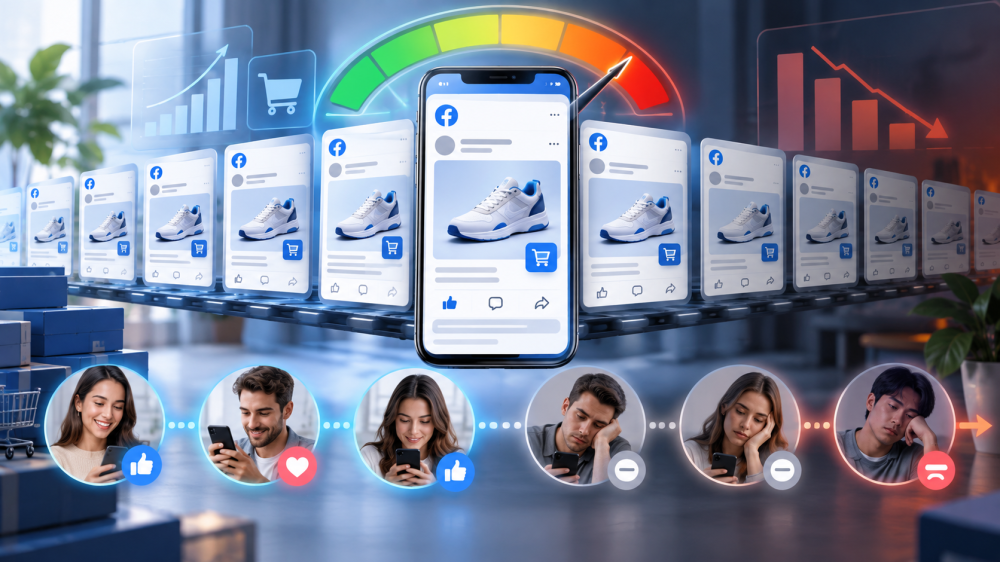
A Facebook ads frequency cap strategy starts with a detail most accounts miss entirely: Meta only lets you set a manual frequency cap on Reach and Brand Awareness objectives.
On Sales campaigns, where most DTC prospecting and retargeting actually runs, there’s no cap field to set at all.
Frequency there is an outcome of audience size and budget, not a dial you turn directly, which changes what “managing frequency” actually means for most accounts reading this.
What Frequency Actually Measures
Frequency is simply impressions divided by reach:
- 15,000 impressions across 5,000 unique people is a frequency of 3.0.
- The number itself is an average, though, which hides the real distribution.
- Some people in that audience saw the ad once. Others saw it ten times.
A healthy-looking account average can still contain a badly over-saturated sub-segment dragging performance down without showing up clearly in the top-line number.
On Reach and Brand Awareness objectives, Meta exposes a direct frequency cap setting, and it’s worth knowing that the cap locks once the ad set is created; changing it later means cloning the ad set rather than editing it in place.
On Sales objectives, the far more common case for ecommerce, there’s no equivalent field. Frequency there is managed indirectly, through audience size, budget, and exclusions, which is exactly why so many accounts never actively manage it at all: there’s no obvious setting labeled “frequency” to go find.
Prospecting vs. Retargeting Tolerance
The tolerance gap between cold and warm audiences is large and consistent across independent benchmarks.
Prospecting on Meta holds up to roughly 2 to 3 impressions per person per week before performance genuinely degrades; retargeting tolerates 5 to 7, since the audience already has established intent and isn’t being asked to form an opinion of the brand from a cold start.
Push past the prospecting threshold and the drop is steep, not gradual: click-through rate falls by roughly 45 percent after four exposures to a cold audience, a sharper cliff than most media buyers expect.
The reason for the gap isn’t arbitrary.
A cold audience member seeing the same ad repeatedly is being asked to notice, evaluate, and act on something unfamiliar every time, and repetition without new information reads as noise, not persuasion.
A warm audience member already knows the brand; the repeated impression functions more like a reminder than an introduction, which is a fundamentally lower cognitive ask.

The Compound Signals That Confirm Real Fatigue
Frequency alone is a lagging indicator.
By the time it’s visibly high, the damage to performance has typically already started, and treating a single frequency number as the whole diagnosis misses two things that matter more.
- The first is hook rate, the percentage of impressions that convert into a 3-second video view.
- The formula is straightforward, 3-second views divided by impressions, with 25% as a reasonable floor, 30% or higher as solid, and 35% or higher as genuinely scalable.
- A creative with hook rate already below 25% has a relevance problem a frequency cap can’t fix, since capping controls exposure, not whether the first frame earns attention in the first place.
Pair frequency with hook rate specifically: rising frequency alongside a stable, healthy hook rate is a very different situation than rising frequency alongside a hook rate that’s dropping too.
The second and third signals are the familiar pair: CTR dropping meaningfully from baseline, and CPM climbing on the same ad set at the same time.
All three moving together, rising frequency, falling hook rate or CTR, rising CPM, is a confident fatigue signal. Any one alone is easier to misread as noise or a temporary dip.
Creative depth changes how much frequency an audience can actually absorb before any of this shows up.
- An audience seeing several different hooks, formats, and offers can tolerate meaningfully higher account-level frequency than one seeing the same single ad on repeat,
- even at an identical average frequency number, and simply duplicating that one ad doesn’t create the variety needed.
The better question isn’t “what’s the right frequency,” it’s how many genuinely distinct impressions you can deliver before repetition becomes visible to the person seeing them.
How to Actually Manage It
For Sales-objective campaigns, where there’s no manual cap field, the real levers are audience size, budget pacing, and exclusions.
If frequency is climbing on a given ad set, the fix is usually expanding the audience or reducing budget concentration, not searching Ads Manager for a setting that doesn’t exist on that objective.
A reasonable starting discipline is reviewing past campaign data to find the frequency point where conversion rate historically started dropping, and treating that as the account’s natural ceiling rather than importing a generic industry number wholesale.
For Reach and Brand Awareness objectives where a manual cap does exist, set it conservatively before launch, since adjusting it later requires cloning rather than editing.
And regardless of objective, add hook rate as a custom column alongside frequency, CTR, and CPM, so a rising frequency number gets read against the signals that actually confirm whether it’s a problem yet.
If you want a clearer read on which of your campaigns are genuinely fatigued versus just running at a normal, healthy frequency for their funnel stage, and whether the reported performance behind that read is itself trustworthy, book a live AdBeacon demo.
FAQ
What’s a good frequency cap for Facebook ads?
Roughly 2 to 3 impressions per person per week for prospecting, and 5 to 7 for retargeting, since warm audiences already have established intent. These are starting benchmarks, not universal rules, your own historical data on where conversion rate starts dropping is the more reliable ceiling.
Can I set a manual frequency cap on all Meta campaign types?
No. Meta only exposes a manual frequency cap field on Reach and Brand Awareness objectives. On Sales campaigns, which cover most ecommerce prospecting and retargeting, frequency is an outcome of audience size and budget rather than a direct setting.
What is hook rate and why does it matter for frequency management?
Hook rate is the percentage of impressions that convert into a 3-second video view. A healthy baseline is around 25 percent or higher. Pairing hook rate with frequency helps distinguish real audience fatigue from a creative that was never landing in the first place, since a frequency cap can’t fix a weak hook.
How much does CTR actually drop from ad frequency fatigue?
Independent benchmarks show click-through rate falling by roughly 45 percent after four exposures to a cold prospecting audience, a steeper drop than most media buyers expect, which is why prospecting frequency tolerance is meaningfully lower than retargeting.
Does more creative variety let an audience tolerate higher frequency?
Yes. An audience seeing several different hooks, formats, and offers can absorb a higher account-level frequency before fatigue sets in than one seeing the identical ad repeatedly, even at the same average frequency number, since repetition of a single asset reads differently to a viewer than variation within a theme.