Google, Gemini, and AI Commerce Standards: What Ecommerce Brands Need to Know About Universal Commerce Protocol
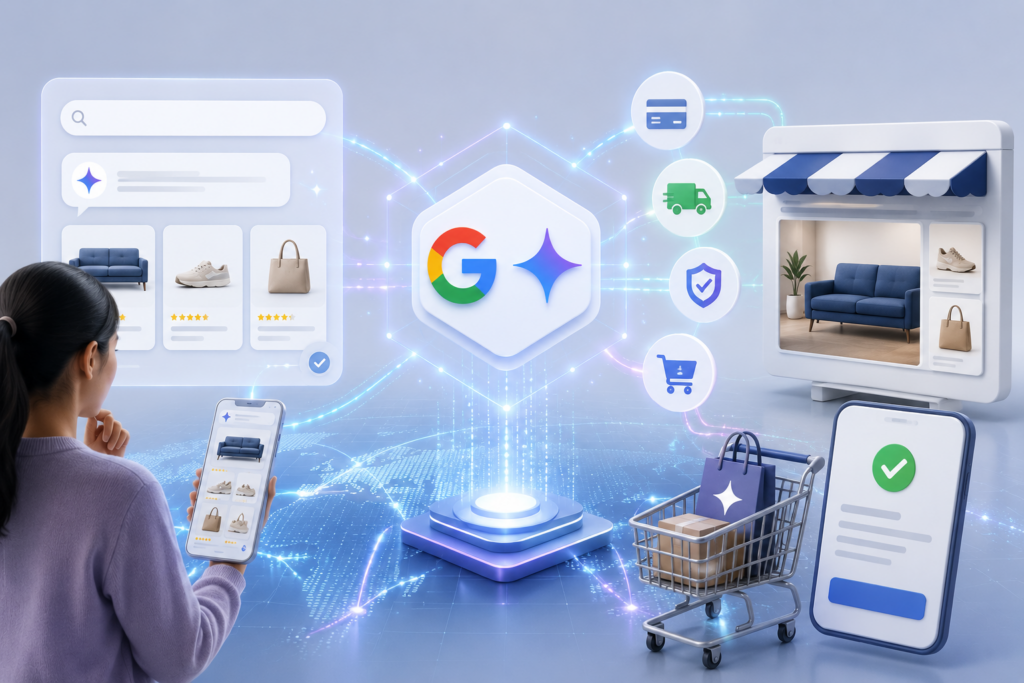
Google, Gemini, and new AI commerce standards are changing how ecommerce brands should think about product discovery, checkout, and attribution.
Google’s Universal Commerce Protocol, or UCP, is an open standard designed to help merchants turn AI interactions into sales by enabling agentic actions on Google AI Mode and Gemini, starting with direct buying.
For ecommerce brands, this is a major shift. Shoppers may increasingly discover, compare, and purchase products inside AI-powered experiences instead of moving through a traditional path from search result to product page to checkout. That creates new opportunities for conversion, but it also creates new attribution gaps.
AdBeacon helps ecommerce brands, agencies, and media buyers prepare for AI commerce by connecting paid media, first-party e-commerce data, customer behavior, product performance, and revenue outcomes into a clearer attribution and optimization layer.
What Is Google’s Universal Commerce Protocol?
Universal Commerce Protocol is Google’s open standard for agentic commerce. Google says UCP is designed for the future of commerce and helps merchants turn AI interactions into instant sales. It is intended to enable agentic actions on Google AI Mode and Gemini, beginning with direct buying.
In practical terms, UCP is meant to help AI shopping experiences connect product discovery, cart actions, checkout, payment, and merchant systems. Instead of simply recommending products, AI assistants can move closer to helping shoppers complete transactions.
Google’s Merchant Center help documentation says that by integrating with UCP, merchants can implement a checkout button on eligible product listings in AI Mode in Google Search and on Gemini. It also notes that the merchant remains the seller.
That last point matters for ecommerce brands. If the merchant remains the seller, brands still need strong product data, accurate availability, reliable pricing, checkout readiness, and first-party attribution to understand what these AI-assisted purchases mean for the business.
Why Google and Gemini Matter for AI Commerce
Google has been one of the most important discovery layers in ecommerce for decades. Product search, Shopping Ads, organic search, Merchant Center feeds, Performance Max, YouTube, and Google Shopping have all shaped how shoppers find products online.
Gemini and AI Mode add a new layer to that discovery path.
Instead of typing a keyword and scanning results, shoppers may ask AI-powered questions like:
- “Find the best sofa for a small apartment under $900.”
- “Compare these three skincare products for sensitive skin.”
- “Which running shoes are best for walking and light workouts?”
- “Find a birthday gift for a 12-year-old who likes art.”
- “Buy a replacement water filter compatible with this model.”

Google has described its new commerce tools as part of a shift toward an agentic shopping era, where retailers can connect with high-intent shoppers and drive sales through AI-powered experiences.
For ecommerce brands, this means Google may become both a discovery surface and a transaction surface.
What Direct Buying in AI Mode and Gemini Could Change
Direct buying through AI Mode and Gemini could reduce friction between product discovery and purchase. A shopper may research a product inside an AI experience, compare options, and buy without visiting the retailer’s full website journey.
AP reported that Google announced partnerships with major retailers including Walmart, Shopify, and Wayfair to let users browse and instantly purchase products within Gemini without visiting a retailer’s website. The report also noted that the rollout was initially for U.S. users.
For shoppers, this can make buying faster.
For ecommerce brands, it raises important questions:
- How will shoppers discover products inside AI Mode and Gemini?
- What product data will influence recommendations?
- Which products will be eligible for direct buying?
- How will checkout behavior be reported?
- How will brands know whether paid media influenced the purchase?
- How will brands compare AI-assisted sales to Shopify, Meta, TikTok, Amazon, and Google Ads performance?
- How will customer quality and repeat purchase behavior be measured?
AI commerce can reduce shopper friction, but it can also reduce visibility into the traditional path to purchase. That makes first-party attribution more important.
Why AI Commerce Standards Matter for E-commerce Brands
AI commerce standards matter because they help define how AI agents, merchants, platforms, and payment systems interact.
Without standards, AI-assisted commerce can become fragmented. Each platform could use different ways to access product data, handle checkout, verify user intent, process payment, apply promotions, manage carts, or pass order information.
Standards like UCP are designed to create more structured, scalable ways for AI agents and commerce systems to work together.
For ecommerce brands, that can affect:
- Product eligibility
- Product data requirements
- Checkout flows
- Payment options
- Offer visibility
- Loyalty and discount handling
- Shipping and fulfillment logic
- Attribution visibility
- Customer data access
- Reporting workflows

This is why UCP is more than a technical announcement. It is a sign that AI shopping is moving toward real commerce infrastructure.
The Attribution Problem With Google AI Mode and Gemini Shopping
Traditional attribution often depends on visible click paths. A shopper searches, clicks an ad, visits a product page, adds to cart, and purchases.
AI commerce can change that flow.
A shopper may ask Gemini for recommendations, receive a shortlist, compare products, and purchase from an eligible listing inside the AI experience. The brand may see the order, but the path that created the purchase may be harder to interpret.
That creates attribution questions:
- Did the shopper discover the product through AI Mode or Gemini?
- Did a Google Shopping ad influence the AI-assisted sale?
- Did Meta or TikTok create demand before the shopper asked Gemini?
- Did prior brand awareness influence the recommendation?
- Was the shopper new or returning?
- Which product data helped the item appear?
- Did the customer come back after the first purchase?
- How profitable was the order after discounts, shipping, and returns?
Ad platforms, AI surfaces, and ecommerce stores may all show different parts of the journey. Brands need first-party attribution to connect those signals to actual revenue and customer behavior.
Why First-Party Data Becomes More Important in AI Commerce
First-party data is information a brand collects directly from its own ecommerce store, customers, checkout, order history, product interactions, and marketing activity.
As AI shopping grows, first-party data becomes more important because brands may not always see every discovery or comparison moment. They can still measure what matters after the interaction becomes a customer action.
First-party data helps ecommerce teams understand:
- Which customers purchased
- Which products were purchased
- Whether customers were new or returning
- What the order value was
- Whether the order was profitable
- Whether the customer returned later
- Which products created long-term value
- Which channels influenced demand
- Which campaigns deserve more budget
- Which AI-assisted journeys are producing valuable customers
AdBeacon helps ecommerce brands use first-party attribution to connect fragmented shopping journeys to store-side revenue and customer outcomes.
Product Data Is the New AI Commerce Foundation
Google AI Mode and Gemini shopping experiences will depend heavily on product data. If AI systems are helping shoppers compare and buy products, they need accurate information about what products are, who they are for, how much they cost, whether they are available, and how checkout works.
Strong product data should include:
- Clear product names
- Accurate product categories
- Complete descriptions
- Variant details
- Product attributes
- Pricing
- Availability
- Images
- Shipping details
- Return policies
- Promotions
- Reviews and ratings
- FAQs
- Use cases
- Compatibility details
Google’s Merchant Center documentation says UCP can enable checkout buttons on eligible product listings in AI Mode and Gemini. That makes eligibility, product data, and checkout readiness strategic priorities for ecommerce teams.
If an AI system cannot understand a product, compare it accurately, or confirm that it can be purchased, the product may struggle in AI-assisted shopping experiences.
How Google AI Commerce Differs From Traditional Google Shopping

Google AI commerce does not replace traditional Shopping immediately. It adds a new AI-native discovery and transaction layer that ecommerce brands need to prepare for.
How AdBeacon Helps Brands Prepare for Google AI Commerce
AdBeacon helps ecommerce brands, agencies, and media buyers connect paid media and commerce activity to first-party revenue outcomes.
For Google AI Mode, Gemini, and UCP-driven shopping experiences, AdBeacon helps teams answer questions like:
- Which channels are creating demand before AI-assisted purchases?
- Which products are driving revenue across paid and AI-influenced journeys?
- Which customers are new versus returning?
- Which campaigns are creating profitable customers?
- Which Google-driven journeys are producing repeat purchases?
- Which products should receive more media support?
- Which channels are overclaiming credit?
- Which conversion paths are worth scaling?
- Which first-party signals should guide budget decisions?
- Which AI commerce outcomes are actually valuable to the business?
AdBeacon gives ecommerce teams a clearer performance layer as AI commerce makes customer journeys more compressed and fragmented.
Why Google AI Commerce Changes Paid Media Strategy
Google AI commerce could change how brands think about paid media. If shoppers can research and buy inside AI Mode or Gemini, product discoverability and checkout readiness may become more closely tied to ad performance.
Paid media teams will need to understand:
- Which campaigns create demand before AI-assisted searches
- Which products are being discovered through AI surfaces
- Which product data affects conversion
- Which offers work best in AI shopping contexts
- Which customers are acquired through Google AI commerce
- Whether AI-assisted purchases increase or decrease AOV
- Whether those customers return
- How AI commerce compares with Performance Max, Shopping Ads, Meta, TikTok, Amazon, and Shopify
The role of the media buyer becomes more strategic. It is not just about bidding and budgeting. It is about connecting product data, campaign data, customer data, and revenue data into one decision-making system.
What E-commerce Brands Should Track
AI-assisted revenue
Track revenue that appears to come from AI Mode, Gemini, or other AI shopping surfaces when referral and order data are available.
Product-level performance
AI commerce often recommends specific products. Brands should know which products convert, which products produce repeat buyers, and which products are profitable.
New customer rate
AI shopping may introduce brands to new customers. Track whether these buyers are actually new or already known to the brand.
Average order value
Compare AOV from AI-assisted journeys against Shopify, Google Shopping, Meta, TikTok, Amazon, email, and direct traffic.
Repeat purchase rate
First-order revenue is not enough. Track whether AI-assisted customers return.
Customer lifetime value
LTV helps brands understand whether AI commerce is creating lasting customer relationships or one-time purchases.
Contribution margin
Direct buying can create sales, but brands still need to account for discounts, shipping, fees, returns, and product margin.
Channel overlap
A purchase inside an AI-assisted flow may have been influenced by paid social, search, email, creators, or prior website visits.
Product data quality
Monitor whether product titles, descriptions, attributes, images, inventory, pricing, and policies are accurate and complete.

How Agencies Should Advise Clients on UCP and AI Commerce
Agencies should treat UCP and AI commerce standards as both a technical opportunity and a measurement challenge.
Clients will need help answering:
- Are we eligible for AI-assisted checkout experiences?
- Is our product data complete and accurate?
- Are our product pages clear enough for AI systems and shoppers?
- Are we tracking AI-assisted revenue?
- Do we know which products are best suited for AI commerce?
- Are we connecting Google AI commerce to paid media reporting?
- Are we measuring customer quality after purchase?
- Are we ready to compare AI commerce against other channels?
AdBeacon helps agencies connect these new AI commerce journeys to first-party attribution and ecommerce performance reporting, making it easier to prove value and guide client strategy.
Common Mistakes Brands Should Avoid
Mistake 1: Treating UCP as only a developer project
UCP has technical requirements, but the business impact extends to marketing, merchandising, product data, attribution, and customer experience.
Mistake 2: Ignoring product data quality
AI shopping relies on structured, accurate product information. Weak product data can limit discoverability and conversion.
Mistake 3: Assuming AI-assisted checkout solves attribution
Checkout may become easier, but attribution can become harder. Brands still need first-party data to evaluate performance.
Mistake 4: Measuring only first-order revenue
AI-assisted purchases should be evaluated by customer quality, repeat purchase behavior, margin, and lifetime value.
Mistake 5: Separating Google AI commerce from paid media
Paid media may create demand before shoppers use AI Mode or Gemini. Brands need cross-channel attribution.
Mistake 6: Waiting until AI commerce is fully mature
Brands that prepare product data, tracking, and reporting early will be better positioned as AI shopping adoption grows.
Best Practices for Preparing for Google AI Commerce
1. Audit product data
Review product titles, descriptions, categories, attributes, variants, images, pricing, availability, and policies.
2. Strengthen Merchant Center hygiene
Make sure product feeds are complete, accurate, and updated. Google AI commerce will depend on reliable product data.
3. Prepare checkout and fulfillment logic
AI-assisted commerce needs accurate shipping, payment, discount, return, and availability information.
4. Use first-party attribution
Track how AI-assisted journeys connect to actual ecommerce revenue, customer behavior, and long-term value.
5. Build product FAQs and comparison content
AI assistants and shoppers both benefit from clear answers about fit, use cases, materials, compatibility, sizing, shipping, and returns.
6. Track new versus returning customers
AI commerce should be evaluated by whether it is acquiring new customers or converting existing demand.
7. Compare AI commerce against other channels
Measure Google AI commerce alongside Meta, TikTok, Amazon, Shopify, Google Ads, email, SMS, affiliates, and direct traffic.
8. Align paid media with product readiness
Prioritize media spend for products with clean data, strong margins, available inventory, and high customer value.
What This Means for the Future of E-commerce
Google, Gemini, and UCP point toward a future where ecommerce discovery and checkout are more conversational, more AI-assisted, and more compressed.
Shoppers may ask for recommendations, compare products, and buy from inside an AI experience. Merchants may need to compete not only for clicks, but also for AI selection, product eligibility, checkout readiness, and customer value after purchase.
The brands that win will likely have:
- Clear product data
- Strong Merchant Center hygiene
- Reliable checkout logic
- First-party attribution
- Product-level performance reporting
- Customer lifetime value tracking
- Inventory-aware media strategy
- Cross-channel measurement
- AI-friendly content
- Better signal quality
AI commerce will reward brands that make their products easy to understand, easy to buy, and easy to measure.
Final Takeaway
Google’s Universal Commerce Protocol, Gemini shopping experiences, and AI Mode checkout represent an important shift in ecommerce.
Product discovery and purchase may increasingly happen inside AI-powered environments, not only on traditional search results pages or e-commerce websites.
For e-commerce brands, the opportunity is faster, more direct access to high-intent shoppers. The challenge is measurement.
AdBeacon helps ecommerce brands, agencies, and media buyers connect AI-assisted commerce activity to first-party revenue, customer behavior, product performance, and long-term value. As Google and Gemini make AI shopping more transactional, first-party attribution will become essential for understanding what is actually driving growth.
Ready to prepare your ecommerce measurement strategy for Google AI Mode, Gemini, and agentic commerce?
Book a demo with AdBeacon to see how first-party attribution, real-time analytics, actionable insights, and performance tracking can help your team understand what is actually driving revenue across AI-assisted shopping journeys.
FAQs About Google, Gemini, and Universal Commerce Protocol
What is Universal Commerce Protocol?
Universal Commerce Protocol, or UCP, is Google’s open standard for agentic commerce. Google says it is designed to turn AI interactions into instant sales and enable agentic actions on Google AI Mode and Gemini, starting with direct buying.
How does UCP work with Google AI Mode and Gemini?
Google says UCP can help merchants implement checkout buttons on eligible product listings in AI Mode in Google Search and on Gemini. The merchant remains the seller.
Why does UCP matter for e-commerce brands?
UCP matters because it can make AI-assisted product discovery more transactional. Shoppers may be able to research, compare, and buy products inside AI experiences instead of going through a traditional website path.
Is Gemini becoming a shopping assistant?
Yes. AP reported that Google announced partnerships with retailers including Walmart, Shopify, and Wayfair to let users browse and instantly purchase products within Gemini without visiting a retailer’s website.
How does Google AI commerce affect attribution?
AI commerce can compress the path from discovery to checkout, which may make traditional click-based attribution less complete. Brands need first-party attribution to connect AI-assisted purchases to customer behavior, product performance, and revenue outcomes.
What product data matters for AI commerce?
Important product data includes product names, categories, descriptions, variants, attributes, prices, availability, shipping details, return policies, images, reviews, and FAQs.
How should ecommerce brands prepare for UCP?
Brands should audit product data, improve Merchant Center hygiene, prepare checkout and fulfillment logic, track AI-assisted revenue, measure customer quality, and use first-party attribution to validate performance.
How does AdBeacon help with Google AI commerce?
AdBeacon helps e-commerce brands and agencies connect Google AI commerce, paid media, and store-side customer behavior to first-party attribution, real-time analytics, actionable insights, and performance tracking.