Shopify AI Tools and Merchant Automation: How E-commerce Brands Should Measure Growth as Store Operations Get Smarter
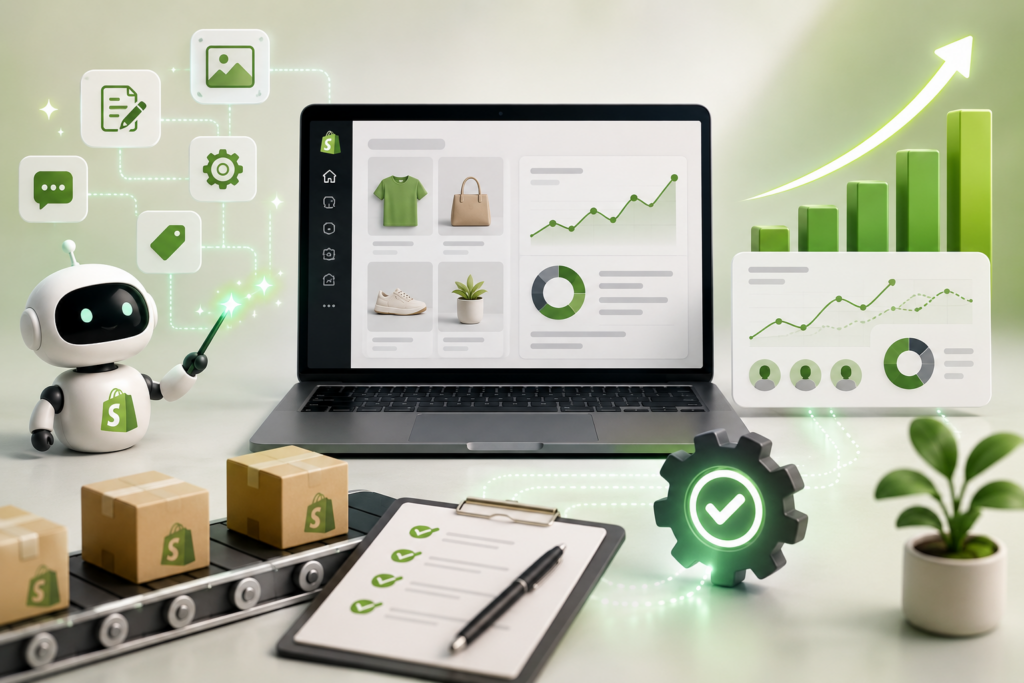
Shopify AI tools are changing how ecommerce merchants run their stores.
From AI-generated product descriptions and automated workflows to AI-assisted store building, product data optimization, and agentic commerce integrations, Shopify is making more parts of e-commerce operations faster and more automated.
For ecommerce brands, this creates a major opportunity. AI can help teams move faster, improve product content, automate repetitive tasks, manage store data, and prepare for AI-assisted shopping journeys.
But automation also creates a measurement challenge: faster execution does not automatically mean better growth.
To understand whether Shopify AI tools are actually helping the business, brands need first-party attribution, real-time analytics, actionable insights, and performance tracking that connect store automation to revenue, customer behavior, product performance, and paid media outcomes.
AdBeacon helps ecommerce brands, agencies, and media buyers use first-party ecommerce data to understand what is actually driving profitable growth across Shopify, paid media, customer journeys, and campaign performance.
What Are Shopify AI Tools?
Shopify AI tools are commerce-focused artificial intelligence features that help merchants create, manage, optimize, and grow their ecommerce stores. Shopify describes Shopify Magic and Sidekick as AI designed for commerce, with tools to help merchants start, run, and grow their businesses.
Shopify AI tools can support tasks such as:
- Writing product descriptions
- Generating store content
- Creating images and creative assets
- Summarizing store performance
- Helping merchants analyze business trends
- Supporting product recommendations
- Improving inventory and demand planning
- Automating workflows
- Preparing product data for AI shopping agents
- Supporting agentic commerce experiences

Shopify has also introduced AI-powered store creation features. Reuters reported in 2025 that Shopify launched an AI Store Builder that can generate complete online store layouts from keywords, including images and text.
The direction is clear: Shopify is making AI part of everyday e-commerce operations.
Why Shopify AI and Merchant Automation Are Getting Attention
Shopify AI tools are getting attention because ecommerce teams are under pressure to do more with less. Brands need to manage products, campaigns, customers, inventory, content, analytics, attribution, creative, and retention across multiple channels.
Manual workflows slow teams down.
AI can help merchants move faster by automating repetitive work and supporting better decisions. Shopify’s own AI e-commerce guidance says tools like Shopify Sidekick can plug directly into storefront operations and help merchants start, manage, and grow their businesses.
It also lists use cases such as writing product descriptions, generating branded images, recommending products, predicting demand, managing inventory, and spotting fraud.
For e-commerce brands, this matters because AI is not limited to ad creative or chatbots. It is becoming part of the operating system for online retail.
What Shopify AI Tools Can Help Merchants Automate
Shopify AI and merchant automation can support several areas of ecommerce operations.
Product Content
AI can help merchants write product descriptions, page copy, FAQs, email subject lines, collection copy, and promotional messaging. Shopify Magic is positioned as a growing suite of AI tools built for commerce, and Shopify has referenced AI-assisted product descriptions and store content as part of that ecosystem.
Product content matters because it influences conversion, search visibility, AI discoverability, and shopper confidence.
Store Setup
AI store-building tools can reduce the time it takes to launch or update a store. Shopify’s AI Store Builder can generate store layouts from descriptive keywords, helping merchants move from concept to storefront faster.
This is especially useful for new brands, product launches, seasonal storefronts, and rapid landing page concepts.
Inventory and Demand Planning
AI can help merchants predict demand, manage inventory, and reduce the risk of stockouts or overstocking. Shopify’s AI ecommerce guidance specifically lists demand prediction and inventory management as areas where AI can help merchants.
For paid media teams, this is important because ad spend should be aligned with product availability. Scaling ads for products that are low in stock can create wasted demand and poor customer experience.
Product Recommendations
AI can help recommend the right products to shoppers, which can support higher average order value and stronger conversion rates. Shopify’s AI ecommerce guidance identifies product recommendations as one of the ways AI can help increase AOV.
But recommendations should be measured against store-side revenue and customer value, not just clicks.
Workflow Automation
Shopify Flow and other automation tools can help merchants automate repetitive operational tasks. AI-assisted workflow automation can support tagging customers, triggering alerts, updating processes, sending notifications, and creating internal efficiencies.
Automation can save time, but brands still need reporting that shows whether those efficiencies improve revenue outcomes.
Agentic Commerce Readiness
Shopify is also preparing merchants for AI shopping agents. Shopify’s agentic commerce guidance explains that product data can flow to AI agents, agents can surface relevant products in conversation, and transactions can be processed through Shopify Checkout.
This means Shopify AI is not only about merchant productivity. It is also about how products may be discovered and purchased in AI-assisted shopping environments.
Why Automation Alone Does Not Guarantee Growth
AI tools can help merchants do more work faster. But faster work is not the same as better business performance.
A Shopify merchant can use AI to write more product descriptions, generate more store pages, produce more creative assets, automate workflows, and prepare product data for AI agents. Those actions may improve productivity, but ecommerce leaders still need to know whether they improve revenue.
The key questions are:
- Did AI-generated product content improve conversion rates?
- Did automated merchandising increase average order value?
- Did product recommendations create more revenue or just shift purchases?
- Did inventory automation prevent wasted ad spend?
- Did AI-assisted store changes improve paid traffic performance?
- Did better product data improve AI-driven discovery?
- Did automation help acquire new customers?
- Did those customers return?
- Did profit improve?

This is where first-party attribution and ecommerce performance tracking become essential.
The Measurement Problem With Shopify AI Tools
Shopify AI tools operate inside or around the e-commerce store. Paid media platforms operate outside the store. Customer journeys move across both!
That creates a measurement problem.
A customer might see a Meta ad, click to a Shopify product page, read AI-assisted product copy, see a personalized product recommendation, add a bundle to cart, abandon checkout, return through email, and purchase later after seeing a Google ad.
Which part of that journey drove the sale?
The answer usually is not one single touchpoint. E-commerce brands need a measurement system that connects paid media, store behavior, customer data, product data, and revenue outcomes.
Shopify can help merchants run the store. AdBeacon helps marketers understand which campaigns, channels, products, creatives, and audiences are driving measurable growth.
Why First-Party Data Matters for Shopify AI Automation
First-party data is the data a brand collects directly from its ecommerce store, customers, checkout, orders, product interactions, and marketing activity.
For Shopify merchants, first-party data can include:
- Product views
- Add-to-cart events
- Checkout events
- Purchases
- Order values
- Product-level revenue
- Customer records
- New versus returning customers
- Repeat purchases
- Customer lifetime value
- Returns and refunds
- Inventory and product availability
- Discount use
- Channel source data

First-party data matters because it gives brands a store-side view of performance. As AI tools automate more store operations, brands need clean data to evaluate whether those automated changes are helping.
Without first-party attribution, teams may see that sales increased, but they may not know why. With first-party attribution, teams can connect store-side outcomes to campaigns, customer behavior, products, and marketing decisions.
How AdBeacon Helps Shopify Merchants Measure AI-Driven Growth
AdBeacon helps ecommerce brands and agencies use first-party attribution to understand what is actually driving revenue across paid media and store-side customer journeys.
For Shopify merchants using AI tools and automation, AdBeacon helps answer questions like:
- Which campaigns are driving revenue after Shopify store changes?
- Which products are gaining traction after AI-assisted content updates?
- Which audiences are converting into new customers?
- Which products create the strongest repeat purchase behavior?
- Which paid media campaigns are aligned with inventory availability?
- Which creative assets are driving higher-value Shopify customers?
- Which channels are overclaiming credit?
- Which Shopify customer journeys are producing long-term value?
- Which automation efforts are tied to measurable growth?
AdBeacon gives ecommerce teams a clearer performance layer around Shopify activity, so automation can be evaluated through business outcomes instead of assumptions.
Shopify AI, Product Data, and AI Shopping Agents
Product data is becoming more important because AI shopping agents need clear, structured, and accurate information to recommend products.
Shopify’s agentic commerce guidance explains that AI agents may use product data, availability, pricing, and engagement signals when surfacing products in conversation.
It also explains that transactions can be processed through Shopify Checkout depending on the platform.
Shopify’s enterprise AI commerce page also emphasizes that Shopify Catalog can sync live inventory and pricing to AI agents so product data stays accurate.
For ecommerce brands, this makes product data a growth asset.
Brands should make sure AI systems can understand:
- What the product is
- Who it is for
- What problem it solves
- What variants are available
- What sizes, colors, materials, or specifications matter
- What inventory is available
- What the price is
- What shipping and returns policies apply
- What reviews and FAQs say
- Why a shopper should choose it
Strong product data can help AI agents understand and recommend products. First-party attribution helps brands understand whether those AI-influenced journeys create valuable customers.
Shopify AI and Paid Media Optimization
Shopify AI tools may improve store operations, but paid media teams still need to understand how those changes affect campaign performance.
For example:
- AI-generated product copy may improve conversion rate for paid traffic.
- AI-assisted product recommendations may increase AOV from Meta campaigns.
- Inventory automation may prevent spend from going to low-stock products.
- Better product data may improve shopping feed performance.
- AI-generated landing pages may support faster creative testing.
- Store automation may improve retention workflows after acquisition.
These are meaningful improvements, but they need to be measured.
AdBeacon helps e-commerce teams connect paid media activity to Shopify outcomes so marketers can see whether AI-assisted store improvements are changing conversion, revenue, customer quality, or lifetime value.
Shopify AI and Inventory Intelligence
Inventory is one of the most important connections between ecommerce operations and paid media. A campaign can be profitable until the product runs out of stock.
A product can have strong demand but weak margin. A slow-moving product may need advertising support, but only if the economics make sense.
AI can help merchants forecast demand and manage inventory. Shopify’s AI ecommerce guidance lists demand prediction and inventory management as AI use cases.
AdBeacon’s Inventory Intelligence helps ecommerce teams connect Shopify inventory data to smarter ad decisions. For paid media teams, that means inventory can become part of the optimization process.
Brands should use inventory data to answer:
- Which products have enough stock to support scaling?
- Which products should not receive more ad spend?
- Which products are high-margin and ready to promote?
- Which products are at risk of stockout?
- Which campaigns are driving demand for constrained inventory?
- Which products should be bundled, promoted, or deprioritized?
AI can help manage operations. Attribution and inventory intelligence help make sure marketing decisions match business reality.
Shopify AI and Customer Lifetime Value
One of the biggest risks in ecommerce automation is optimizing only for first-order performance. AI tools may help generate more sales, but not all sales are equally valuable.
A customer who buys once and never returns is different from a customer who buys repeatedly. A customer who buys a high-margin product is different from a customer who buys only during discounts.
A customer who returns products frequently is different from a loyal customer who increases lifetime value.
AdBeacon helps Shopify merchants evaluate performance through customer value, not just first-order revenue.
Teams should track:
- First-order revenue
- Repeat purchase rate
- Time to second purchase
- Customer lifetime value
- Product affinity
- Discount behavior
- New versus returning customers
- Retention impact by channel
- Creative impact on customer quality
- Campaign impact on LTV
As Shopify AI helps merchants automate more customer experiences, LTV becomes an essential measurement layer.
Shopify AI Tools vs First-Party Attribution

Shopify AI helps merchants act faster. AdBeacon helps them understand which actions create growth.
Common Mistakes With Shopify AI and Merchant Automation
Mistake 1: Assuming automation equals optimization
Automation can reduce manual work, but it does not guarantee better revenue, profitability, or customer quality.
Mistake 2: Publishing AI-generated content without review
AI-generated product descriptions or FAQs can include inaccurate claims, missing details, or off-brand language. Human review is still important.
Mistake 3: Ignoring product data quality
AI tools and AI shopping agents depend on accurate product data. Weak titles, missing attributes, outdated inventory, or vague descriptions can limit performance.
Mistake 4: Measuring store changes without attribution context
If conversion rate changes after a store update, brands need to understand whether the cause was content, traffic mix, campaign changes, seasonality, offer changes, or audience quality.
Mistake 5: Separating inventory from media buying
Paid media should be connected to inventory availability, margin, and product performance. Scaling ads for products that cannot support demand creates waste.
Mistake 6: Measuring only first-order sales
Shopify automation should be evaluated against customer value, repeat purchase behavior, retention, and lifetime value.
Best Practices for Shopify Merchants Using AI Automation
1. Start with clean product data
Make sure product titles, descriptions, variants, inventory, pricing, images, FAQs, and policies are accurate. AI tools work better when the underlying data is strong.
2. Review AI-generated content before publishing
AI can speed up content creation, but teams should verify accuracy, claims, tone, product details, and compliance.
3. Connect store automation to performance metrics
Track whether AI-assisted changes improve conversion rate, AOV, customer acquisition, repeat purchase behavior, and revenue.
4. Use first-party attribution to validate paid media impact
When Shopify store changes improve or hurt performance, use first-party attribution to understand how paid traffic responds.
5. Align ad spend with inventory
Use inventory data to guide which products should receive more budget and which should be paused, bundled, or deprioritized.
6. Track new versus returning customers
AI-powered store improvements may increase conversions, but brands need to know whether they are acquiring new customers or converting existing ones.
7. Prepare product data for AI shopping agents
Write product information in a way that both humans and AI systems can understand. Include clear categories, use cases, attributes, FAQs, pricing, availability, and policy information.
8. Measure customer lifetime value
Use LTV to understand which automated workflows, campaigns, and product journeys create long-term revenue.
What This Means for Agencies
Shopify AI tools give agencies new ways to support ecommerce clients. Agencies can help clients improve product content, organize catalogs, prepare for AI shopping agents, automate workflows, and connect store operations to paid media performance.
But the biggest agency opportunity is measurement.
Clients will want to know whether AI-assisted work is creating business impact. Agencies that can connect Shopify automation to first-party attribution will be better positioned to prove value.
Agencies should help clients answer:
- Did AI-assisted product content improve paid traffic conversion?
- Did AI-powered recommendations increase AOV?
- Did inventory automation reduce wasted ad spend?
- Did better product data improve campaign performance?
- Did AI-supported store changes improve new customer acquisition?
- Did these changes improve LTV?
- Which campaigns should be scaled next?
AdBeacon helps agencies turn Shopify data, paid media performance, and first-party attribution into clearer client reporting and smarter optimization decisions.
Final Takeaway
Shopify AI tools and merchant automation are making ecommerce operations faster, smarter, and more connected.
Shopify Magic, Sidekick, AI Store Builder, Shopify Catalog, inventory automation, product recommendations, and agentic commerce tools are helping merchants improve how they create, manage, and scale online stores.
But automation should be measured by outcomes, not activity.
The ecommerce brands that win with Shopify AI will be the ones that connect automation to first-party data, campaign attribution, product performance, customer behavior, and revenue impact.
AdBeacon helps Shopify merchants, agencies, and media buyers understand what is actually driving growth so teams can use automation with more confidence and make smarter decisions across paid media and ecommerce operations.
Ready to connect Shopify automation to real ecommerce growth?
Book a demo with AdBeacon to see how first-party attribution, real-time analytics, actionable insights, inventory intelligence, and performance tracking can help your team understand what is actually driving revenue.
FAQs About Shopify AI Tools and Merchant Automation
What are Shopify AI tools?
Shopify AI tools are commerce-focused AI features that help merchants create content, manage store operations, analyze performance, automate workflows, optimize product data, and prepare for AI-assisted shopping journeys.
What is Shopify Magic?
Shopify Magic is Shopify’s suite of AI tools designed for commerce. It helps merchants with tasks such as writing content, creating store assets, and supporting business operations.
What is Shopify Sidekick?
Shopify Sidekick is Shopify’s AI assistant for commerce. Shopify positions Sidekick as part of its AI tools designed to help merchants start, run, and grow their businesses.
What is Shopify AI Store Builder?
Shopify AI Store Builder is a generative AI feature that can create online store layouts from keywords. Reuters reported that the tool generates complete layouts, including images and text.
How can Shopify AI help e-commerce brands?
Shopify AI can help ecommerce brands write product content, generate visuals, recommend products, predict demand, manage inventory, automate workflows, analyze performance, and prepare product data for AI shopping agents.
Why does first-party attribution matter for Shopify AI?
First-party attribution helps brands understand whether AI-assisted store changes are improving real business outcomes such as purchases, revenue, new customer acquisition, repeat purchase behavior, AOV, and customer lifetime value.
How does AdBeacon help Shopify merchants?
AdBeacon helps Shopify merchants connect paid media activity to first-party ecommerce data, including purchases, customer behavior, product performance, revenue impact, and optimization insights.
How should brands measure Shopify AI performance?
Brands should measure Shopify AI performance by conversion rate, revenue, average order value, new customer rate, repeat purchase rate, product-level performance, inventory efficiency, customer lifetime value, and paid media impact.