Google's Attributed Branded Searches Just Went Global. Here's What the $31 Number Actually Proves
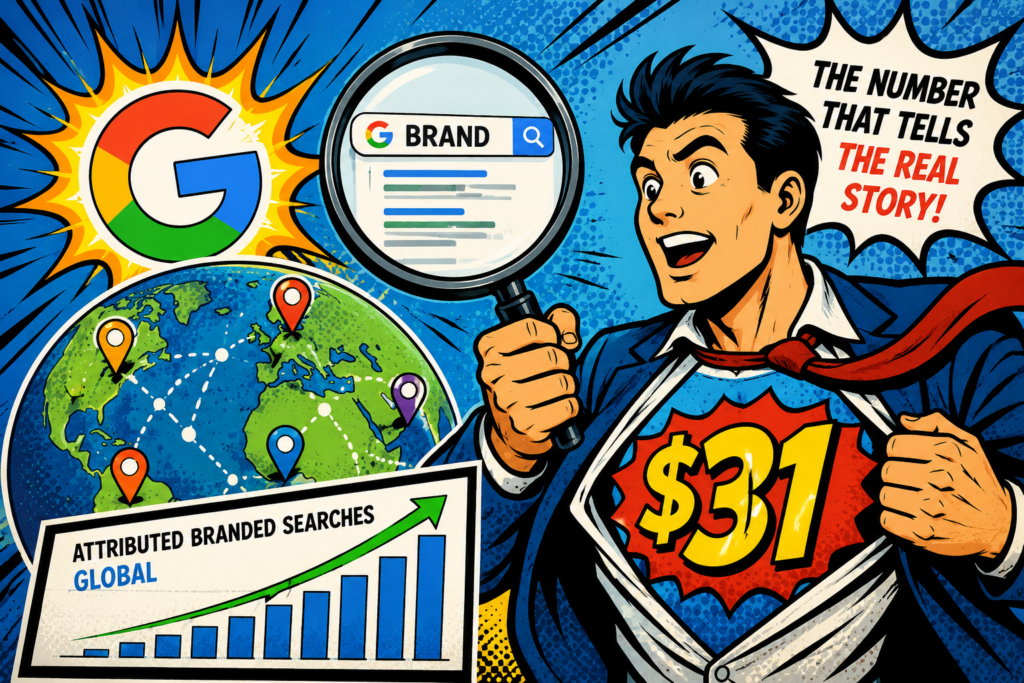
This week Google rolled out Attributed Branded Searches (ABS) as a reporting metric available worldwide in Google Ads.
The pitch: every extra branded search a YouTube ad generates is worth an average $31 in sales.
For any brand weighing a bigger YouTube budget, that is a compelling number. Before it lands in a board deck, it is worth knowing exactly what it measures and where it came from.
What Attributed Branded Searches Actually Measures
Attributed Branded Searches counts how many people saw or watched a YouTube ad, then later searched for that brand on Google or YouTube, whether or not they ever clicked it. It uses view-through attribution instead of a click.
Google connects the search back to the ad exposure using a lookback window of up to 30 days, and if a person saw more than one ad before searching, the credit goes to whichever ad they saw last.
YouTube is effectively the world’s second largest search engine, so Google is positioning ABS as a way to prove that video ads create demand even when nobody clicks.
ABS is not brand new. It launched last year in a handful of markets, and this week’s news is the global expansion plus a headline dollar figure attached to it for the first time. It is also not self-serve.
Advertisers request activation through a Google representative, then manually map every variation of their brand name, including misspellings and product lines, before the metric starts counting anything.
There is no historical backfill.
Data only starts accumulating from the moment activation happens, and it cannot currently be set as a primary bidding goal.
Where the $31 Figure Comes From (and What It Leaves Out)
The $31 number sits on a footnote most people will scroll past.
Google attributes it to internal first-party data combined with Nielsen IQ offline sales data collected between 2023 and 2025, described as a median across more than 500 U.S. advertisers concentrated in CPG, tech, auto, healthcare, and a few other verticals.
Two things are worth flagging before anyone puts this number in a forecast.
Google’s headline calls it an “average,” while the underlying study describes a median, and those rarely match on data this skewed.
The sample is also U.S. only, weighted toward CPG, and pulled entirely from advertisers Google selected for its own study.
None of that makes the number false. It does mean an apparel brand or a specialty food retailer running Shopify should not assume their own cost-per-search economics will look anything like the ones buried in Google’s footnote.
The Same Pattern AdBeacon Keeps Flagging, Just Wearing a Different Logo
Google publishing a study that proves Google’s own product drives sales is a platform grading its own homework, the same dynamic AdBeacon has pointed to for years in Meta’s self-reported ROAS. It is not a new problem.
It is the same problem, wearing a different logo.
Analysts who covered Google Marketing Live 2026 raised a related concern before ABS even went global.
Several warned that isolating YouTube’s lift inside Google’s own ecosystem leaves a blind spot for what is happening on Meta, TikTok, and every other channel running at the same time, and that Demand Gen results should not be compared directly to other campaign types without checking them against a source outside Google.
There is a more specific version of that problem built into ABS itself.
Last-impression credit means if someone sees a Meta ad on Monday and a YouTube ad on Wednesday, then searches for the brand on Thursday, Google counts that search as YouTube’s. Meta likely counts a version of the same conversion too.
Neither platform has any incentive to subtract the other’s claim, which is exactly the kind of double-counting that made AdBeacon’s Google Ads attribution gaps worth documenting in the first place.
What To Actually Do With Attributed Branded Searches
Use ABS as a directional signal for whether YouTube is building brand awareness, not as a revenue number.
Since it cannot be set as a primary bidding goal today, the safest place for it is a segment inside “All Conversions,” where the team can watch the trend without letting it steer spend automatically.
Before assuming a rising ABS count means rising revenue, check it against branded search demand and revenue movement in a measurement system that is not graded by the platform running the ad.
If independently measured branded traffic and revenue move together with ABS, that is a real signal worth acting on. If ABS climbs while first-party numbers stay flat, trust the numbers that can be verified.
Validate anything meaningful with a real incrementality test or a marketing mix model before shifting real budget.
Google’s own Meridian tool is one option for that layer, and it is worth using precisely because it is not scored by the same system that generated the ABS number. The goal is not to distrust everything Google publishes.
It is to treat a platform’s self-reported lift the same way any vendor’s case study gets treated: useful context, not proof.
A branded search is a real signal that someone remembered an ad. It is not the same as a sale, and it is definitely not the same as $31 landing in a bank account.
If you want to see what your YouTube and Meta spend is actually driving, measured independently of either platform’s own scorecard, book a live AdBeacon demo and we will show you the gap on your own account.
FAQ
What is Google’s Attributed Branded Searches metric?
Attributed Branded Searches (ABS) is a Google Ads reporting metric that counts branded searches on Google or YouTube made by people who were previously exposed to a YouTube ad, whether or not they clicked it.
Is Attributed Branded Searches based on clicks?
No. ABS uses view-through attribution. It counts anyone who saw or watched the ad and later searched for the brand within a lookback window of up to 30 days.
Where does Google’s $31 per search figure come from?
Google cites internal data combined with Nielsen IQ offline sales data from 2023 to 2025, a median across more than 500 U.S. advertisers concentrated in CPG and related verticals, not a universal benchmark for every category.
Can I bid on Attributed Branded Searches in Google Ads?
Not currently. ABS can be added to “All Conversions” for tracking, but Google has not made it available as a primary bidding goal.
Should brands treat Attributed Branded Searches as proof of YouTube ROI?
Treat it as a directional awareness signal, then validate against independently measured revenue and search data before reallocating budget. Platform-reported lift is context, not proof.
Sources
- Google: Unlock deeper insights for YouTube brand campaigns
- Jyll Saskin Gales: Google Ads Attributed Branded Searches Conversions Explained
- Seer Interactive: What Google’s Attributed Branded Searches Feature Means for Marketers
- Monks: Our Take on the Agentic Shift at Google Marketing Live 2026
- David Tamachi: Attributed Branded Searches in Google Ads, Demand Gen Guide