Last-Click Attribution Is Killing Your Ad Budget: Here's the Proof
Last-click attribution problems don’t announce themselves. There’s no alert that says “you just defunded the channel that was actually working.”
Instead, a report quietly shows one campaign underperforming, someone cuts its budget, and the real damage shows up two or three months later as a slower top of funnel and a shrinking pool of people to retarget.
By then it’s hard to trace the cause back to a measurement model.
What Last-Click Attribution Actually Measures (and Misses)
Last-click attribution gives 100% of the credit for a conversion to the final touchpoint before purchase.
- Nothing before that click counts for anything in the report,
- not the video someone watched three weeks earlier,
- not the influencer post that made them search for the brand,
- not the retargeting ad they scrolled past twice before finally clicking through on the third.
That model works fine when a customer journey genuinely has one touchpoint: someone sees an ad and buys immediately. It falls apart the moment a journey has more than one, which describes most ecommerce purchases now.
The typical path to purchase runs five to ten or more touchpoints across channels, devices, and days or weeks before someone converts. Last-click looks at that entire path and credits the last inch of it.
The structural bias this creates is consistent and predictable: it over-credits whatever sits closest to the conversion (branded search, retargeting, email) and erases whatever sits upstream (prospecting, influencer content, organic social, awareness video).
It’s not that upstream channels stop working. It’s that the measurement model was never built to see them.
A Hypothetical Brand Walkthrough
Picture a skincare brand running TikTok prospecting, Meta retargeting, and branded Google search side by side.
- A shopper discovers the brand through a creator’s video on TikTok, doesn’t click.
- A week later she sees a Meta retargeting ad, doesn’t click that either.
- A few days after that, she searches the brand name directly on Google,
- clicks the branded search ad, and buys.
Last-click attribution gives Google branded search 100% of the credit for that sale. TikTok, the channel that actually created the demand in the first place, gets nothing.
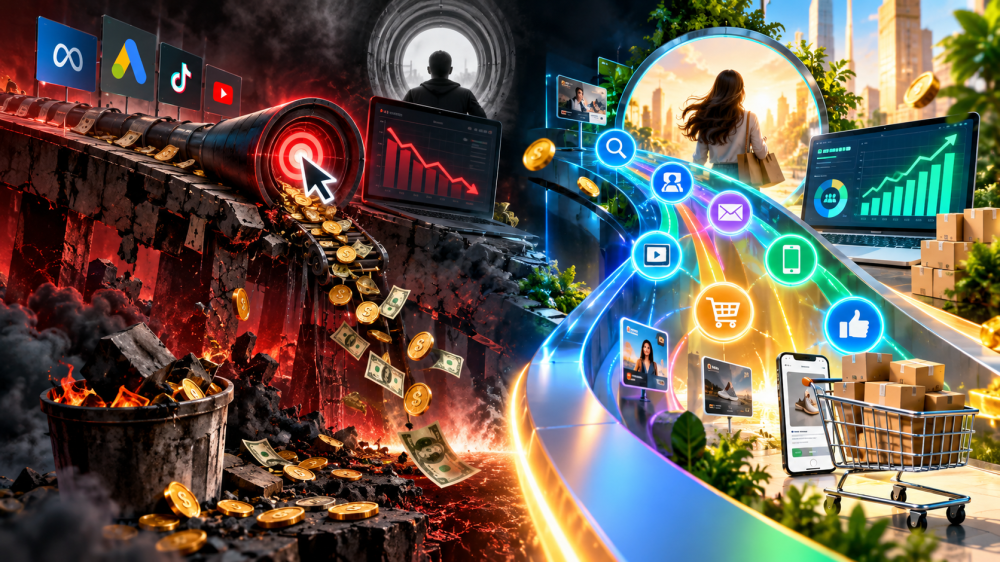
Multiply that pattern across a few thousand customers and the report tells a clean story: branded search is a star performer, TikTok is a waste of budget. The brand cuts TikTok spend to fund more branded search.
Here’s where it turns into a death spiral rather than a one-time misallocation.
With less TikTok prospecting running, fewer people discover the brand in the first place. Branded search volume, the channel that looked so efficient, starts declining too, because there are fewer people out there who already know the brand name to search for.
The team can’t figure out why their “best” channel is losing steam. The measurement model that told them to cut the real driver is the same one now hiding the consequence.
This isn’t a hypothetical pattern in the loose sense. Research from Fospha, which tracks more than $4 billion in annual paid media spend, found that brands running on last-click systematically undervalue TikTok by 30 to 50% compared to full-funnel measurement.
That’s not a rounding error. That’s a channel getting a third to half the credit it actually earned, every single reporting period, compounding into budget decisions quarter after quarter.

Which Channels Get Systematically Undervalued
The pattern is consistent enough to name specifically. Channels that sit upstream in the customer journey get erased by last-click, regardless of industry:
- Influencer and creator content. The awareness happens on the platform; the click, if it happens at all, often happens somewhere else entirely, days later.
- Prospecting and top-of-funnel video. These campaigns are designed to introduce the brand, not to close the sale on the spot, which makes them look inefficient under a model built to reward closing.
- Organic social and earned mentions. Nearly invisible to last-click by definition, since there’s rarely a trackable “click” to credit at all.
- Display and awareness advertising generally. Built for reach and recall, not immediate action, and penalized accordingly.
Meanwhile, last-click systematically over-credits whatever intercepts demand right before the purchase: branded search, retargeting, and remarketing email.
Those channels aren’t doing anything wrong, but they’re capturing intent that something else created, and the report doesn’t distinguish between capturing and generating.
Some industry voices have started saying this plainly rather than hedging around it. At industry summits in 2026, both TikTok and Meta have pushed advertisers publicly toward multi-touch and incrementality-based measurement over last-click, an unusual thing for platforms to say when a simpler model is often easier to sell against.
What to Use Instead
The fix doesn’t require ripping out your entire measurement stack overnight, and more teams are already making the shift than you might expect. A few concrete steps, in order of effort:
Start by looking at assisted conversions, not just last-click conversions.
Most ad platforms and GA4 already surface this data, showing which channels appear frequently earlier in the path even when they rarely get the final click. If a channel shows up constantly as an assist and rarely as a last-click winner, that’s the channel last-click is hiding from you.
Move to multi-touch attribution as your primary reporting model,
not a side report nobody checks. Multi-touch distributes credit across the touchpoints in a path instead of handing it all to the finish line, giving a much closer picture of what actually influenced the sale.
Pair multi-touch with click-based, first-party measurement
rather than relying entirely on platform-reported numbers, since platform attribution has its own credit-taking problems layered on top of the last-click problem. The two issues compound if left unaddressed together.
Watch for the death spiral signal specifically.
If cutting a channel’s budget is followed a few weeks later by declining performance in a channel you didn’t touch, especially branded search or direct traffic, that’s usually evidence the cut channel was generating demand the surviving channel was simply capturing.
Even Google’s own documented testing on advertisers switching from last-click to a more distributed model shows a meaningful lift in conversions at the same budget, because spend shifts away from channels that were only closing deals and toward channels that were actually creating them.
Google has been pruning legacy attribution options from its own platform in the same direction, which is a signal worth paying attention to from the company that built last-click into the industry’s default in the first place.
If you want to see which of your channels last-click is currently hiding, and what your budget allocation would look like under independent, multi-touch measurement instead, book a live AdBeacon demo.
—-
FAQ
What is the problem with last-click attribution?
Last-click attribution gives 100 percent of conversion credit to the final touchpoint before a purchase, ignoring every earlier interaction. Since most customer journeys involve five or more touchpoints across channels, this systematically undervalues upper-funnel channels like prospecting, influencer content, and awareness video, while overvaluing channels that simply capture demand right before the sale.
Which channels does last-click attribution undervalue the most?
Upper-funnel and awareness channels: influencer and creator content, prospecting video, organic social, and display advertising. Research tracking over $4 billion in paid media spend found last-click undervalues TikTok specifically by 30 to 50 percent compared to full-funnel measurement.
What is the “death spiral” in attribution?
It’s what happens when a brand cuts an upper-funnel channel based on a weak last-click number, which then reduces the demand flowing into lower-funnel channels like branded search. Those channels then start underperforming too, but the cause is hard to trace back to the original cut.
What should ecommerce brands use instead of last-click attribution?
Multi-touch attribution, which distributes credit across every touchpoint in a customer’s path rather than crediting only the final one, paired with first-party, click-based measurement that isn’t dependent on any single platform’s self-reported numbers.
How do I know if last-click is hurting my budget allocation?
Check assisted conversions against last-click conversions for each channel. A channel that appears frequently as an assist but rarely as the final click is being undervalued. Also watch for performance drops in unrelated channels shortly after cutting a top-of-funnel channel, a common death spiral signal.
Sources
- ClickZ: Why Is Last-Click Attribution Still Costing Ecommerce Brands Money in 2026?
- LayerFive: Why Last-Click Attribution Is Failing Ecommerce in 2026
- Search Performance Marketing: Attribution Models for Paid Search in 2026
- Aspire: Why Last-Click Attribution Fails Creator Marketing
- Monkedia: Last-Click Attribution Is Lying to You