What Is MCP for Meta Ad Optimization? How the Model Context Protocol Connects AI to Your First-Party Data
MCP is everywhere in paid media right now, and most media buyers still can’t explain what it actually does. That’s not a knock on anyone.
A recent industry analysis found that most marketing analysts haven’t heard of MCP yet, even though more than 10,000 MCP servers already exist and every major ad platform has shipped support for one.
The term arrived fast and got technical fast, which is exactly why it’s worth a plain explanation, especially now that MCP Meta optimization has gone from a niche developer topic to something with a real, official launch behind it.
On April 29, 2026, Meta shipped its own official Ads MCP server, hosted at mcp.facebook.com/ads. That’s the moment MCP stopped being a theoretical connector for Meta advertisers and became something anyone running Meta ads can actually turn on.
What MCP Actually Is, in Plain Terms
The Model Context Protocol, or MCP, is an open standard that Anthropic introduced in November 2024 for connecting AI assistants like Claude or ChatGPT to outside tools and data sources.
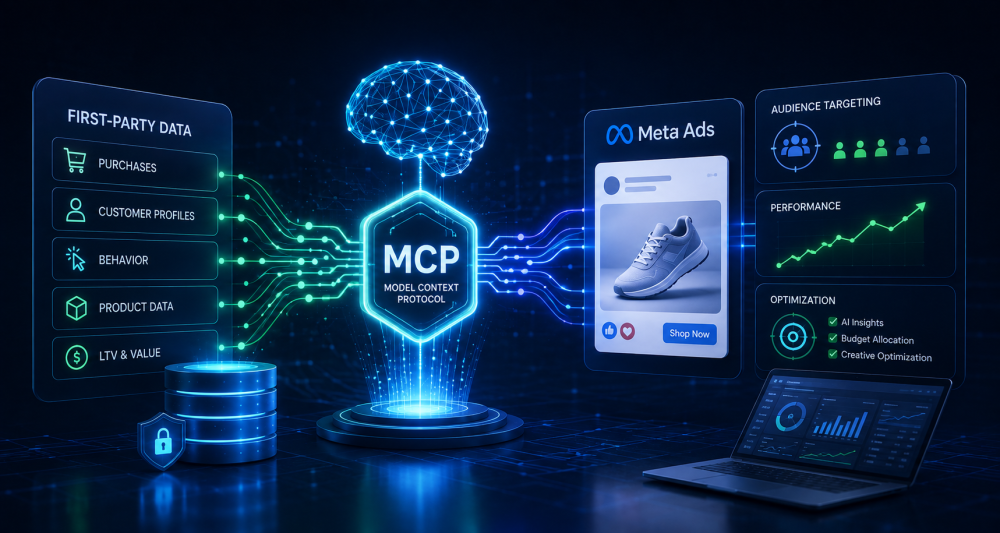
Before MCP, every pairing of an AI tool and an external system needed its own custom-built connection. An AI tool that wanted to read your Meta ad data, your Google Sheet, and your CRM needed three separate integrations, each built and maintained separately. MCP replaces that with one shared format.
A system exposes an MCP server once, and any MCP-compatible AI tool can connect to it the same way, without a custom integration for every new pairing.
Growth has been fast by any standard.
MCP’s developer toolkit went from roughly 100,000 downloads in its first month to 97 million monthly downloads by March 2026, a jump of nearly a thousand times in under a year and a half.
That’s the adoption curve underneath why MCP Meta optimization is suddenly a real conversation instead of a hypothetical one.
Why It Matters for Meta Ads Specifically Right Now
Meta’s official Ads MCP server exposes 29 tools spanning reporting, campaign management, catalog operations, and account diagnostics, all reachable through a single Meta Business OAuth connection with no developer app or app review required. That’s a meaningful shift.
Before this launch, connecting an AI tool to a Meta ad account meant going through an unofficial third-party server or building a custom integration against the Marketing API directly.
Meta also built in a guardrail worth knowing about: everything the official MCP creates lands paused. A human still has to approve and launch it.
That’s consistent with the pattern across the industry so far.
Most official ad-platform MCP servers that have shipped this year default to read access, or gate write access behind an explicit approval step, because letting an AI agent read your data safely is a very different risk than letting it spend your budget unsupervised.

What MCP Doesn’t Do (and Why That Matters for Optimization)
Here’s the part that gets lost in the excitement: MCP is a connection standard, not a data quality guarantee. It’s a transport layer.
It moves data between a system and an AI tool, but it doesn’t change what that data says. When an AI agent connects to Meta’s official Ads MCP, it’s reading Meta’s own reported numbers, the same view-through credit and platform-specific definitions that make AI outputs only as reliable as the data behind them.
MCP makes that data easier to reach. It doesn’t make it more accurate.
This is exactly where a second, first-party MCP connection earns its place alongside Meta’s own.
AdBeacon’s MCP Server exists for this specific gap: it gives Claude, ChatGPT, or any MCP-compatible AI tool a live read on verified, click-only, first-party conversion data, the kind of signal that isn’t shaped by how a platform defines its own success.
Connect both, and an AI agent working through Meta’s official MCP for campaign structure can reason against AdBeacon’s MCP for what actually happened, side by side, instead of taking Meta’s self-reported number as the whole picture.
What to Actually Do With This
If you’re running Meta ads and haven’t touched MCP yet, the practical starting point is small.
Connect Meta’s official Ads MCP for read-only reporting first: creative fatigue checks, spend pacing, account diagnostics. Get comfortable with what the connection surfaces before anything approaches a write action.
From there, layer in an AI tool built specifically for media buyers so the agent is reasoning against verified data, not just Meta’s own dashboard piped into a chat window. That combination, official platform access plus independent first-party signal, is quickly becoming the baseline setup rather than an advanced one.
MCP made the connection easy.
What you connect it to still decides whether the optimization that follows is any good. If you want to see what a first-party MCP connection actually looks like against your own Meta account, book a live AdBeacon demo.
—-
FAQ
What is MCP in simple terms?
MCP, or Model Context Protocol, is an open standard that lets AI tools like Claude or ChatGPT connect to outside systems, such as an ad account or a database, using one shared format instead of a custom-built connection for every pairing.
Is MCP the same thing as an API?
Not exactly. An API is how one system talks to another. MCP sits on top of that idea and standardizes it specifically for AI tools, so an AI assistant can discover and use tools, resources, and prompts across many different systems the same way, rather than needing a separate custom integration for each one.
Do I need to be technical to use MCP for Meta ads?
Not for the official Meta Ads MCP. It connects through a standard Meta Business OAuth login, the same kind of login used for most app connections, without requiring a developer account or custom code.
Is the official Meta Ads MCP safe to connect?
It’s Meta’s own sanctioned server, which is a meaningful difference from earlier unofficial third-party connectors. Read access is low-risk. Write actions, meaning anything the AI creates or changes, land paused by default and require a human to approve them before they go live.
What does AdBeacon’s MCP add on top of Meta’s own MCP?
Meta’s MCP gives an AI tool access to Meta’s own reported data. AdBeacon’s MCP gives that same AI tool access to verified, first-party, click-only attribution data, so it can weigh what Meta reports against what your store actually sold rather than relying on one platform’s version of events.