
5 Holiday 2026 Predictions Are In. The AI Traffic One Explains Why Your Tracking Data Looks Incomplete
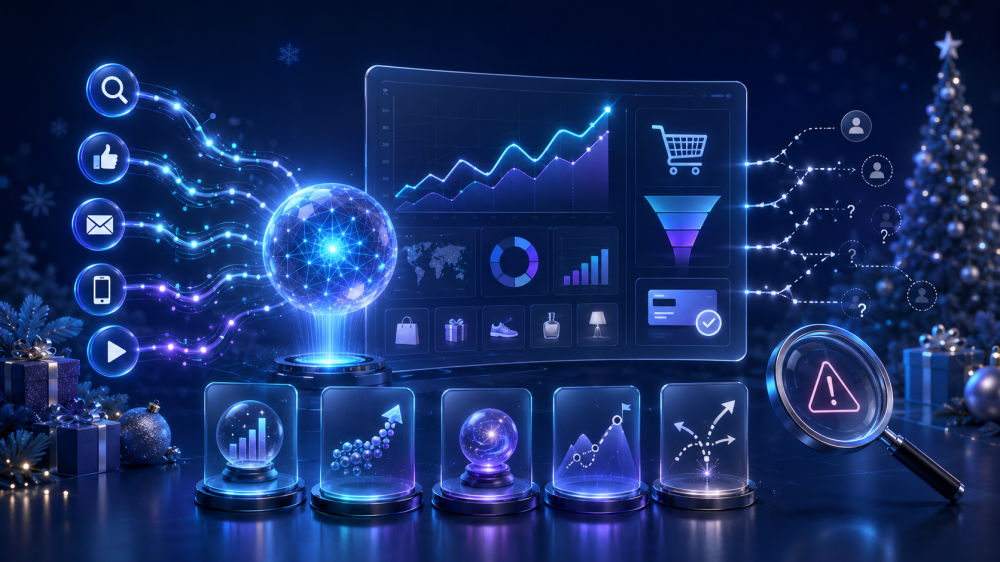
If your team keeps asking why is my tracking data incomplete this year, the newest holiday forecast has a clue buried inside it. Practical Ecommerce just published its annual five predictions for the 2026 holiday season, and two of them,
- AI-referred shoppers converting dramatically better
- And buy now, pay later crossing $22 billion,
- Point straight at the two channels most likely to make your Q4 reporting look wrong even when your campaigns are working.
Here’s what the forecast actually says, and what it means for how you measure the season that decides your annual numbers.
What the Forecast Says
Practical E-commerce’s 2026 holiday predictions call for U.S. online holiday sales to grow about 8% over last year, ahead of the National Retail Federation’s full-year retail growth estimate.
Two of the five predictions matter most for measurement specifically.
- First, shoppers referred from generative AI tools are expected to convert at least 25% better than shoppers from non-AI channels this peak season, building on a trend where AI-referred shoppers already converted 31% better last Christmas and 54 percent better on Thanksgiving Day, alongside a 693% year-over-year jump in AI-driven retail traffic during the 2025 season.
- Second, buy now, pay later services are forecast to finance more than $22 billion in U.S. online holiday purchases for the first time.
The other three predictions, ecommerce growth, cross-border spending, and Amazon’s marketplace share, are useful planning context.
The AI and BNPL predictions are the ones that will quietly distort what your reporting tells you about the season while it’s happening.
Why AI-Referred Shoppers Will Make Your Tracking Data Look Incomplete
The conversion advantage in the forecast is real, but most stores can’t actually see where it’s coming from.
Most AI apps strip referrer headers when they send someone to your site, which means the visit shows up in standard analytics as direct traffic, indistinguishable from someone who typed your URL from memory.
One 2026 analysis of over 446,000 site visits found 70.6% of AI-driven traffic arrives with no referrer at all, landing entirely in the direct bucket.
A marketing researcher cited in the same analysis found her measurable referral traffic had dropped 90% even as new users grew 126 percent year over year, because the users hadn’t disappeared, they’d just stopped carrying any source signal at all.
That’s the mechanism behind why is my tracking data incomplete this holiday season specifically.
A shopper asks ChatGPT or Gemini which gift to buy, clicks through to your product page, and converts. Your platform dashboards have no idea an AI assistant was involved.
The sale gets logged as direct, or worse, gets folded into whatever channel happened to touch that session last, and the actual AI-referral conversion advantage Practical E-commerce is forecasting becomes invisible in your own reporting at the exact moment you’d want to double down on it.
Why BNPL Growth Adds a Second Layer of Distortion
Buy now, pay later crossing $22 billion in holiday spending compounds the problem.
When a shopper checks out through a BNPL provider, the transaction often routes through a third-party payment gateway before landing back on your confirmation page.
Depending on how that redirect is configured, the payment provider can appear as the referring source of the sale instead of whatever ad or channel actually drove the shopper there in the first place.
Combine that with the deferred, installment-based nature of BNPL purchases, and holiday revenue recognition gets murkier too.
A sale financed through BNPL still counts as a full conversion the moment it happens, but the cash doesn’t arrive the same way a single-payment transaction does, which matters if your reporting stack times “recovered revenue” or channel attribution to payment completion rather than the sale itself.
What to Check Before the Season Starts
Both of these predictions point at the same underlying problem: platform and default analytics attribution wasn’t built to handle either AI referral traffic or split-payment checkout, and both are growing fast heading into the highest-stakes reporting window of the year.
GA4 now has a dedicated AI Assistant channel for traffic it can positively identify, but that only catches sessions where the AI tool actually passes a recognizable source, which is still the minority of AI-driven visits. Worth auditing now, before Black Friday:
- Pull your current direct-traffic segment and check what share of it converts on product or category pages rather than the homepage, a common signature of AI-referred sessions arriving mid-funnel
- Confirm your BNPL provider’s checkout redirect isn’t overwriting the original referral source in your analytics
- Set expectations with your team now that a rising direct-traffic conversion rate this Q4 may reflect AI referrals you can’t yet see cleanly, not a channel you should stop measuring
- Compare your platform-reported channel mix against a first-party, click-based view of the same period once the season closes, since the gap between the two is exactly where AI and BNPL distortion tends to hide
This is the same root problem behind why BNPL is quietly wrecking your real conversion numbers, and it’s closely related to the broader gap between where customers discover you through AI and what your attribution data can actually see.
Neither problem is solved by waiting for platforms to fix their own dashboards.
Both get solved by measuring against data your own store generated, independent of whatever a platform or payment gateway decided to report.
Practical Ecommerce’s forecast is a good read for planning inventory and cash flow this holiday season. For measuring whether the season actually worked, the more useful question isn’t whether the 8% growth prediction holds.
It’s whether your reporting can actually see the AI-referred and BNPL-financed sales that are driving it. If you want a first-party, click-based view of your holiday traffic that doesn’t lose AI referrals to the direct bucket, book a live AdBeacon demo before the season starts.
—-
FAQ
Why is my tracking data incomplete during the holiday shopping season?
Two fast-growing holiday traffic sources, AI-referred shoppers and buy now, pay later checkouts, commonly break standard attribution. AI apps often strip referrer headers, so those visits land in direct traffic instead of a labeled channel, and BNPL checkout redirects can overwrite the original referral source.
Why does AI-referred traffic show up as direct traffic in my analytics?
Most AI apps and assistants don’t pass a referrer header when they send a user to your site. Without that signal, standard analytics tools classify the visit as direct, the same category used for someone who typed your URL from memory, even though the visit originated from an AI recommendation.
Does buy now, pay later affect ad attribution?
It can. BNPL checkouts often route through a third-party payment gateway before returning to your confirmation page, and depending on the redirect configuration, the payment provider can appear as the referring source instead of the ad or channel that actually drove the shopper to your site.
How can I see AI-referred conversions if my analytics classifies them as direct?
Comparing platform-reported channel data against a first-party, click-based measurement layer helps surface the gap, since first-party tracking ties conversions back to the actual click on your own domain rather than relying on a referrer header an AI app may have stripped.
Sources
- Practical Ecommerce: 5 Predictions for 2026 Holiday Shopping
- Digital Commerce 360: Generative AI Shifts Online Holiday Shopping Traffic in 2025
- TapClicks: How to Track AI Referral Traffic and Fix Your Marketing Attribution in 2026
- Catalog: Referral Traffic in Google Analytics, How to Track AI and Direct Visits in GA4