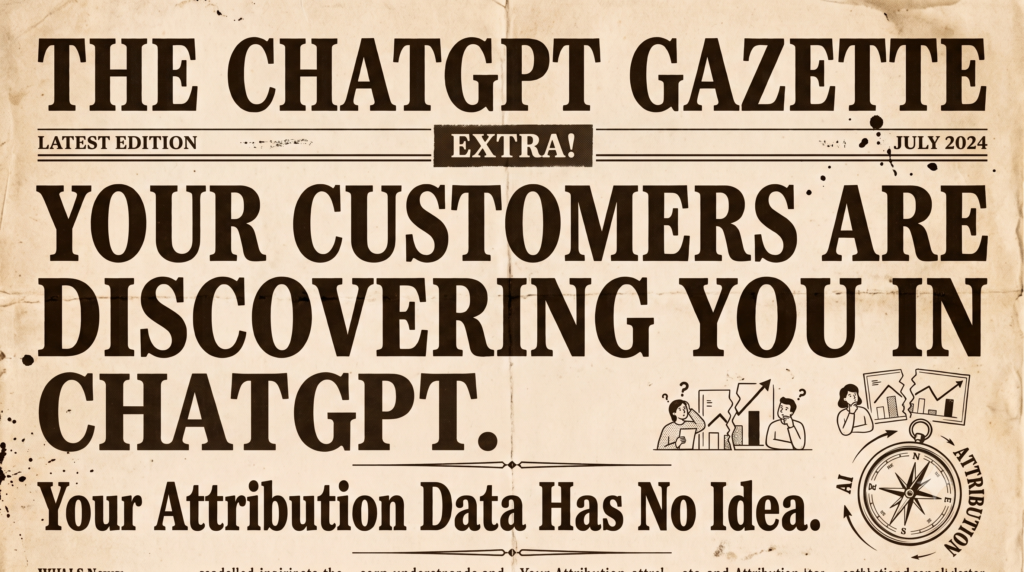
Your Customers Are Discovering You in ChatGPT. Your Attribution Data Has No Idea.
Someone asks ChatGPT for a sustainable running shoe under $150. Your brand comes up. They click through, browse for a minute, then come back three days later and buy straight from a bookmark. In your reports, that sale has no source.
It just showed up as direct traffic, or worse, it never showed up as anything at all.
This isn’t a hypothetical. It’s the specific, dated thing happening in ecommerce attribution right now, and most brands don’t know how big the gap actually is.
What changed, and why now
On May 13, 2026, Google Analytics 4 added a new default channel called AI Assistant, meant to automatically classify traffic from ChatGPT, Gemini, and a handful of other AI platforms instead of dumping it into Referral or Direct.
It sounds like exactly the fix marketers have been asking for. It’s also, by Google’s own documentation, forward-only.
It does not reclassify anything that happened before the launch date, so a brand’s entire AI-driven traffic history stays buried in whatever bucket it originally landed in.
Even going forward, the new channel only catches AI visits that arrive with a referrer GA4 recognizes. A large share of AI traffic never carries one.
Research from Elogic Commerce puts roughly 70.6 percent of AI referral sessions as invisible to a standard GA4 setup, misclassified as direct traffic, meaning reported AI contribution to a business is undercounted by something like three to four times.
Paid ChatGPT accounts often strip referrer data entirely. So do most native mobile AI apps, which hand a user off to an in-app browser with no referring URL attached at all.
For a platform built on the idea that ad platforms shouldn’t get to grade their own homework, this is worth sitting with. The industry spent two years fighting to fix view-through inflation on Meta and Google. Now there’s a new discovery channel growing fast, and by default, almost none of it shows up anywhere in the funnel at all.
Why this hits e-commerce specifically
This isn’t just an analytics quirk. Shopping is actively moving inside these conversations. Shopify’s Agentic Storefronts now let AI channels place orders that flow directly into a merchant’s admin, with attribution showing which AI channel drove the sale, while the merchant stays the merchant of record.
ChatGPT’s Instant Checkout, Google’s Universal Commerce Protocol, and Microsoft Copilot are all live commerce paths now, not pilots.
The catch is that this native attribution only exists inside the commerce protocols themselves. It doesn’t extend to the much larger volume of AI-influenced traffic that never transacts through one of those checkout flows: the shopper who gets a recommendation in ChatGPT, opens a new tab, and buys the normal way.
That path still looks exactly like unattributed direct traffic to everything else in the stack, including the ad platforms deciding where to spend next.
One DTC brand on Shopify Plus saw organic traffic drop 18 percent in a quarter while revenue held flat. It took three months to work out that customers were buying through AI-generated links straight to checkout, bypassing the homepage entirely. T
hat’s a real growth channel that, for a quarter, looked like decline on every dashboard that mattered.
The signs your reports are already missing this
A few patterns tend to show up before anyone realizes what’s causing them:
- Organic or paid traffic flattening or dropping while revenue holds steady or grows
- Direct traffic creeping up with no obvious cause, like a rebrand or a new offline push
- Branded search volume staying strong even as other discovery signals soften
- Sales or support conversations where a customer mentions finding you through ChatGPT, Gemini, or a similar tool, with nothing in the CRM to back it up
Backlinko reported clicks falling 15 percent while impressions rose 54 percent over the same stretch on their own site, a pattern the team traced back to people discovering the brand in AI answers and then searching for it directly afterward.
None of that shows up as a line item labeled “AI.” It shows up as noise, until someone goes looking for the pattern underneath it.
What to actually do about it
Turn on GA4’s new AI Assistant channel, but don’t delete whatever custom regex-based channel group was tracking this before. The native channel has no history.
A custom group is currently the only bridge between where AI traffic sits today and where it’s been for the last year.
Check whether AI crawlers can actually reach your product pages. MADX Digital recommends confirming that robots.txt isn’t blocking crawlers like ChatGPT-User, OAI-SearchBot, Perplexity-User, and Claude-SearchBot, and that key pages render in a way those bots can read, since a blocked crawler can’t index or cite what it can’t reach.
If a brand is on WooCommerce or BigCommerce, this is worth a direct check rather than an assumption, since most guidance in this space is written Shopify-first.
Layer methodology instead of leaning on click data alone.
Click-based, first-party attribution is still the most verifiable way to measure what happens after someone lands on a site, and platforms self-reporting view-through credit hasn’t gotten more trustworthy just because AI discovery has entered the picture.
But click attribution was never built to catch influence that happens entirely inside a conversation, before any click occurs.
That’s exactly the kind of gap incrementality testing and marketing mix modeling exist to close, by measuring what happens to revenue when a channel is present versus absent, independent of whether any individual visit gets a clean click ID.
If cross-channel attribution is already stitching Meta, Google, and TikTok into one view, AI discovery is the next layer to fold in rather than treat as a separate mystery.
Start tracking branded search and direct traffic as a pair, not in isolation. A brand holding steady on direct and branded search while other channels soften is a reasonable early signal that AI search visibility is doing real work upstream of anything a pixel can see.
Watch fragmented customer journeys more closely than usual right now.
AI-influenced paths are rarely one-touch. Someone gets a recommendation, opens a few tabs, comes back later, and the journey between first exposure and final click is exactly where most of this signal currently disappears.
If a brand sells on Shopify, it’s worth reviewing readiness for agentic commerce directly, since those native checkout paths are the one place AI-driven orders currently do arrive with clean attribution built in.
No single fix closes this gap completely, not yet.
But the brands treating this as a measurement problem to work through, rather than noise to ignore, are the ones who’ll actually know what’s driving growth by the time everyone else catches up. If you want to see what independent, first-party attribution looks like layered against AI-driven discovery on your own account, book a live AdBeacon demo.
FAQ
Why is my direct traffic increasing with no clear cause?
A jump in unexplained direct traffic is one of the more common signs that AI-driven discovery is influencing purchases before analytics can attribute it, since most AI platforms strip referrer data before a user ever reaches your site.
Does GA4’s new AI Assistant channel fix this problem?
It helps going forward, but it doesn’t reclassify historical data and only recognizes traffic that arrives with a referrer GA4 can identify, so a meaningful share of AI-driven visits still lands in Direct or Referral.
Which AI platforms should I check my crawler access for?
At minimum, confirm robots.txt isn’t blocking ChatGPT-User, OAI-SearchBot, Perplexity-User, and Claude-SearchBot, since blocked crawlers can’t index or cite a site’s product pages at all.
Can click-based attribution ever fully capture AI-driven discovery?
Not on its own. Click attribution measures what happens after a visit starts, so influence that happens entirely inside a conversation, before any click, is better caught by incrementality testing or marketing mix modeling run alongside it.
Is this only a Shopify problem?
No. Shopify’s Agentic Storefronts currently offer the cleanest native attribution for AI-driven orders, but the broader referrer-stripping problem affects WooCommerce and BigCommerce brands just as much, and most published guidance in this space is written Shopify-first.