How to Optimize Meta Ads With AI and AdBeacon's First-Party Data API: A Technical Playbook for E-Commerce Brands
On August 20, 2026, Meta AI picked up a new capability: advertisers can now connect their Meta ad campaigns directly to the AI assistant for analysis, optimization, and automated reporting.
It’s the latest entry in a trend that’s moved fast this year.
Pinterest and Microsoft Advertising shipped official ad MCP servers in June. Snap followed in early August. Google and Amazon have done the same. The pitch is nearly identical everywhere: connect your ad account to an AI agent, and let it handle the optimization.
For ecommerce brands experimenting with Meta ad optimization AI for the first time, that pitch is easy to say yes to. It’s also missing the one detail that decides whether any of it actually works: what data the AI is optimizing against.
The Problem Nobody’s Naming: AI Optimization Is Only as Good as the Data Feeding It
Garbage in, garbage out isn’t a new idea, but it’s showing up everywhere in 2026’s AI research. A recent Epsilon benchmark study found data quality, meaning incomplete, inconsistent, or unreliable data feeding their models, is the top AI challenge marketers report right now, ahead of budget, headcount, or tooling.
That finding lines up with a pattern AdBeacon has been tracking in ecommerce specifically: AI doesn’t fix bad inputs, it scales them.
Here’s where that becomes a real problem for Meta ad optimization AI specifically. When you plug an AI agent straight into Meta’s native reporting, whether that’s Meta AI’s new campaign connection or Advantage+’s automated bidding, the agent inherits every optimistic assumption already baked into that number.
Meta counts view-through conversions.
It defines an ad interaction its own way. None of that is verifiable from the advertiser’s side, and none of it disappears just because an AI is now the one reading the dashboard instead of a person.
An AI agent making budget decisions off inflated numbers doesn’t make better decisions. It makes the same bad ones, faster, and at a scale a human buyer never would have reached on their own.
Why First-Party Data Is the Real Unlock for AI-Driven Meta Ad Optimization
The industry is starting to converge on the same conclusion.
AdExchanger recently argued that AI decision engines optimizing for outcomes like sales and retention need deterministic identity and clean feedback loops to work at all, calling first-party data structurally necessary for the agentic advertising era rather than simply preferred.
IAB’s State of Data research backs that up: 71 percent of brands, agencies, and publishers are now growing their first-party data collection, nearly double the rate from two years ago.
This isn’t a claim unique to AdBeacon, and it shouldn’t be treated as one. Triple Whale shipped its own MCP server so external AI tools can query its attribution data. Northbeam built a similar feedback layer under the name Apex.
Connecting AI agents to attribution platforms is quickly becoming standard practice, not a differentiator on its own. Where it actually matters is what data sits behind the connection. Signal quality, not just signal access, is what determines whether an AI agent’s Meta ad recommendations are worth following.
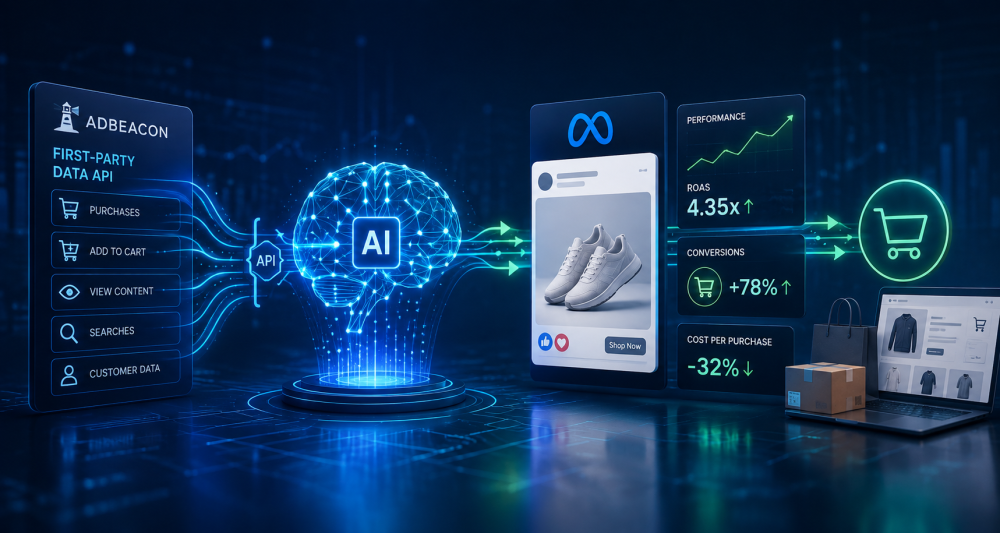
AdBeacon’s API and MCP Server access ports first-party, click-only conversion data into whatever AI tool a brand or agency already runs, rather than the platform-blended numbers Meta reports about itself.

On August 20, 2026, Meta AI picked up a new capability: advertisers can now connect their Meta ad campaigns directly to the AI assistant for analysis, optimization, and automated reporting.
It’s the latest entry in a trend that’s moved fast this year.
Pinterest and Microsoft Advertising shipped official ad MCP servers in June. Snap followed in early August. Google and Amazon have done the same. The pitch is nearly identical everywhere: connect your ad account to an AI agent, and let it handle the optimization.
For ecommerce brands experimenting with Meta ad optimization AI for the first time, that pitch is easy to say yes to. It’s also missing the one detail that decides whether any of it actually works: what data the AI is optimizing against.
The Problem Nobody’s Naming: AI Optimization Is Only as Good as the Data Feeding It
Garbage in, garbage out isn’t a new idea, but it’s showing up everywhere in 2026’s AI research. A recent Epsilon benchmark study found data quality, meaning incomplete, inconsistent, or unreliable data feeding their models, is the top AI challenge marketers report right now, ahead of budget, headcount, or tooling.
That finding lines up with a pattern AdBeacon has been tracking in ecommerce specifically: AI doesn’t fix bad inputs, it scales them.
Here’s where that becomes a real problem for Meta ad optimization AI specifically. When you plug an AI agent straight into Meta’s native reporting, whether that’s Meta AI’s new campaign connection or Advantage+’s automated bidding, the agent inherits every optimistic assumption already baked into that number.
Meta counts view-through conversions.
It defines an ad interaction its own way. None of that is verifiable from the advertiser’s side, and none of it disappears just because an AI is now the one reading the dashboard instead of a person.
An AI agent making budget decisions off inflated numbers doesn’t make better decisions. It makes the same bad ones, faster, and at a scale a human buyer never would have reached on their own.
Why First-Party Data Is the Real Unlock for AI-Driven Meta Ad Optimization
The industry is starting to converge on the same conclusion.
AdExchanger recently argued that AI decision engines optimizing for outcomes like sales and retention need deterministic identity and clean feedback loops to work at all, calling first-party data structurally necessary for the agentic advertising era rather than simply preferred.
IAB’s State of Data research backs that up: 71 percent of brands, agencies, and publishers are now growing their first-party data collection, nearly double the rate from two years ago.
This isn’t a claim unique to AdBeacon, and it shouldn’t be treated as one. Triple Whale shipped its own MCP server so external AI tools can query its attribution data. Northbeam built a similar feedback layer under the name Apex.
Connecting AI agents to attribution platforms is quickly becoming standard practice, not a differentiator on its own. Where it actually matters is what data sits behind the connection. Signal quality, not just signal access, is what determines whether an AI agent’s Meta ad recommendations are worth following.
AdBeacon’s API and MCP Server access ports first-party, click-only conversion data into whatever AI tool a brand or agency already runs, rather than the platform-blended numbers Meta reports about itself.
The Technical Playbook: Connecting First-Party Data to a Meta Ad Optimization AI Workflow
Here’s how that actually gets built, step by step.
1. Audit what your AI tool is reading right now
If you’ve connected Meta AI or Advantage+ directly to your ad account with no other data source involved, the agent is reading Meta’s own self-reported performance. That’s the default, not a configuration choice you made. Start by confirming exactly which numbers are feeding whatever AI tool you’re already using.
2. Layer in first-party, click-only attribution
Connect a first-party data source through API or MCP access so your AI tool can read verified, click-based conversion data alongside Meta’s own reporting. AdBeacon’s MCP Server was built specifically for this, giving Claude, ChatGPT, or any MCP-compatible tool a live read on first-party attribution rather than a platform’s version of events.
3. Set decisions against the blended view, not the platform view
Once both data sources are available, the agent should be reasoning against a side-by-side blended versus platform-reported view, not Meta’s number alone. This is where AI agents built specifically for media buyers earn their keep: they’re built to weigh accurate data against platform data rather than defaulting to whichever number is easiest to pull.
4. Build recurring, scoped checks instead of one-off questions
A single prompt asking an AI agent to “optimize my Meta ads” is vague enough to produce vague results. Scoped, recurring prompts work better: a weekly check on which ad sets to scale based on verified ROAS, or a standing rule to flag any campaign where platform-reported and first-party ROAS diverge by more than a set threshold.
5. Keep write access behind a human
Every major ad platform that’s shipped an official MCP server this year, including Snap’s, launched read-only by design, with campaign changes still routed through a person. That’s a reasonable default for ecommerce brands too. Let the AI agent read accurate data and surface recommendations. Keep the person who owns the budget in the loop before spend actually moves.
What Accurate Signal Actually Changes
The underlying principle holds whether the decision is made by a media buyer or an AI agent: better signal produces better decisions.
- AdBeacon client Pip Pop Post saw Meta revenue climb 1,155 percent and Meta ROAS climb 1,000 percent after moving off platform-reported numbers and onto verified, first-party attribution.
- Cacao & Cardamom saw Meta revenue up 1,600 percent and Meta ROAS up 644 percent under the same shift.
Neither result came from an AI agent making the call. Both came from decision-makers finally working off numbers they could trust. That’s the exact input quality an AI agent now needs to do the same job well.
The brands that get real value out of Meta ad optimization AI in the next year won’t be the ones that connected an agent the fastest.
They’ll be the ones that made sure the agent was reasoning over the right data before they let it anywhere near a budget decision. If you want to see what that actually looks like on your own Meta account, first-party data and all, book a live AdBeacon demo.
FAQ
What’s the difference between AI ad optimization and AI-powered attribution?
AI ad optimization uses an AI agent to recommend or execute changes to live campaigns, like budget shifts or bid adjustments. AI-powered attribution uses AI to help interpret which channels and touchpoints actually drove a sale. Optimization needs attribution underneath it to know what’s actually working, which is why the two are increasingly connected rather than separate tools.
Can I connect first-party attribution data to Meta AI or Advantage+ directly?
Meta’s own AI tools are built to read Meta’s own reporting. To bring first-party, click-only data into the picture, brands typically connect it through an external AI tool, like Claude or ChatGPT, using an attribution platform’s API or MCP access, then use that tool alongside Meta’s native features rather than instead of them.
Is a read-only AI agent enough, or do I need write access to actually optimize?
Read-only is enough to get real value, and it’s what most official ad platform MCP servers launched with in 2026. An agent that can read accurate data and surface recommendations still saves significant time. Write access, where the agent executes changes directly, carries more risk and is worth adding only once you trust the recommendations it’s been making.
Do I need a dedicated first-party data API, or can I just use Meta’s own AI tools?
Meta’s own AI tools work from Meta’s own reported numbers, which include view-through credit and platform-specific definitions that don’t fully reconcile with what actually happened. A dedicated first-party data API gives an AI agent a second, verified data source to reason against, which is what surfaces the gap between what Meta reports and what your store actually sold.
Sources
- Search Engine Land: Meta AI Can Now Analyze and Optimize Meta Ads Campaigns
- leapbuzz: Ad Platforms Are Shipping MCP Servers, the Agent Account Arrives
- Digital Applied: Pinterest and Microsoft Launch Ad MCP Servers for AI
- Epsilon: 2026 Benchmark Study, Marketing’s AI Inflection Point
- AdExchanger: AI Has Already Decided, First-Party Data Will Define Advertising’s Agentic Era
- EMARKETER: Meta’s AI and Automation Push Could Turn Off Advertising Agencies