
WooCommerce 10.9 Made Stores Machine-Readable for AI Agents. Your WooCommerce Attribution Tracking Needs a Look.
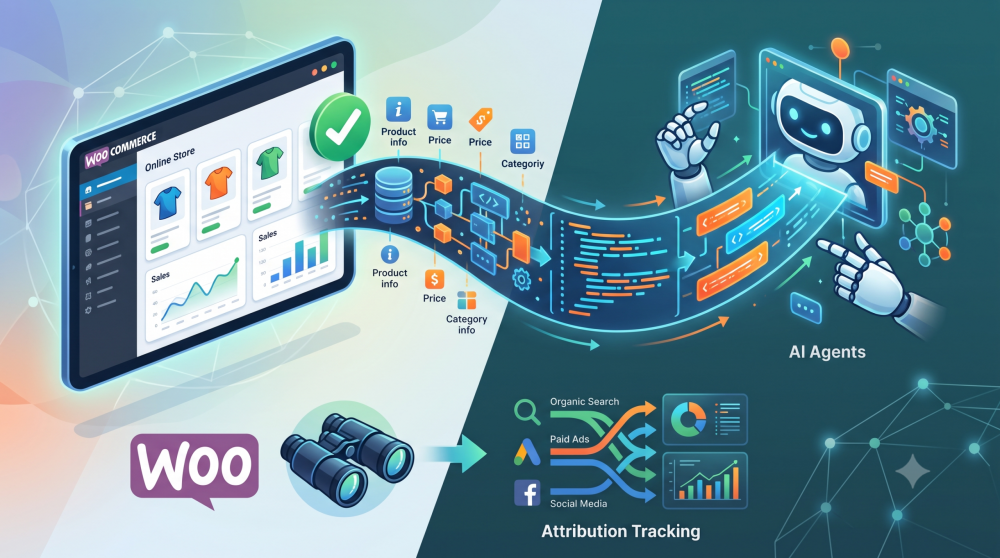
WooCommerce attribution tracking just got a new complication it wasn’t built for.
On June 23, 2026, WooCommerce 10.9 shipped the platform’s clearest move yet into agentic commerce: seven canonical “domain abilities” for products and orders, exposed through the WordPress MCP Adapter, that make any WooCommerce store natively addressable by AI agents.
No merchant-facing button, no announcement most store owners will ever see, just infrastructure that quietly landed on top of a platform that already had thinner, less authoritative attribution guidance than Shopify to begin with.
That timing is the real story here.
WooCommerce runs roughly half of tracked ecommerce sites, and its store owners are now getting agentic-commerce readiness before most of them have a solid answer for basic multi-platform attribution, let alone attribution for sales an AI agent helped complete.
This is worth understanding now, while the AI-agent layer is still a developer preview, rather than after it’s live on your store’s normal upgrade cycle.
What WooCommerce 10.9 Actually Changed and How AI-Agent Addressability Works
Before 10.9, an AI agent or automation tool that wanted to act on a WooCommerce store worked through the standard REST API, and every integration interpreted operations like “create a product” or “update an order status” slightly differently.
There was no single authoritative definition.
WooCommerce 10.9 fixed that by shipping seven schema-defined “abilities,” canonical operations for products and orders that any Model Context Protocol client, Claude Code, Cursor, ChatGPT with connectors, or any other MCP-compatible tool, can call through a standardized, permission-controlled interface.
Five of those seven abilities can write changes, not just read them, meaning an agent with the right permissions can create or delete products, update order status, or add notes to a live store.
Each operation runs through schema validation before execution, rejecting unknown fields and unsupported values up front, which is the mechanism that makes it safe to let a probabilistic system act on real inventory and real orders in the first place.
It’s still officially a developer preview, and WooCommerce’s own guidance is to pilot it against a staging store with tightly scoped API keys before pointing an agent at real revenue.
The strategic intent, as Automattic’s engineering team has described it, is for WooCommerce to sit as an orchestration layer that any AI platform can plug into, regardless of which model or assistant a merchant or shopper is using, rather than depending on a single vendor’s closed system.
That’s a meaningfully different approach from a walled-garden AI checkout feature, and it means the agent-readable surface is going to expand across the WooCommerce ecosystem on the normal plugin upgrade cycle, whether or not any given store owner has thought about what it means for their tracking.
Why WooCommerce Attribution Has Always Lagged Shopify-First Tooling
This isn’t a new problem, 10.9 just raised the stakes on an existing one.
Most attribution guidance, tooling, and case studies in ecommerce are written Shopify-first, because Shopify has the largest, most vocal merchant base and the deepest third-party app ecosystem to draw content and integrations from.
WooCommerce, despite powering something close to half of tracked ecommerce sites, has never had the same depth of attribution-specific tooling or documentation, largely because it’s an open-source, self-hosted plugin rather than a single managed platform with one canonical way of doing things.
That gap compounds with agentic commerce layered on top of it.
WooCommerce-plus-agentic-commerce content barely exists yet, which means a store owner trying to figure out what AI-agent addressability means for their tracking setup is working from a genuinely thin body of guidance, thinner than what a Shopify brand navigating an equivalent question would find.
That’s the double coverage gap this moment creates: attribution content for WooCommerce has always lagged, and the AI-agent layer on top of it is even less mapped.
What Clean Product Data and Structured Feeds Mean for a WooCommerce Store Specifically
An AI agent querying a store through MCP abilities is only as useful, and only as accurate, as the product data it’s reading.
Incomplete titles, missing structured attributes, inconsistent categorization, and stale inventory data don’t just hurt SEO anymore, they directly degrade what an agent can correctly recommend, price, or transact on behalf of a shopper.
A WooCommerce store’s product catalog quality just became infrastructure for a second audience beyond human shoppers and search crawlers.
Because WooCommerce is self-hosted and plugin-dependent rather than running on a single managed catalog schema, product data quality varies enormously from store to store in a way it doesn’t on more locked-down platforms.
Auditing product titles, attributes, categories, and stock accuracy for completeness and consistency is a more urgent task on WooCommerce specifically than it might be elsewhere, since there’s no platform-level guardrail forcing that structure the way there is on more prescriptive systems.
A clean, structured feed is what makes a store legible to an agent in the first place, before attribution even enters the picture, and it’s the same underlying discipline behind making sure your store is visible to customers discovering you through an LLM in the first place, whether the agent is shopping on a customer’s behalf or simply reading your catalog to answer a question.
Setting Up First-Party, Server-Side Tracking That Survives Both Browser Privacy Changes and Agent-Mediated Checkout
Browser-based pixel tracking already has a well-documented reliability problem, iOS privacy restrictions and ad blockers mean a meaningful share of users never fire a browser-side conversion event at all.
Agent-mediated commerce adds a second, newer failure mode on top of it: if an AI agent completes or assists a transaction through WooCommerce’s write-capable abilities rather than a shopper clicking through a normal browser checkout flow, a tracking setup that only fires from a thank-you page or a client-side pixel may never see that conversion happen.
The fix for both problems is the same: trigger tracking from the WooCommerce order object itself, server-side, rather than from a browser event.
When an order is created in WooCommerce’s backend, that’s the signal to send to your ad platforms and attribution layer, independent of whether a human clicked through a normal checkout page or an agent completed the action through the abilities API.
This approach, paired with Conversions API delivery to Meta, Google, and TikTok, captures conversions regardless of how the purchase reached the order table, which is exactly the resilience a store needs as agent-mediated interactions become a growing, if still early, share of how transactions get initiated.
Why Platform-Agnostic, Click-Only Measurement Matters Even More for a Store That Isn’t Shopify-Native
WooCommerce store owners are already operating with less specific attribution guidance than Shopify brands get by default.
Layering AI-agent addressability on top of that gap makes independent, first-party measurement less optional, not more.
A platform-native reporting view was always only a translation of what happened on that specific platform, and a WooCommerce store now has two forces pulling at that translation simultaneously: thinner industry-wide tooling for the platform itself, and a genuinely new transaction pathway that most tracking setups weren’t built to account for.
Click-only, first-party measurement tied to your own order data doesn’t depend on whichever agent, browser, or checkout path a transaction happened to take.
It verifies what actually drove a sale against your own records, rather than trusting a single platform’s dashboard to have correctly captured an interaction that may not have looked like a traditional browser session at all.
That’s the same discipline behind who gets attribution credit when an AI buys something for someone and what agentic commerce means for e-commerce brands preparing now, applied specifically to a platform where the underlying attribution foundation was already thinner than most.
AdBeacon natively supports WooCommerce, which means your attribution layer doesn’t have to be rebuilt from scratch to account for either the agent-readiness gap or the attribution-content gap this platform has always had.
Book a live AdBeacon demo to see how first-party, server-side tracking holds up on a WooCommerce store as agentic commerce becomes real.
—–
FAQ
What did WooCommerce 10.9 actually change?
It shipped seven canonical “domain abilities” for products and orders, exposed through the WordPress MCP Adapter, making WooCommerce stores natively addressable by any Model Context Protocol client. Five of the seven abilities can write changes, not just read data.
Is WooCommerce’s AI-agent addressability live for all stores?
The underlying infrastructure ships by default through the normal WooCommerce upgrade cycle, but the feature is still officially a developer preview, and WooCommerce recommends piloting it on a staging store with tightly scoped API keys before using it against real revenue.
Why does WooCommerce have less attribution content available than Shopify?
Shopify has the largest merchant base and deepest third-party app ecosystem, which means most attribution tooling and guidance gets written Shopify-first. WooCommerce, as an open-source, self-hosted plugin rather than a single managed platform, has never had the same depth of dedicated attribution content.
How does agent-mediated checkout affect conversion tracking?
If an AI agent completes a transaction through WooCommerce’s write-capable abilities rather than a shopper clicking through a normal browser checkout, tracking that only fires from a thank-you page or browser pixel may never capture that conversion. Server-side tracking triggered by the order object itself catches it regardless of how the order was created.
What should a WooCommerce store owner check first before an agent starts interacting with their store?
Product data quality, complete titles, structured attributes, accurate categorization, and current stock levels, since an agent’s ability to correctly recommend or transact depends entirely on how clean and structured that underlying data is.